


Mastering AI Search Strategy for Modern Enterprise Brands
How to Build an AI Search Strategy for Brands
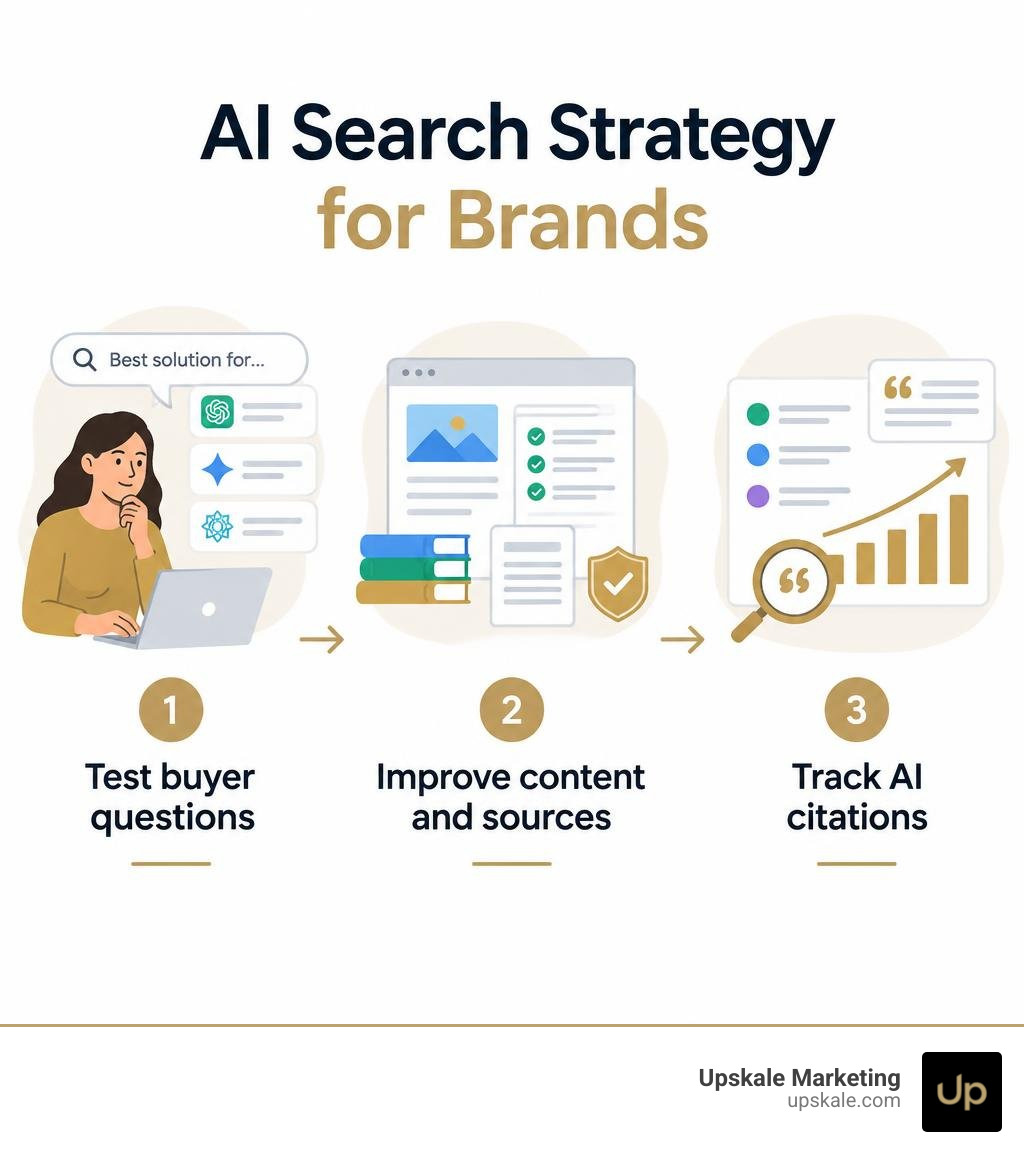
Start with the questions your customers ask AI tools. Test those questions in ChatGPT, Gemini, and Perplexity. Note when your brand appears, which sources the tools cite, and where competitors show up instead. Then make your key pages easy to access, give clear answers to buyer questions, keep brand facts consistent across trusted third-party sources, and track mentions and citations over time.
This builds on traditional SEO, but the goal is broader than earning a high-ranking link. Customers may get a complete answer without visiting a website, so your brand also needs to be accurate and useful within that answer.
I’m Scott Brazdo, MBA, founder and CEO of Upskale Marketing, and I bring more than 30 years of marketing and brand strategy experience to AI search strategy for brands. Today, I help businesses strengthen the content and signals that support visibility in AI-generated answers.
Introduction
The way consumers and business buyers find information has fundamentally shifted. As of October 2026, half of all consumers actively use AI-powered search engines, assistants, and summarizers to guide their daily decisions. This massive evolution in digital discovery stands to impact an estimated $750 billion in consumer and B2B revenue by 2028.
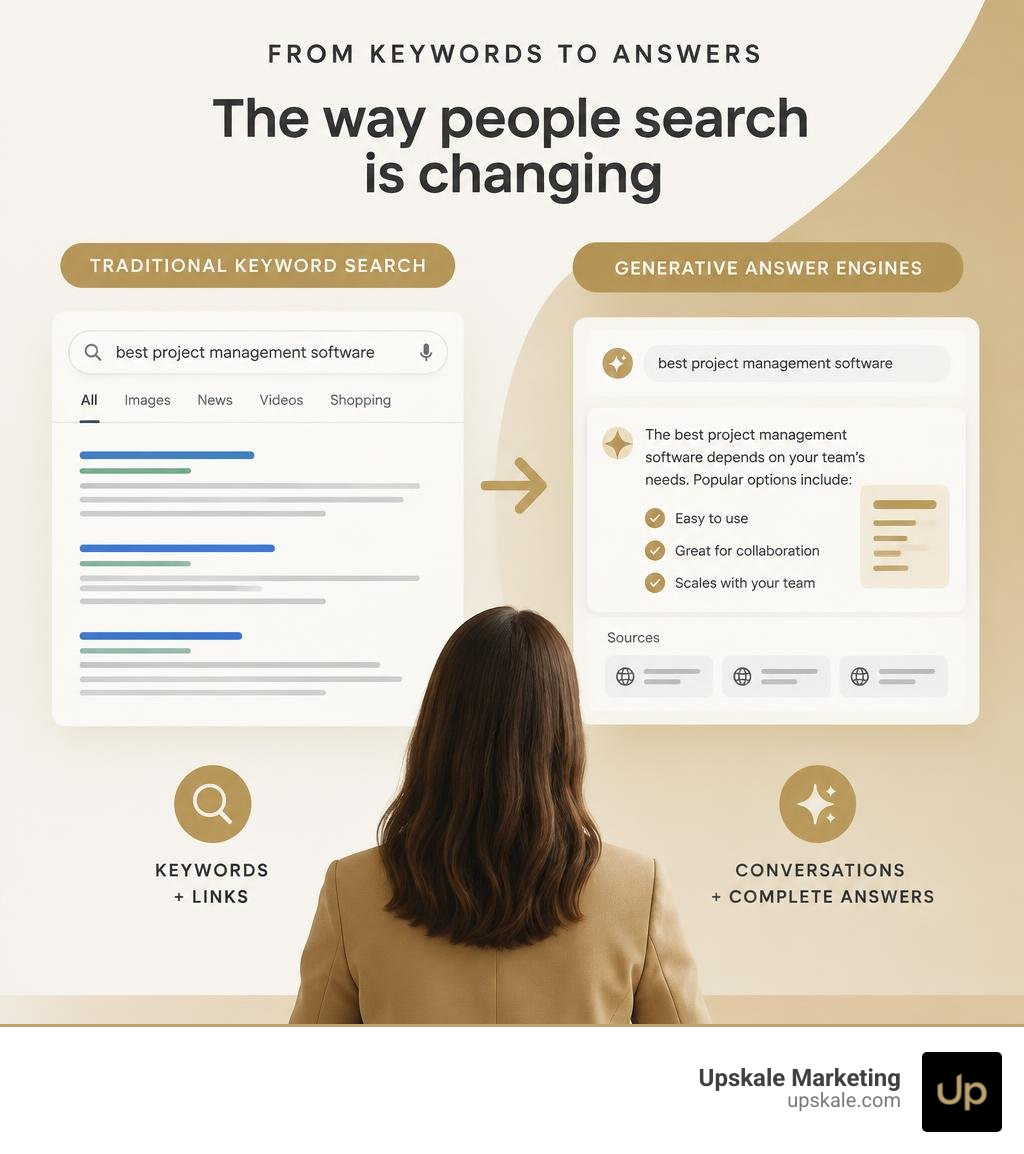
We are moving away from traditional keyword queries toward conversational discovery. Instead of sorting through pages of blue links, buyers ask complex, multi-layered questions directly to generative engines like ChatGPT, Google Gemini, and Perplexity. In response, these platforms synthesize research from dozens of domains into a single, cohesive summary.
About 50 percent of Google searches already include AI summaries, a number projected to surpass 75 percent by 2028. For modern enterprises, this means the traditional consumer decision journey is being completely rewritten inside the generative answer box. Understanding how to earn brand inclusion in these summaries is the focus of Generative Engine Optimization (GEO) and Answer Engine Optimization (AEO).
Building an Enterprise AI Search Strategy for Brands in 2026
The rapid consumer adoption of generative engines has disrupted traditional digital marketing funnels. A significant 44 percent of AI-powered search users report that conversational AI is now their primary and preferred source of insight. This outpaces traditional search engines at 31 percent, brand websites at 9 percent, and dedicated review directories at just 6 percent.
Because generative tools answer queries directly within the interface, zero-click behavior is rising quickly. Brands that fail to adjust their digital footprint risk an estimated 20 to 50 percent decline in organic traffic from traditional search channels. To maintain relevance, organizations must adopt winning generative search optimization approaches that prioritize answer synthesis and entity presence.
| Traditional SEO Metrics | Generative AI Search Criteria |
|---|---|
| Keyword density & ranking positions | Direct answer clarity & contextual relevance |
| Backlink quantity & PageRank | Entity validation across independent sources |
| SERP clicks & impressions | Citation frequency & synthesized mention share |
| Metadata & title tags | Structured schema & semantic data integrity |
| Individual page optimization | Comprehensive topic authority & cross-web consensus |
Aligning Your AI Search Strategy for Brands with the Modern Buyer Journey
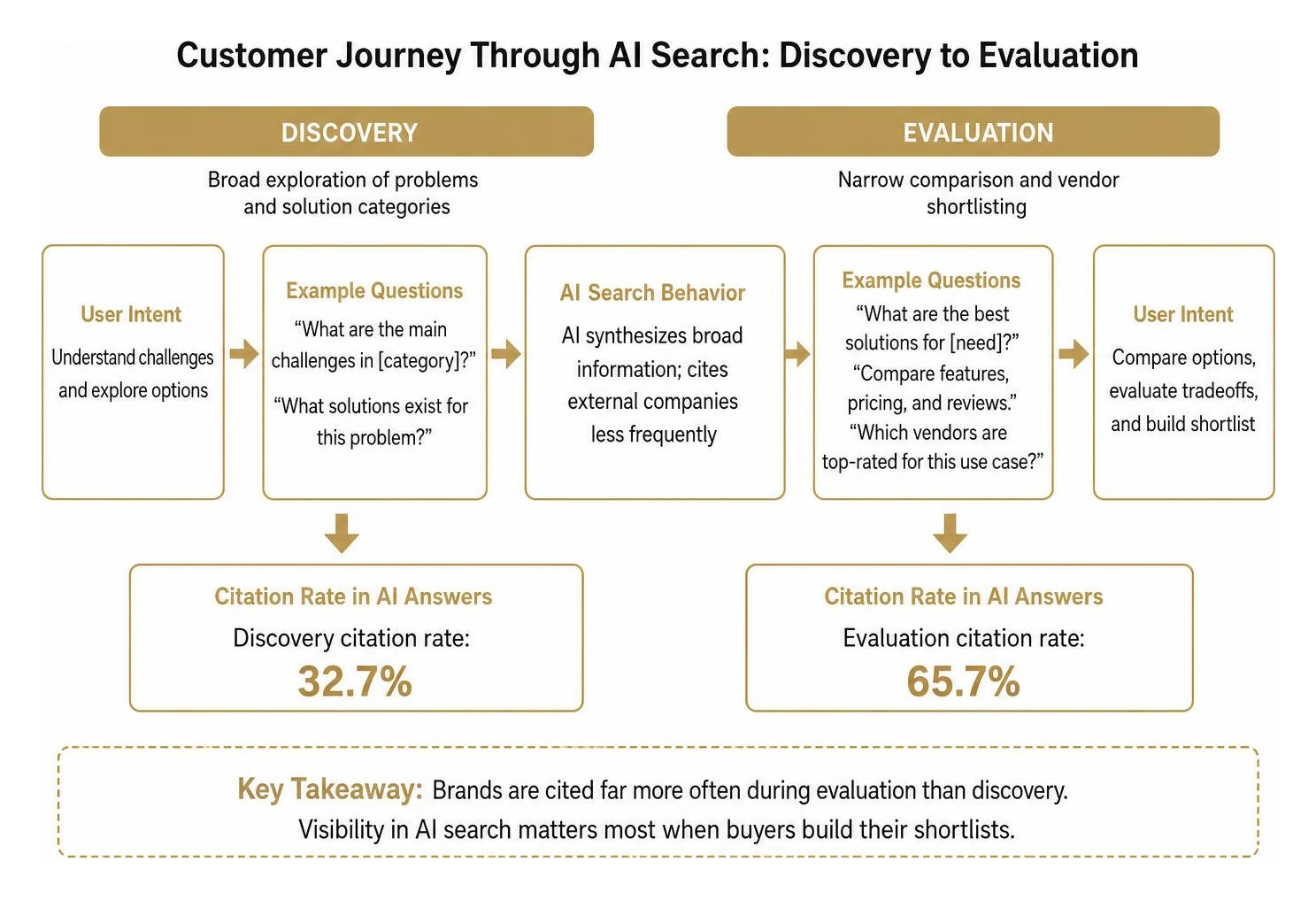
Modern buyers interact with conversational search tools differently depending on where they are in their purchase journey. During the early discovery phase, when users ask broad questions about market challenges or product categories, AI engines cite external companies less frequently. Research across tens of thousands of buyer questions reveals a discovery citation rate of roughly 32.7 percent.
However, as buyers transition into the evaluation stage—asking for comparative evaluations, feature tradeoffs, and vendor shortlists—the citation rate jumps to 65.7 percent. This widening gap means that without targeted actionable AI search optimization insights, your brand might be completely invisible during the crucial moments when buyers build their shortlists.
Shifting from Blue Links to Direct Answer Inclusions
In conventional search results, securing a top-three ranking guaranteed a reliable stream of qualified visitors. In generative search, however, engines synthesize multiple web sources into one final response. More than four in ten AI answers name no specific brand at all; across comprehensive buyer queries, only 56.7 percent of AI responses cite at least one enterprise.
Even across major enterprise sectors such as financial services, consumer electronics, hospitality, and retail, prominent market leaders are frequently absent from generative responses. A September 2026 AI readiness benchmark across 158 enterprise organizations revealed an average readiness score of only 50.9 out of 100. Overcoming this absence requires restructuring how your digital assets present facts, figures, and solutions to modern crawlers.
How Generative Engines Select, Synthesize, and Cite Brand Content
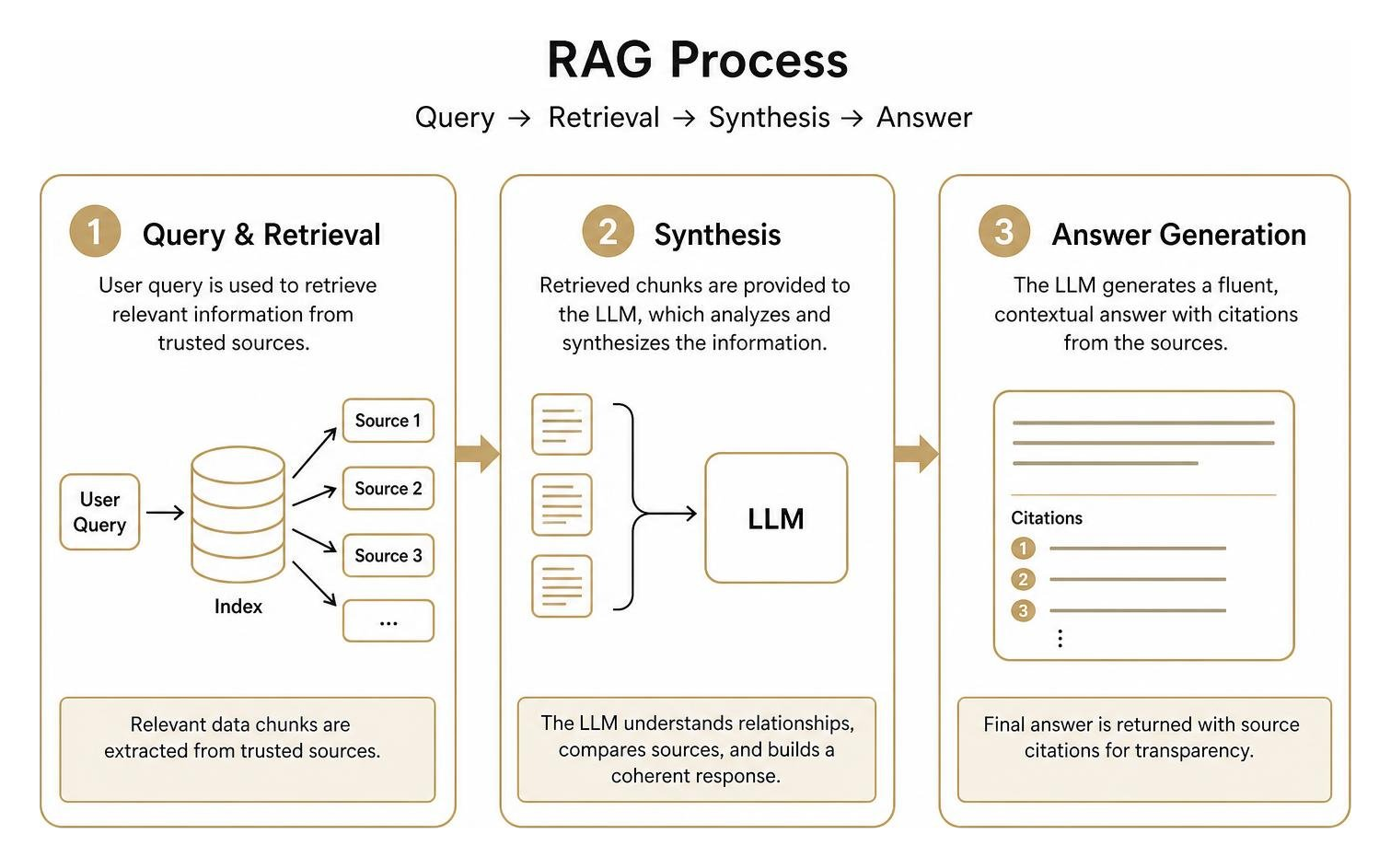
Generative search platforms rely on Retrieval-Augmented Generation (RAG) to produce real-time, accurate answers. When a user enters a prompt, the engine queries an index, extracts relevant data chunks from trusted sources, and sends those chunks to a large language model (LLM) to craft a fluent response.

To earn citations, brands must ensure their digital materials are easily parsed, extracted, and synthesized. Using practical AI search optimization techniques helps position your core web properties as primary data sources during the retrieval phase.
Answer-First Content Formatting and Semantic Clarity
Language models prioritize content that answers questions concisely and directly. If an article hides a definition or solution beneath hundreds of words of filler, retrieval algorithms may skip over the page entirely.
Adopting an answer-first editorial framework makes it easier for AI systems to locate and extract your insights. Key formatting principles include:
- Placing a direct, factual summary immediately beneath each primary question heading.
- Backing up key claims with original statistics, data points, and transparent sourcing.
- Using concise bullet points, tables, and short paragraphs to explain multi-step workflows.
- Eliminating ambiguous promotional jargon in favor of plain, descriptive language.
Structuring your pages using techniques for preparing content for conversational AI engines ensures both human readers and automated systems can quickly understand your core message.
Technical Infrastructure and Bot Accessibility
Even the most insightful content cannot be cited if AI crawlers are blocked from accessing it. Search engines and AI labs deploy specialized crawlers to build their vector databases and verify facts.
Enterprise technical teams should verify that their robots.txt files permit crawling by major AI user agents. Furthermore, maintaining clean XML sitemaps, fast server response times, and indexable site structures ensures that LLM retrieval pipelines always index your freshest information. Following proven methods for optimizing modern crawler indexing ensures your technical foundation supports consistent visibility.
Expanding Authority Across Third-Party Knowledge Ecosystems
Generative models rarely rely on a company’s owned website as their sole source of truth. When synthesizing answers, AI engines blend information from thousands of distinct domains, giving significant weight to independent third-party publishers, industry publications, and user-generated forums.

Achieving strong visibility requires earning organic mentions across the external websites that language models reference when verifying claims. You can explore strategies for winning AI search brand mentions to expand your presence across the digital ecosystem.
Hardening Entity Data Across Structured Directories
Large language models rely heavily on knowledge graphs to understand entities, their attributes, and their relationships to other organizations. If your corporate details vary across different directories, search engines may struggle to accurately identify your company.
Implementing comprehensive schema markup (such as Organization, Product, Article, and FAQ schema) helps clarify your brand’s core data. Aligning this structured data across external platforms like Wikidata, Crunchbase, and industry databases provides models with reliable facts, supporting your overall strategy for building ChatGPT brand authority.
Unifying Brand Narrative Across Unowned Web Sources
When an AI engine evaluates your brand’s reputation, it assesses sentiment across reviews, independent buyer guides, and forum discussions. If unowned sources contain outdated information or negative sentiment, the synthesized response will reflect those issues.
To protect your brand narrative, actively monitor unowned touchpoints and provide industry publications with up-to-date product specifications, capabilities, and positioning. Taking proactive steps toward teaching language models your brand narrative helps ensure third-party consensus aligns with your strategic positioning.
Measuring Visibility, Auditing Performance, and Avoiding Strategic Pitfalls
Despite the rapid shift toward conversational search, just 16 percent of brands systematically track their AI search performance. This tracking gap leaves most organizations unaware of how their products are portrayed across generative platforms.
Because generative outputs vary based on prompt phrasing, geographic context, and model updates, evaluating performance requires multi-run sampling over time. Reviewing practical approaches for evaluating enterprise AI visibility will help your team establish baseline metrics and monitor progress accurately.
How to Audit and Benchmark an AI Search Strategy for Brands
Auditing your generative search footprint involves several systematic steps:
- Build a Prompt Inventory: Gather the real conversational queries, product comparisons, and troubleshooting prompts your prospective customers use.
- Execute Multi-Run Testing: Run these queries across ChatGPT, Gemini, and Perplexity using standardized testing environments.
- Measure Citation Share: Record how often your brand is cited compared to direct alternatives across discovery and evaluation queries.
- Evaluate Narrative Sentiment: Review the synthesized text to ensure descriptions of your products, pricing tiers, and capabilities are accurate and positive.
- Identify Source Gaps: Note which external review sites and publications the models cite when omitting your company.
Common Mistakes That Erase Brand Presence in AI Summaries
As organizations adapt to generative search, several recurring strategic mistakes can hurt visibility:
- Gating Foundational Insights Behind Form Walls: If your whitepapers and comparison data are locked behind forms or stored in unstructured PDF files, AI crawlers cannot extract or cite that information.
- Over-Optimizing for Single Keywords: Keyword stuffing confuses natural language processors; modern engines prioritize contextual relevance and comprehensive coverage over keyword density.
- Ignoring Inconsistent Entity Data: Conflicting corporate names, addresses, or product descriptions across external directories create uncertainty in knowledge graphs.
- Relying Exclusively on Owned Channels: Failing to cultivate third-party mentions on trusted publisher sites leaves AI models without independent verification of your claims.
- Using Static Monthly Reporting: Because AI search engines update rapidly, relying on traditional monthly rank tracking fails to capture shifting citation patterns.
Frequently Asked Questions About AI Search Strategy
How does AI search optimization differ from traditional SEO?
Traditional SEO focuses on earning high placements for individual web pages on search engine results pages. AI search optimization focuses on training generative systems to retrieve, validate, and cite your brand within synthesized text answers, emphasizing structured data, entity clarity, and multi-source consensus.
Why are leading brands frequently omitted from AI search answers?
Brands are often omitted due to ambiguous entity information, low citation diversity across external publishers, missing structured schema, or content locked behind forms or unstructured PDFs that AI crawlers cannot easily parse.
What metrics should enterprises track for generative search performance?
Key performance indicators include AI citation frequency, synthesized brand recommendation rates, sentiment scores across generative summaries, prompt visibility share, and the accuracy of product attributes described in AI-generated answers.
Conclusion
The rise of generative discovery represents a significant transformation in digital marketing. Earning brand visibility in conversational platforms is not about exploiting temporary algorithmic loopholes—it is an evolving discipline centered on building genuine authority, clear information structures, and strong consensus across the web.
Succeeding in this landscape requires aligning your content, technical infrastructure, and digital PR into a unified program. We at Upskale Marketing help enterprise leaders navigate this transition by combining strategic marketing experience with dedicated answer engine optimization.
If you are ready to understand where your organization stands in conversational search and uncover actionable growth opportunities, schedule a free AI evaluation with Upskale Marketing today. Explore our comprehensive AI optimization services to ensure your brand remains the top recommendation when buyers ask AI who to trust.