


10 Powerful SEO Prompts for GPT to Streamline Your Search Workflow
Make SEO Prompts for GPT Work as a Workflow
Give GPT a clear audience, a specific SEO goal, real input data, and an output format. Then connect the prompts: discover keywords, group them by search intent, build a content brief, improve page titles, check technical details, and review search results. Verify any suggested metrics or code before you use them.
The 10 prompts below follow that path. They are designed to help you make better decisions about both search pages and the answers AI assistants may show customers.
I’m Scott Brazdo, MBA, founder of Upskale Marketing, with more than 30 years of experience in marketing and brand strategy. I bring that experience to seo prompts for gpt, with a focus on useful content, sound data, and human review.
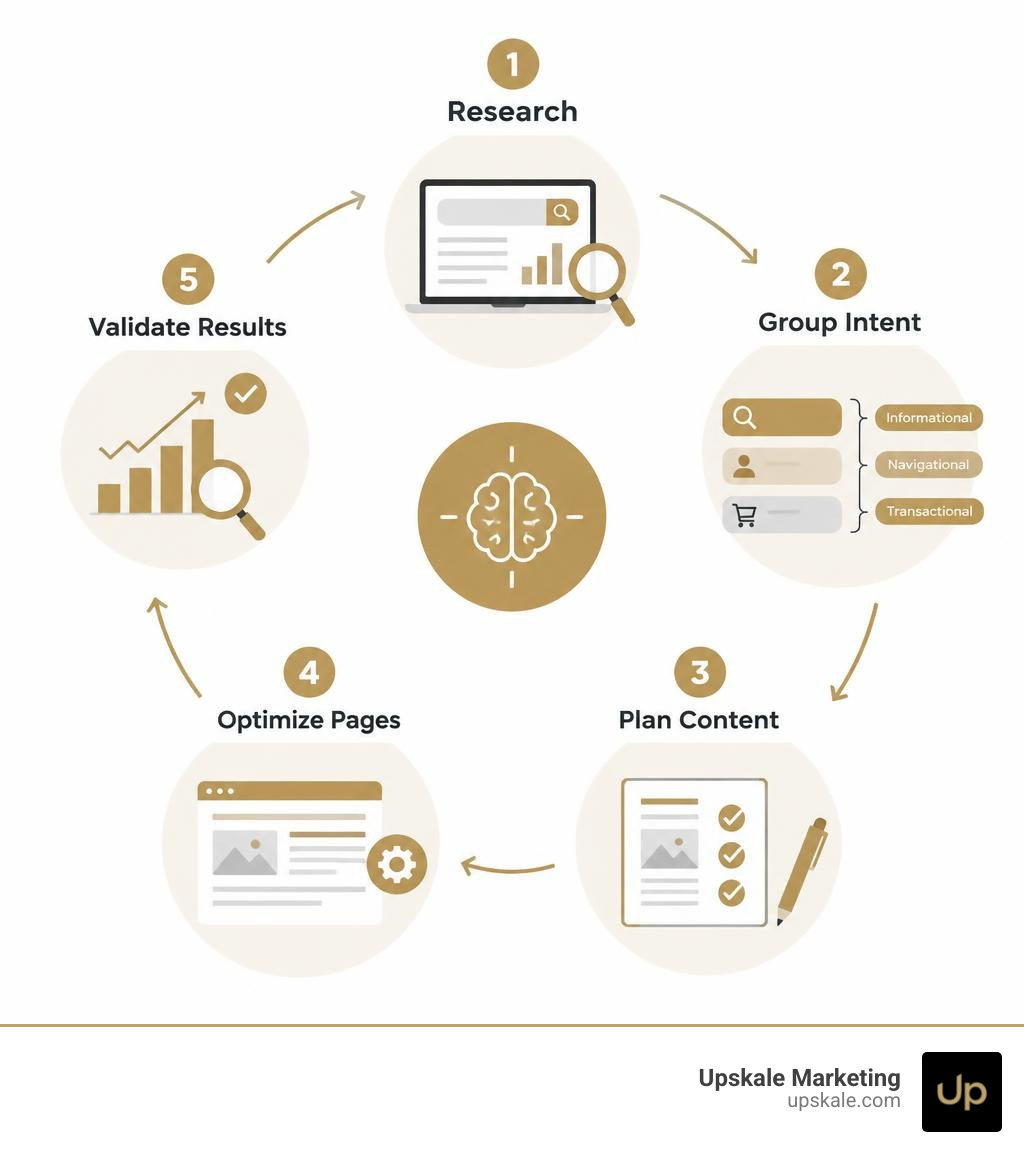
Core Frameworks for Building High-Impact SEO Prompts for GPT
Approximately 86% of SEO professionals use AI models like ChatGPT as digital assistants to accelerate their daily tasks. However, entering a vague instruction such as “write an SEO article about cloud storage” yields generic, surface-level content that rarely gains traction in organic search.
High-impact AI SEO relies on structured prompt engineering principles that turn an LLM from a generic writer into a methodical search strategist.
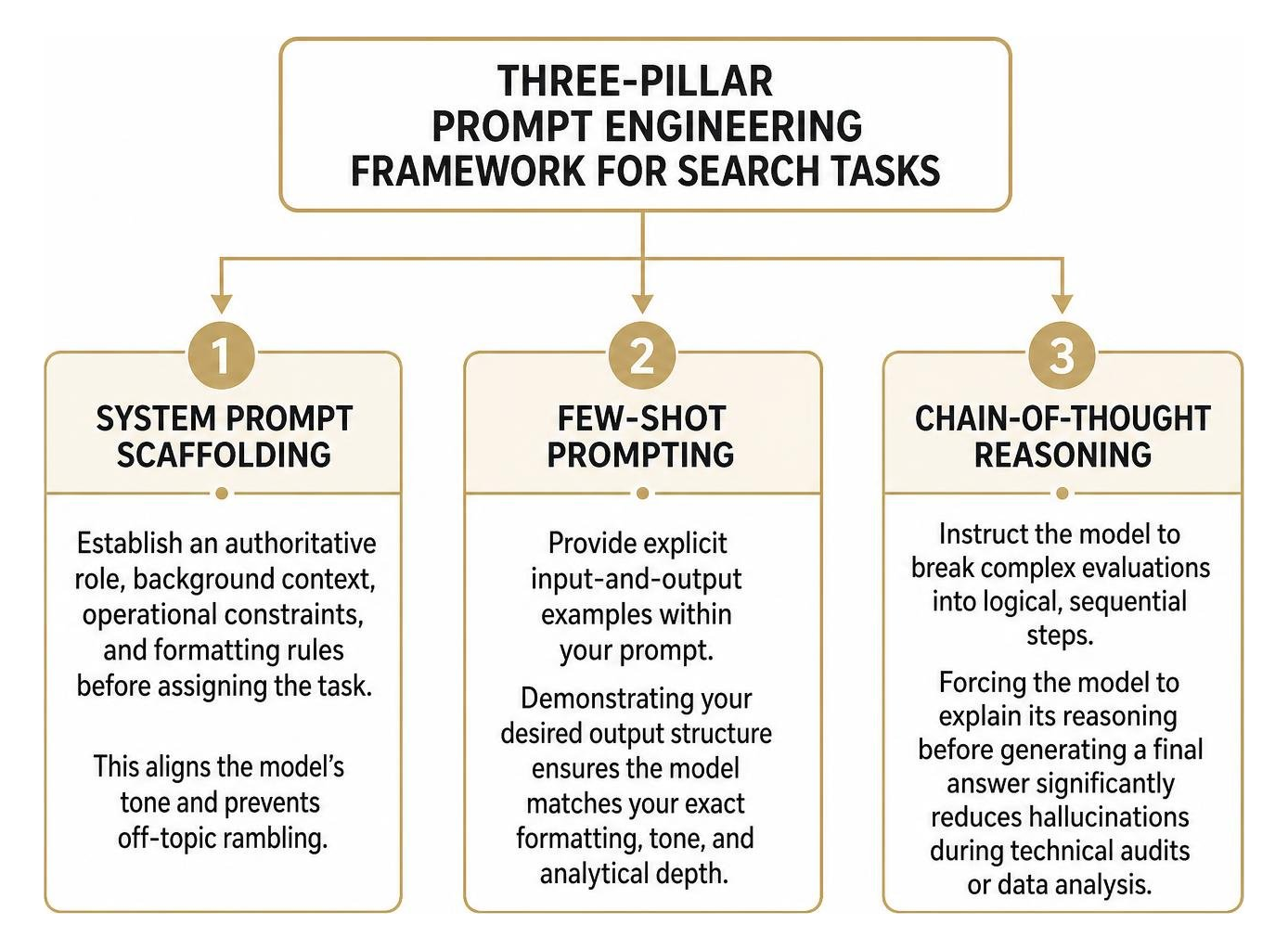
To get precise, repeatable outputs, build your prompts around three core frameworks:
- System Prompt Scaffolding: Establish an authoritative role, background context, operational constraints, and formatting rules before assigning the task. This aligns the model’s tone and prevents off-topic rambling.
- Few-Shot Prompting: Provide explicit input-and-output examples within your prompt. Demonstrating your desired output structure ensures the model matches your exact formatting, tone, and analytical depth.
- Chain-of-Thought Reasoning: Instruct the model to break complex evaluations into logical, sequential steps. Forcing the model to explain its reasoning before generating a final answer significantly reduces hallucinations during technical audits or data analysis.
10 Production-Ready SEO Prompts for GPT Across the Search Lifecycle
To build sustainable search performance, prompts should operate as an interconnected workflow where the output of one phase directly informs the next. The following production-ready templates take your team through every stage of organic search execution.
1. Context-Driven Seed Keyword Discovery
Keyword research often stalls when generic prompts produce broad, non-actionable lists. This prompt anchors discovery to your specific target persona, sales funnel stage, and customer pain points.

Copy-Paste Prompt:
Act as a senior search strategist. I am developing an organic search strategy for a mid-sized B2B software company targeting operations managers at growing businesses. Our core offering solves inefficient manual scheduling processes at the MOFU (middle-of-funnel) stage. Generate a prioritized list of 15 seed keyword ideas mapped to specific search intents, explaining the underlying problem the searcher is trying to solve for each.
2. Long-Tail Expansion and Intent Clustering
Once you identify your core seeds, expand them into conversational long-tail queries and group them into topical clusters to establish organic relevance without cannibalization.
Copy-Paste Prompt:
Act as an SEO content architect. Take the following core seed keyword: scheduling software for small teams.
- Generate 15 long-tail query variations covering informational, commercial, and transactional search intents.
- Group these queries into distinct topical clusters based on search intent and topical relevance to prevent keyword cannibalization.
- Organize the final output in a table with columns: Cluster Name, Long-Tail Keyword, Search Intent, and Recommended Content Format.
3. Entity-Rich Content Brief Generator
Modern search algorithms and generative engines prioritize semantic entities, structured topic depth, and clear topical relevance. A comprehensive brief guides creators to teach large language models how to tell your brand story accurately and authoritatively.
Copy-Paste Prompt:
Act as an SEO content director. Create a comprehensive, entity-optimized content brief for the primary keyword: cloud storage security best practices. Structure the brief with:
- Target Audience & Core Search Intent
- Recommended Working Title & Meta Description
- Primary Semantic Entities and NLP Concepts to cover
- Complete H2 and H3 Heading Outline with key points to address under each section
- Key Questions to Answer based on common user queries
6. JSON-LD Schema Markup Generator
Structured data allows search engines and answer engines to interpret the entities, relationships, and context on your website accurately.
Copy-Paste Prompt:
Act as a technical SEO specialist. Generate valid, clean JSON-LD schema markup for an article page based on the following details:
- Page Title: “10 Ways to Improve Team Productivity”
- Page URL: https://upskale.com/team-productivity
- Author Name: Jane Smith
- Publisher / Organization Name: Upskale Marketing
- Organization Logo URL: https://upskale.com/logo.png
- Date Published: 2026-01-15
- Brief Article Summary: A practical guide covering ten proven strategies for improving team productivity in remote and hybrid workplaces. Provide the structured data markup ready for validation.
5. Contextual Internal Linking Architecture
Internal links establish topical authority, pass link equity across your domain, and provide crawlers with a clear conceptual hierarchy.
Copy-Paste Prompt:
Act as an SEO information architect. Review the target new article topic: “How to Choose an Accounting Software Platform” (core topic: software selection criteria). Here is a list of our existing related pages:
- https://upskale.com/cloud-accounting-guide (Guide to Cloud Accounting)
- https://upskale.com/business-budgeting-templates (Small Business Budgeting Templates)
- https://upskale.com/payroll-integrations-overview (Payroll Integration Best Practices)
- Identify the 5 most contextually relevant existing pages to link to this new article.
- Provide natural anchor text recommendations for each link that maintain topical relevance without over-optimizing.
- Suggest 3 opportunities where the new article should link back out to existing core pillar pages.
6. JSON-LD Schema Markup Generator
Structured data allows search engines and answer engines to interpret the entities, relationships, and context on your website accurately.
Copy-Paste Prompt:
Act as a technical SEO specialist. Generate valid, clean JSON-LD schema markup for an article page based on the following details:
- Page Title: “10 Ways to Improve Team Productivity”
- Page URL: https://upskale.com/team-productivity
- Author Name: Jane Smith
- Publisher / Organization Name: Upskale Marketing
- Organization Logo URL: https://upskale.com/logo.png
- Date Published: 2026-01-15
- Brief Article Summary: A practical guide covering ten proven strategies for improving team productivity in remote and hybrid workplaces. Provide the structured data markup ready for validation.
7. Technical Audit and Migration Redirect Mapping
Site migrations, URL restructuring, and page consolidations require precise 301 redirect mapping to avoid broken user paths and preserve accumulated link equity.

Copy-Paste Prompt:
Act as a technical search consultant managing a site migration. Compare the following legacy URLs with our new site URL structure: Legacy URLs:
- https://upskale.com/services/search-engine-optimization
- https://upskale.com/articles/ai-tools-2025
- https://upskale.com/about-us-team New URLs:
- https://upskale.com/ai-seo
- https://upskale.com/ai-search-optimization-insights-upskale-marketing/
- https://upskale.com/about
- Map each legacy URL to its closest 1:1 equivalent new URL based on content topic and search intent.
- Flag any orphaned legacy URLs that lack an obvious equivalent.
- Format the final output as a two-column 301 redirect map: Source URL, Target URL.
8. Competitor Content Gap and E-E-A-T Audit
Evaluating top-ranking pages allows you to pinpoint information gaps and strengthen your Experience, Expertise, Authoritativeness, and Trustworthiness (E-E-A-T). This analysis is essential for winning the citation game with AI search brand mentions across modern conversational platforms.
Copy-Paste Prompt:
Act as an SEO content auditor. Compare our draft content with top-ranking coverage on the topic: “benefits of remote team collaboration tools.” Our Draft: Overview covering asynchronous communication, daily standup check-ins, and shared task tracking boards for distributed teams. Top-Ranking Content / Topics: Real-time document co-authoring, automated cross-platform notification routing, enterprise security benchmarks, and quantifiable productivity impact metrics.
- Identify 3 to 5 critical information gaps or subtopics our draft is missing.
- Recommend specific ways to enhance Experience, Expertise, Authoritativeness, and Trustworthiness (E-E-A-T), such as original examples, expert quotes, or proprietary data.
- Suggest unique value additions that give our page higher information gain.
9. Google Search Console Diagnostic and CTR Drop Analysis
Diagnosing performance drops requires analyzing real search performance numbers rather than guessing at algorithm updates.
Copy-Paste Prompt:
Act as a search analytics specialist. Analyze the following Google Search Console performance data for https://upskale.com/blog/team-productivity: Performance Data:
- Query: “team productivity tips” | Period 1: Imp 4,200, Clicks 210, CTR 5.0%, Avg Pos 4.2 | Period 2: Imp 4,800, Clicks 120, CTR 2.5%, Avg Pos 4.1
- Query: “hybrid team collaboration guide” | Period 1: Imp 3,100, Clicks 90, CTR 2.9%, Avg Pos 7.5 | Period 2: Imp 5,400, Clicks 110, CTR 2.0%, Avg Pos 6.8
- Identify queries experiencing significant CTR drops despite stable or improving average positions.
- Highlight queries with high impressions but below-average CTR that represent quick-win title or snippet optimization opportunities.
- Provide 3 specific diagnostic takeaways and prioritized action items to restore lost traffic.
10. AEO and Generative Search Snippet Optimization
Answer Engine Optimization (AEO) focuses on structuring content so AI answer engines can easily parse, summarize, and cite your insights. Learn more about these emerging patterns through our AI search optimization insights.
Copy-Paste Prompt:
Act as an Answer Engine Optimization (AEO) specialist. Optimize the following section of content for direct AI citations and answer engine extraction: Target Question / Topic: “What is the difference between AEO and traditional SEO?” Source Content: Traditional SEO centers around optimizing pages for search engine algorithms and ranking on search engine result pages. Answer Engine Optimization (AEO) structures data and content specifically for AI systems to parse, synthesize, and cite as direct answers to conversational user queries.
- Create a concise, 40-to-60-word direct answer block that defines the core answer immediately.
- Structure supporting context using a clear bulleted list with key takeaways.
- Ensure the phrasing uses authoritative, entity-dense language suitable for conversational AI citation.
Advanced Prompt Chaining: Connecting Research to Technical Execution
Single, isolated prompts often produce disjointed results. A marketing team might spend hours running disconnected prompt lists, only to generate dozens of keyword suggestions where very few map to actual business goals.
Every hour a team spends fixing disconnected outputs is an hour lost for strategic testing and growth. Prompt chaining connects research, content strategy, and technical tasks into a streamlined production pipeline.
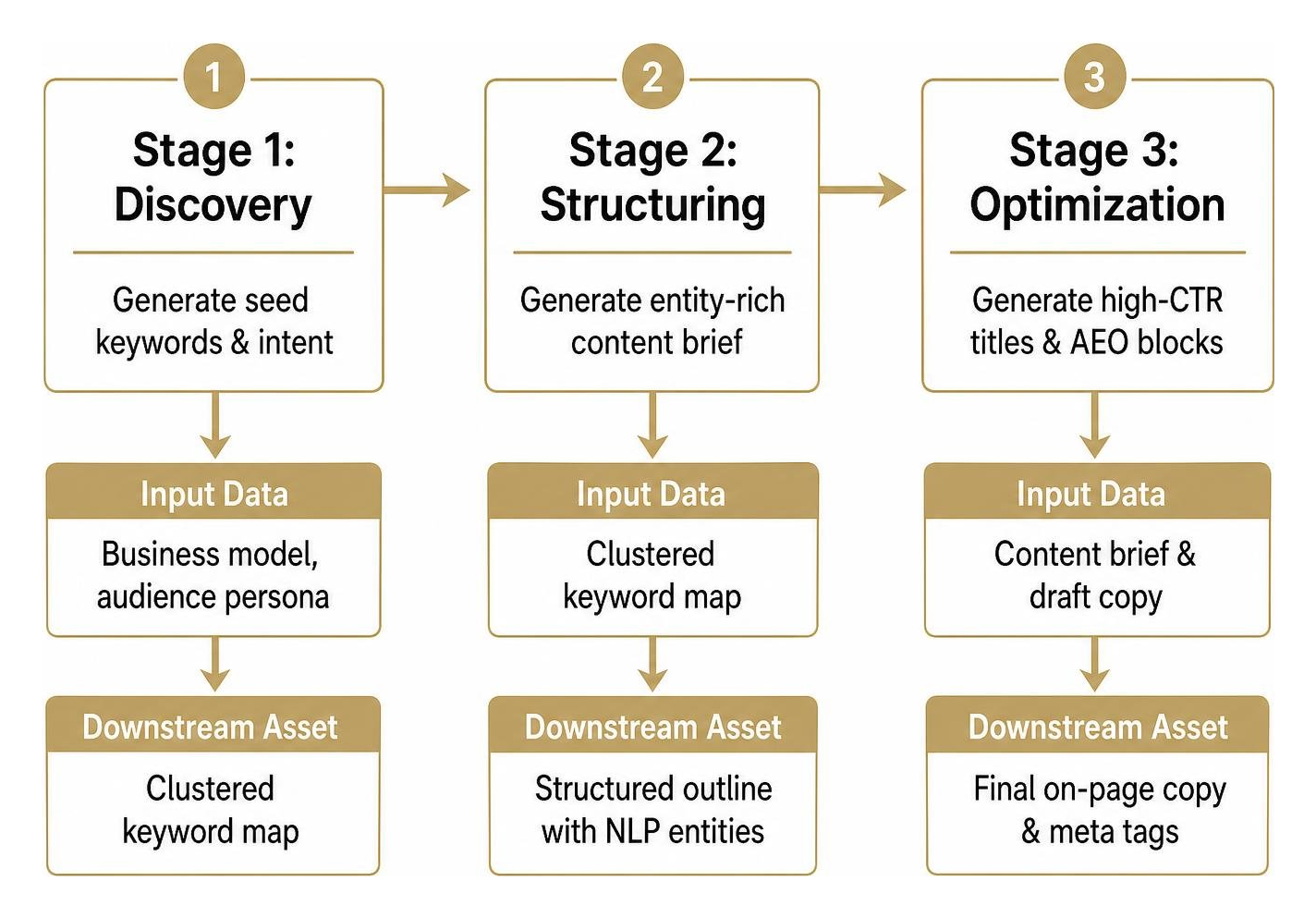
| Stage | Input Data | Prompt Objective | Downstream Asset Produced |
|---|---|---|---|
| Stage 1: Discovery | Business model, audience persona | Generate seed keywords & intent | Clustered keyword map |
| Stage 2: Structuring | Clustered keyword map | Generate entity-rich content brief | Structured outline with NLP entities |
| Stage 3: Optimization | Content brief & draft copy | Generate high-CTR titles & AEO blocks | Final on-page copy & meta tags |
| Stage 4: Technical | Final URLs & content entities | Generate JSON-LD schema & internal links | Valid structured data & link architecture |
Avoiding Common Pitfalls When Running SEO Prompts for GPT
Generative AI models are powerful reasoning engines, but they lack direct access to proprietary index metrics, live search volume databases, and private crawl logs unless you feed that data directly into the session.
Preventing Metric Hallucinations in SEO Prompts for GPT
LLMs cannot calculate real-time search volume, backlink counts, or exact keyword difficulty scores. If you ask an LLM, “What is the monthly search volume for this term?”, it will generate a plausible-sounding number based on language probabilities rather than verifiable search logs.
To prevent hallucinations:
- Never ask the model to estimate search volume, competition metrics, or live ranking positions.
- Export real data from Google Search Console or analytics tools, and paste it directly into the prompt.
- Include a strict grounding constraint: “Only analyze the data provided above. Do not invent or estimate search volumes or metrics.”
Overcoming Generic Content Patterns in SEO Prompts for GPT
Google has stated that its systems focus on the quality of content rather than how that content is produced. However, unedited AI output often falls into predictable patterns: repetitive sentence structures, passive tone, and an overuse of introductory clichés.
To maintain high editorial standards:
- Enforce Natural Keyword Distribution: A reliable guideline is to maintain a natural keyword density of roughly one to three mentions of your target phrase per 100 words. Avoid artificial repetition.
- Inject Original Information Gain: Incorporate real customer stories, proprietary survey results, or distinct brand perspectives that an AI model cannot synthesize on its own.
- Apply Systematic Human Review: Run every AI-assisted draft through human editorial review to verify brand voice, confirm factual claims, and refine styling before publication.
Frequently Asked Questions About SEO Prompts for GPT
Can GPT prompts replace dedicated SEO tools?
No. LLMs do not maintain live crawler networks, backlink databases, or daily search volume tracking. They excel at processing, structuring, and synthesizing search data that you supply, but you still need analytics platforms and search console tools to gather raw metric data.
How do I prevent GPT from hallucinating search volume data?
Supply the raw data directly within your prompt text. Export your performance metrics, paste them into the conversation, and instruct the model to analyze only the provided records without inferring external numbers.
What model version is best for complex SEO tasks?
Advanced multimodal models like GPT-4o handle everyday tasks like keyword clustering, meta tag creation, and schema generation with speed and precision. For multi-step analytical reasoning—such as diagnosing complex traffic drops or building intricate redirect maps—reasoning-focused models like GPT-4.5 provide deeper contextual evaluation.
Building a Scalable AI Search Strategy
Structured prompts streamline search workflows, improve content consistency, and speed up routine optimizations. However, earning lasting visibility across both traditional search engines and emerging AI platforms requires more than isolated copy templates. It requires a comprehensive approach to entity positioning, brand authority, and digital signal management.
At Upskale Marketing, based in Orlando, Florida, we combine decades of brand strategy experience with cutting-edge AI optimization to help businesses earn recommendations across leading AI platforms like ChatGPT, Gemini, and Copilot.
If you want to understand how your brand currently appears across conversational answer engines, schedule a free AI evaluation with Upskale Marketing. We will provide a straightforward, data-driven assessment of your current AI search visibility and highlight strategic opportunities to expand your digital footprint.