


Winning the Next Era of Generative Search Engine Optimization
Introduction
To optimize for AI search, brands need to remove technical barriers through clean, server-rendered HTML, front-load direct answers in modular passages that AI engines can extract and cite, and reinforce verifiable entity authority through consistent expertise and trust signals. The search landscape is undergoing its most profound transformation in decades. As platforms like ChatGPT, Gemini, and Microsoft Copilot reshape how people seek solutions, the mechanism behind discovery has shifted from static page matching to dynamic synthesis. These platforms rely heavily on Retrieval-Augmented Generation (RAG) to ground their conversational answers in real-time, indexed web data.
When a user submits a complex prompt, modern answer engines execute a process known as query fan-out. Rather than evaluating a single query string, the system generates multiple related sub-queries behind the scenes to fetch diverse, authoritative viewpoints. It then parses these retrieved passages, identifies the most reliable data points, and constructs a unified answer with direct citations.
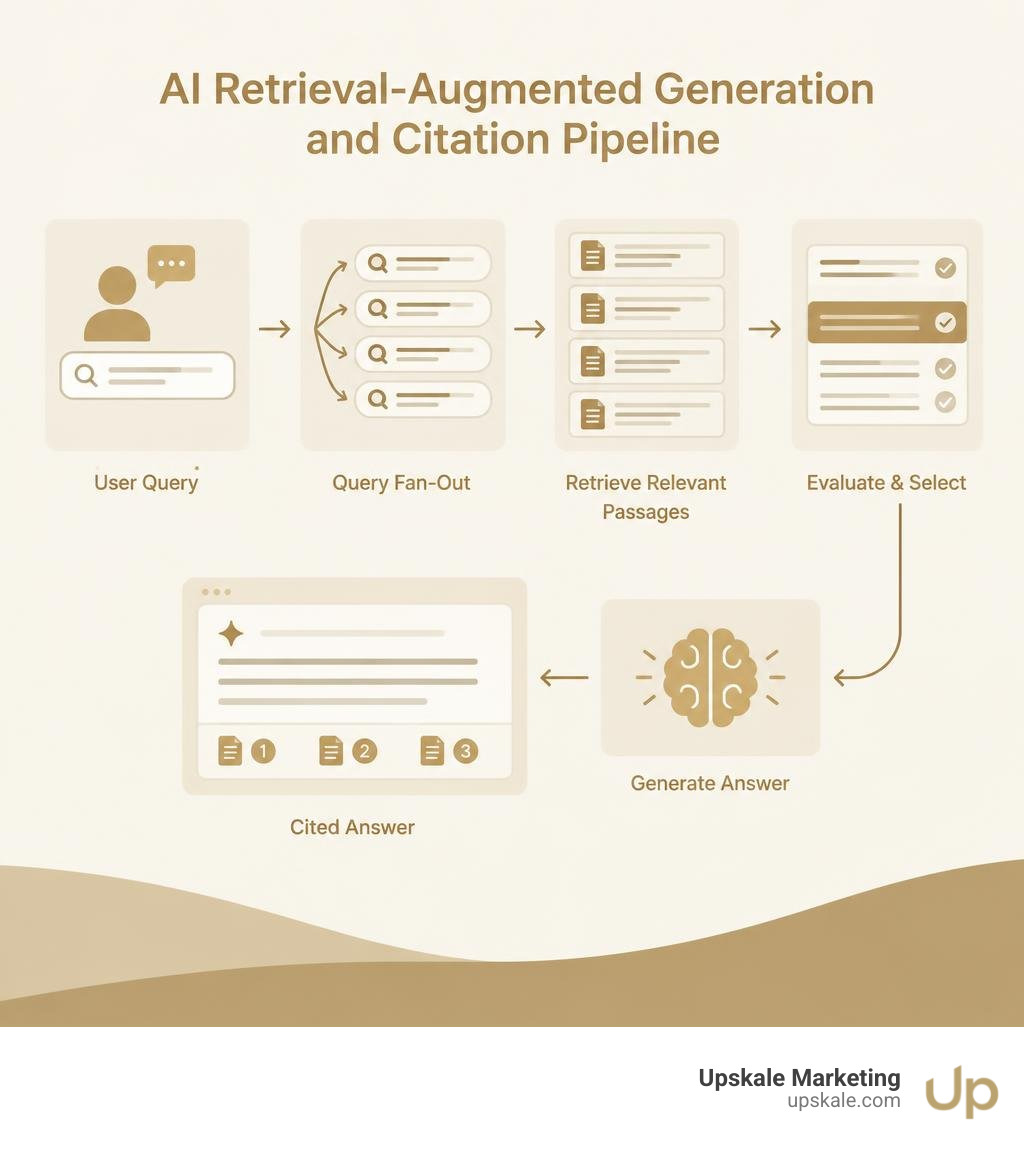
Understanding this pipeline makes one thing clear: generative engines do not digest content the way traditional crawlers do. They do not just rank URLs; they evaluate, extract, and combine factual passages. To win visibility in this environment, businesses must adjust both their technical infrastructure and their content models.
Technical Foundations: How to Optimize for AI Search Crawlers and Agents

Before an AI engine can cite your brand, its underlying retrieval systems must be able to access, read, and interpret your pages without friction. This makes technical hygiene the absolute prerequisite for any visibility strategy. At Upskale Marketing, our work in AI Optimization consistently reveals that if the technical foundation is broken, even the most authoritative content remains completely invisible to language models.
Structuring HTML and Information Architecture to Optimize for AI Search
Unlike search bots that maintain extensive computing pipelines to execute heavy client-side JavaScript, most AI crawlers process raw HTML directly. If your primary text, product details, or industry data rely entirely on client-side JavaScript rendering, AI agents may simply bypass the content.
To ensure efficient extraction:
- Prioritize Server-Rendered HTML: Deliver all essential information, proof points, and definitions directly within the initial HTML payload.
- Maintain a Logical Site Hierarchy: Use a clean directory structure with intuitive category nesting, avoiding excessive faceted navigation that creates redundant URL paths.
- Normalize URLs and Use Canonical Tags: Keep URL structures standardized and ensure canonical tags clearly establish the authoritative version of every page.
- Optimize Internal Linking: Link related contextual concepts together using descriptive anchors. Logical internal link networks help AI crawlers map entity relationships across your website.
- Maintain Automated XML Sitemaps: Keep sitemaps updated in real time, ensuring
lastmodtimestamps accurately reflect genuine editorial refreshes.
Controlling Crawler Directives and Access Protocols
AI search platforms utilize specific automated agents to gather live web context. Managing how these agents interact with your domain requires strict attention to your server configurations and header directives:
- Robots.txt Rules: Confirm your robots.txt file does not inadvertently block major AI user-agents or their underlying retrieval bots from accessing core commercial and informational content.
- Meta Robots and X-Robots-Tag: Verify that critical pages do not contain restrictive
noindexornosnippettags. If an answer engine cannot generate a text snippet from your page, it cannot cite it in synthesized responses. - Fast Server Response Times: AI agents operate with tight latency budgets during real-time retrieval steps. Slow page load speeds can cause crawlers to drop the retrieval request entirely.
Content Architecture: The Front-Weighting and Passage Extraction Framework

Once your technical architecture allows seamless crawler access, content formatting dictates whether an AI model chooses your text as a source citation. AI retrieval models favor modular, direct text blocks.
Industry data demonstrates a distinct “front-weighting” retrieval pattern: an estimated 44.2% of citations generated by leading language models originate from the top 30% of a webpage’s body text. AI models prioritize immediate clarity over long-form narrative buildup.
| Passage Extraction Criteria (AI Search) | Traditional Search Ranking Factors |
|---|---|
| First 30% Answer Density: Core conclusions placed immediately beneath headings | Broad Topical Coverage: Comprehensive coverage across the entire page body |
| Self-Contained Modularity: Standalone sections that make sense when extracted alone | Page-Level Keyword Density: Repetition and semantic clustering across the document |
| Visible Proof & Data: Specific numerical claims in crawlable text | Anchor Text & Backlink Volume: Domain-level link equity and inbound anchors |
| Natural Conversational Headings: Phrased as explicit questions | Keyword-Optimized Headers: Focused strictly on target query strings |
Formatting Content for Direct Answer Placement
To ensure your insights are easily lifted and quoted by conversational models, follow these structural guidelines:
- Lead with the Direct Answer: Provide the core answer, definition, or recommendation in the very first sentence under each subhead.
- Use Question-Style Headings: Match H2 and H3 headers to the natural conversational prompts users enter into AI platforms.
- Write Self-Contained Passages: Ensure each section answers one distinct question completely without relying on context from preceding paragraphs.
- Publish Visible Numerical Proof: Embed statistics, percentages, and benchmark data directly in plain text rather than concealing them inside infographics or scripts.
Maximizing Brand Authority and Citation Signals
AI search engines are designed to minimize hallucinations by validating claims against recognized entity sources. Building brand authority requires reinforcing strong E-E-A-T (Experience, Expertise, Authoritativeness, and Trustworthiness) markers across all published materials.
Every informational asset should clearly state author credentials, medical or technical review bylines where relevant, and verifiable source citations. Developing deep domain authority across interconnected service and informational pages is central to winning the citation game with AI search brand mentions. When an engine recognizes your brand as an established, verifiable entity, it naturally selects your domain when formulating high-intent recommendations.
Engineering and Algorithmic Mechanics Behind Answer Ranking
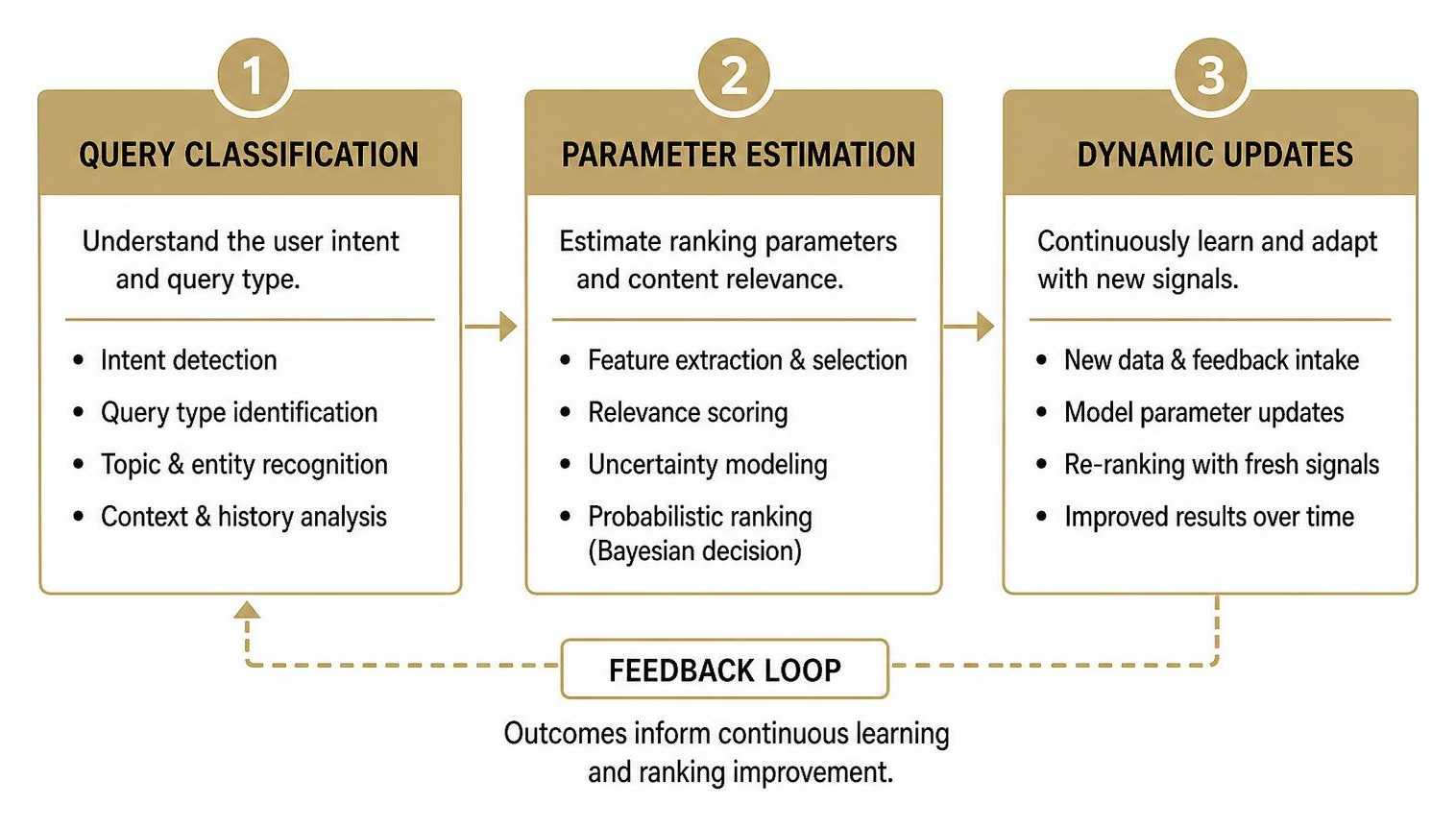
To truly master AI optimization, it is valuable to examine the underlying algorithmic principles that govern how machines classify, evaluate, and rank information under uncertainty. Modern AI search systems draw heavily on classic pattern recognition, parameter estimation, and probabilistic decision frameworks.
Algorithmic Principles: Feature Extraction and State Estimation to Optimize for AI Search
In machine learning toolboxes and statistical pattern recognition frameworks (such as PRTools in MATLAB environments), data processing follows a disciplined pipeline: feature extraction, classification, parameter estimation, and state estimation.
- Supervised vs. Unsupervised Learning: Supervised models evaluate labeled training data to identify authoritative text structures, while unsupervised techniques discover latent topic clusters across the web.
- Feature Extraction and Selection: Search engines reduce thousands of raw web page attributes into precise signals—such as passage readability, entity coherence, and semantic proximity to user intent. By selecting only high-value features, retrieval models maximize ranking speed and minimize computational noise.
- Bayesian Decision Theory: When an AI engine generates a response, it operates under uncertainty. Bayesian methods allow the model to combine prior knowledge (such as historical domain authority and verified entity data) with real-time query signals to calculate the most probable, accurate answer.
- State Estimation and Dynamic Updating: Dynamic search environments can be modeled as evolving state-space systems. While classification assigns discrete labels (such as whether a page is helpful or commercial), state estimation techniques (analogous to Kalman filtering or particle filtering in dynamical systems) continuously track shifting parameters over time—such as user satisfaction trends, topic freshness, and citation stability.
- Mitigating Overfitting: Just as training algorithmic models on narrow datasets leads to high variance and poor generalization, over-optimizing content for rigid keyword formulas creates brittle pages that fail when AI platforms adjust their retrieval weights. True optimization focuses on stable underlying features: clarity, accuracy, and strong contextual relevance.
Domain-Specific Optimization: Pharmacokinetics and High-Precision Entities
In high-stakes technical and YMYL (Your Money or Your Life) domains, AI engines enforce extreme entity precision. For instance, in pharmaceutical discovery contexts, search models must accurately interpret complex biochemical parameters such as lipophilicity ($\log P$), which dictates how easily a molecule crosses biological membranes and governs its overall pharmacokinetic behavior.
If an AI engine parses specialized content containing conflicting or improperly labeled biochemical properties, its uncertainty estimation algorithm will deprioritize the source to prevent inaccuracies. Maintaining exact terminology, verified metrics, and consistent entity definitions ensures that algorithmic extraction systems can confidently rely on your technical publications.
Monitoring and Measuring AI Search Visibility
Evaluating success in generative search requires looking beyond traditional rank-tracking dashboards. Because conversational responses are personalized, dynamic, and synthesized in real time, businesses must track a broader spectrum of visibility indicators:
- Generative Reporting in Search Consoles: Track your domain’s performance across AI Overviews and AI search modes to monitor passage-level impressions and interactive queries.
- Recommendation and Scenario Prompt Audits: Monitor how often your brand surfaces when users ask AI platforms for top recommendations, vendor comparisons, or scenario-based problem solving within your vertical.
- Evidence-Driven Content Refreshes: Maintain a disciplined update schedule. When industry statistics, research studies, or product capabilities change, update the visible text promptly so AI retrieval systems capture the freshest data points.
Frequently Asked Questions About Generative Search Engine Optimization
How do AI search engines extract and cite content from a webpage?
AI search engines utilize retrieval agents that parse the raw HTML of indexed pages to locate concise, high-density passages. The retrieval pipeline evaluates the top portion of the document, selects modular paragraphs that directly resolve the prompt, and feeds those excerpts into the language model to synthesize the final cited answer.
Why is raw HTML preferred over client-side JavaScript for AI crawlers?
Most AI crawlers operate with strict computational limits and avoid the overhead of executing heavy client-side scripts. Delivering clean, server-rendered HTML ensures that your headings, body copy, and data points are immediately readable during rapid indexation and retrieval cycles.
What is the difference between classification and state estimation in AI search systems?
Classification assigns discrete labels to static inputs—such as categorizing a page as a comparison guide or an informational overview. State estimation, by contrast, tracks continuously changing dynamic variables over time, such as content freshness, topical authority shifts, and real-time user intent signals.
Conclusion
The transition toward generative, agentic search represents an exciting evolution in digital marketing. Earning consistent visibility across ChatGPT, Gemini, Copilot, and emerging AI search features is not about chasing short-term algorithmic loopholes. Instead, it is an ongoing, sophisticated marketing discipline centered on building technical accessibility, structured content clarity, and undeniable entity authority.
As an Orlando, Florida AI optimization agency, Upskale Marketing brings decades of strategic marketing expertise to help businesses build enduring digital presence across conversational platforms.
If you want to understand how your brand currently performs in answer engines, schedule a free, data-driven AI evaluation with Upskale Marketing today to discover your visibility opportunities and explore comprehensive AI optimization strategies.