


Teach Large Language Models How to Tell Your Brand Story
The Shift from Traditional Discovery to AI Search Brand Storytelling
To teach large language models how to tell your brand story, you need to establish a single, machine-readable source of truth for your business and reinforce it with consistent third-party validation. That means creating a canonical Entity Home on your own domain with structured data, publishing original research and expert insights that add information gain, and earning citations from authoritative external sources that confirm the same core facts. When those signals align, AI search engines can resolve your brand as a distinct entity and synthesize an accurate narrative instead of drifting toward fragmented or hallucinated claims.
Search behavior has experienced a fundamental transformation. Between 58% and 60% of all online queries now resolve as zero-click searches. Instead of clicking through ten blue links to visit your website, prospective buyers increasingly consume synthetic answers generated on the spot. Google AI Overviews alone integrate between 12 and 14 inline citations per response, gathering narrative fragments from across the open web to tell users who you are and whether your solution fits their needs.
This synthetic discovery layer introduces a serious operational challenge: narrative fragmentation. When an engine like ChatGPT, Gemini, or Perplexity answers a category query, it does not evaluate your brand through a single polished landing page. It aggregates unstructured data points from comparison sites, industry analyses, social channels, and media reviews.
If those external data points conflict, the engine encounters ambiguity. When language models encounter ambiguity, they extrapolate. This creates AI brand drift—a compounding disconnect where the narrative an answer engine generates drifts further and further from your actual market positioning, core capabilities, and value proposition.
| Dimension | Traditional SEO Brand Building | AI Answer Engine Discovery |
|---|---|---|
| Primary Audience | Human searchers clicking organic blue links | Large language models synthesizing multi-source data |
| Narrative Control | Centralized on high-ranking, owned web pages | Decentralized across external citations, forums, and entities |
| Evaluation Signal | Backlinks, keyword density, and on-page metadata | Entity consistency, factual consensus, and information gain |
| Search Outcome | Site visits, session duration, and pageviews | Zero-click answers, model citations, and conversational placement |
| Primary Vulnerability | Algorithm ranking shifts and SERP competition | AI brand drift, hallucinated claims, and narrative omission |
Mastering AI search brand storytelling requires moving past traditional keyword targeting to establish clear, machine-readable facts and high-authority contextual proof points that language models can readily verify and cite.
Why LLMs Require a Canonical Brand Narrative
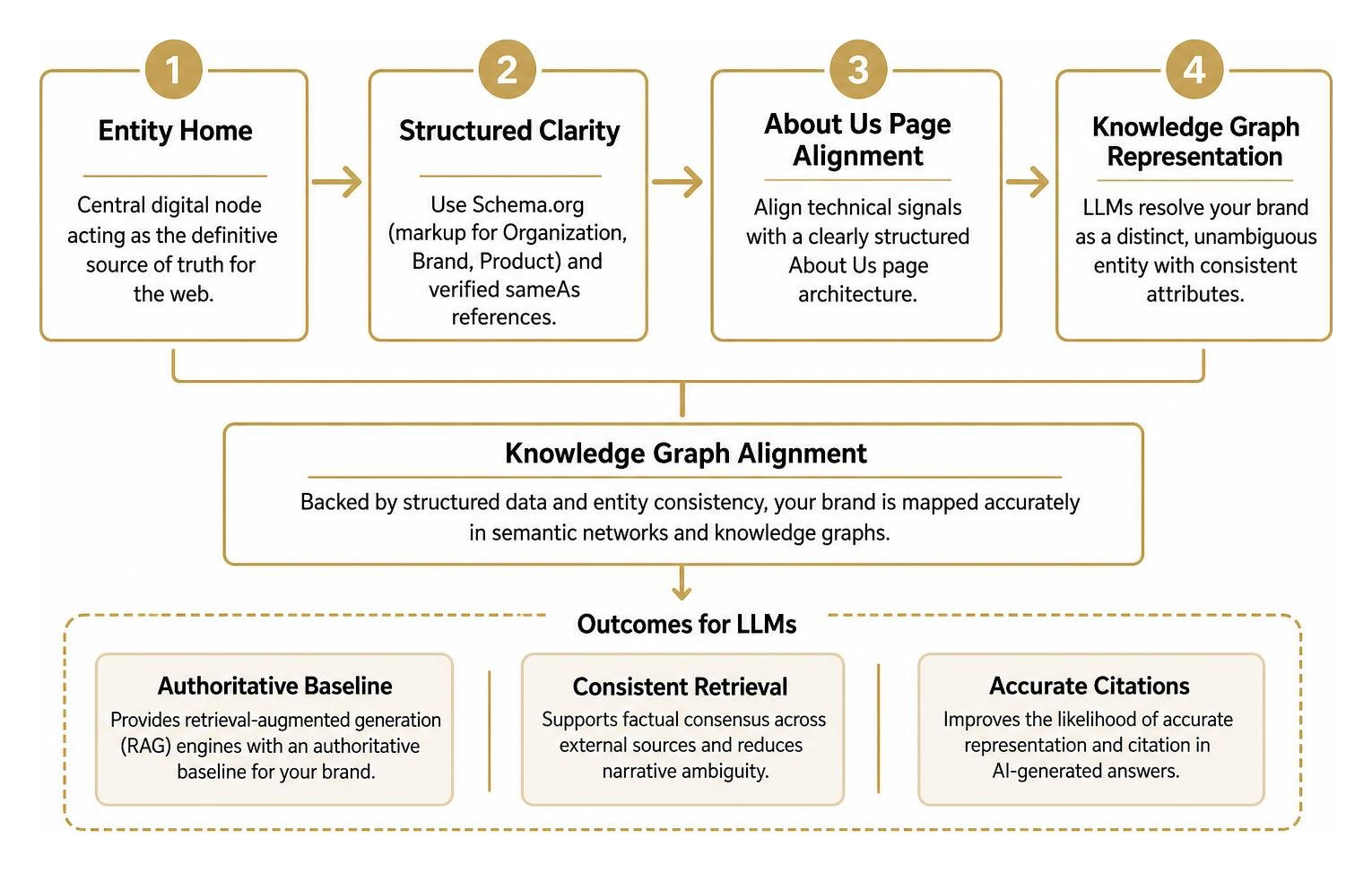
Large Language Models (LLMs) operate on semantic networks and knowledge graphs. To represent your brand accurately, an algorithm must resolve your company as a distinct, unambiguous entity with consistent attributes.
To establish this clarity, your brand needs a designated Entity Home. This central digital node acts as the definitive source of truth for the web. By backing your owned assets with rigorous Schema.org structured data—such as Organization, Brand, and Product markups paired with verified sameAs references—you provide machines with a structured blueprint of your company. Aligning these technical signals with a clearly structured About Us page architecture provides retrieval-augmented generation (RAG) engines with an authoritative baseline that anchors all downstream citations.
The 85% Third-Party Reality in Model Training
While an Entity Home provides the baseline, language models rarely rely on brand-owned domains alone. In fact, research demonstrates that roughly 85% of brand mentions generated by AI systems stem from third-party sources rather than a company’s own website.
Citation mechanics vary across answer engines, but external consensus remains the primary trust signal:
- Informational Queries: Wikipedia represents 47.9% of citations for informational queries within ChatGPT Search.
- Community Consensus: Mentions on discussion platforms like Reddit and Quora deliver a 4x higher citation likelihood in ChatGPT Search responses.
- Brand-Owned Authority: Gemini maintains a high brand-owned citation rate at 52.15%, demonstrating a stronger tendency to trust what an entity states directly on its verified domain.
Because search engines cross-reference diverse inputs to generate consensus scores, modern digital PR and earned media placement are no longer just about referral traffic. They directly provide the corroborating evidence AI engines require to validate your story.
Applying Transmedia Storytelling Principles to AI Optimization
To influence how AI models construct brand stories, modern organizations are adopting principles from transmedia storytelling. Originally developed for complex narrative universes, transmedia storytelling involves distributing distinct, non-redundant pieces of a overarching narrative across multiple communication channels so the whole becomes greater than the sum of its parts.
When applied to Answer Engine Optimization (AEO), your digital footprint becomes a cohesive storyworld. Because models assemble answers from fragments scattered across the digital ecosystem, every channel must supply a specific, verifiable dimension of your brand’s expertise while reinforcing a single factual core.
Core Principles of AI Search Brand Storytelling
Adapting narrative design to algorithmic synthesis relies on several foundational mechanics:
- Spreadability vs. Drillability: Spreadability ensures your top-level brand value proposition is easily distributed and parsed across broad consumer channels. Drillability provides technical white papers, original data sheets, and comprehensive documentation for models conducting deep semantic retrieval on complex queries.
- Continuity vs. Multiplicity: Continuity represents the non-negotiable, canonical facts of your business—your founding history, core leadership, proprietary technologies, and product capabilities. Multiplicity allows different perspectives, such as partner testimonials and user reviews, to validate those core facts from unique viewpoints without altering foundational truths.
- Entity Consistency: Models run thousands of stochastic processes; in testing, fewer than 1 in 100 runs produce the exact same brand list for identical category queries, and fewer than 1 in 1,000 produce the list in the identical order. However, organizations with strong cross-platform continuity consistently appear in 55% to 77% of AI responses, proving that unified entity strength breaks through retrieval noise.
Extractability and Worldbuilding Across Diverse Media
Language models do not limit their ingestion to traditional written copy. Multi-modal retrieval systems crawl, parse, and cite audio-visual content with increasing frequency.
YouTube holds a substantial advantage in modern search ecosystems, appearing in up to 29.5% of Google AI Overviews—outperforming competing video repositories by over 200x. Similarly, audio programming accompanied by detailed, high-quality text transcripts receives 4 to 7 times more AI citations than untranscribed audio. Structuring multi-format assets ensures that video demonstrations, executive interviews, and technical podcast transcripts provide rich, extractable factual answers that AI models can quote directly.
Overcoming the AI Sameness Trap with Human-Led Authority
The proliferation of generative AI has created widespread content fatigue. Today, 79% of technology marketers employ generative AI tools within their content pipelines, with 48% relying on these platforms to generate initial drafts.
This automated volume has flooded search indexes with predictable, homogenous text—the “AI beige” phenomenon. Consumers have developed sharp detection for this uniformity: 82% of adults report noticing AI-written copy regularly, a figure that climbs to 88% among audiences aged 22 to 34. More critically, only 15% of US adults trust organizations that deploy customer-facing AI without visible human guidance, while 67% of consumers state they must trust a brand before considering a commercial transaction.

Balancing Generative Efficiency with Authentic Insight
To earn durable visibility in answer engines, businesses must bypass generic phrasing, predictable syntax, and empty filler. Real authority cannot be manufactured by stringing together statistical probabilities of what a standard blog post looks like.
The most effective editorial workflows use a human-in-the-loop framework. This model relies on frontline business experiences to originate every narrative asset:
- Capturing verbatim client pain points from sales discovery transcripts.
- Documenting specific operational lessons learned during customer onboarding.
- Extracting unfiltered technical commentary directly from internal Subject Matter Experts (SMEs).
Once real human experience forms the core argument, generative tools can assist in formatting, structural organization, and semantic indexing. This preserves the authentic voice and nuanced perspective that modern language models weigh heavily during quality evaluations.
Grounding AI Search Brand Storytelling in Proprietary Data
Information Gain is an essential factor in modern information retrieval. When an algorithm assesses dozens of competing documents on a given subject, pages that merely rephrase existing consensus score poorly. Conversely, documents that introduce unique factual anchor points, original surveys, and verified proprietary benchmarks are prioritized for citation extraction.
Campaigns centered on genuine emotional resonance and authentic human outcomes perform twice as well as purely rational product descriptions, driving a 31% lift in commercial impact compared to 16% for generic copy. Grounding your public assets in original case results, industry benchmarks, and behavioral observations gives answer engines factual, un-hallucinated data points that naturally earn placement within synthesized search responses.
Structuring Content to Win Answer Engine Citations
Winning real estate in conversational search engines requires structuring written content for both rapid human comprehension and efficient machine extraction. When language models execute retrieval-augmented generation routines, they parse pages into semantic chunks, evaluate their factual relevance, and extract concise statements to answer user prompts.
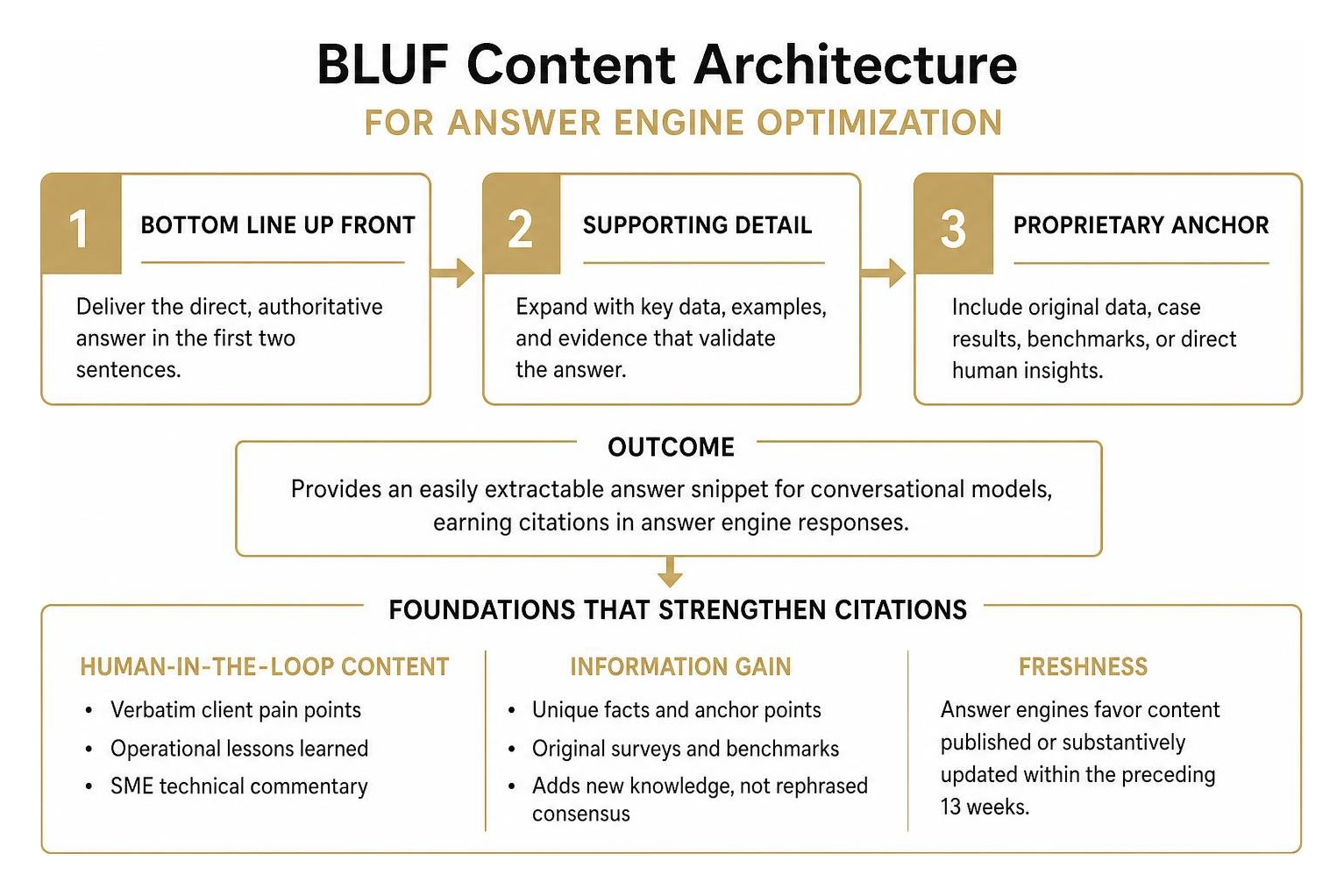
The most effective structure follows the Bottom-Line-Up-Front (BLUF) architecture. By delivering a direct, authoritative answer in the first two sentences of a section before expanding into supporting data, you provide an easily extractable answer snippet for conversational models. Supporting this structure across a comprehensive digital presence ensures that both traditional crawlers and modern retrieval bots find immediate clarity across every tier of your website.
The 13-Week Freshness Cycle and Content Decay
Answer engines prioritize timeliness alongside authority. Retrieval systems favor recent source material, with studies showing that roughly half of all citations in conversational search engines point to digital resources published or substantively updated within the preceding 13 weeks.
Simply updating a metadata date stamp without altering on-page copy does not satisfy retrieval engines; models evaluate semantic delta and factual additions. Maintaining a disciplined content refresh cadence ensures your material counters natural content decay and semantic drift.
Translating Legacy Brand Equity into Answer Engine Placement
Established organizations with decades of market presence often discover a frustrating reality: extensive real-world brand equity does not automatically translate into AI search dominance.
While legacy businesses may hold high offline recognition, conversational answer engines evaluate brands based on their presence across the full landscape of modern comparison resources, category roundups, and active third-party discussions. If a multi-decade enterprise does not actively cultivate source-level authority across these dynamic reference points, nimble competitors will capture category-level recommendations. Converting historical brand prestige into answer engine placement requires systematically mapping the external resources LLMs reference for your vertical and establishing a verified presence across every key touchpoint.
Monitoring and Measuring Brand Narratives in LLMs
Managing your brand across conversational search requires continuous measurement. Because generative tools synthesize responses dynamically, monitoring brand positioning requires looking beyond static keyword rankings to track citation share, factual fidelity, and recommendation frequency across all major engines.

Key Metrics for AI Visibility and Sentiment
To systematically gauge how effectively your narrative is represented across AI search engines, monitor these core performance indicators:
- Citation Share: The percentage of category-relevant queries in which your domain or proprietary assets are cited as an inline source within engines like Perplexity, ChatGPT Search, and Google AI Overviews.
- Recommendation Ranking: The position and frequency with which your brand appears when users ask conversational models for top-tier service providers or product solutions in your category.
- Narrative Fidelity: The factual accuracy of the generated answer, measuring whether the model correctly communicates your primary capabilities, target audience, and value propositions without introducing hallucinations.
- Source Diversity Score: The variety and authority of third-party domains citing your brand, confirming that your entity is corroborated across publications, directories, and industry communities.
- Entity Sentiment Alignment: The qualitative tone and trust signals associated with your brand descriptions across multiple concurrent AI generation runs.
Frequently Asked Questions About AI Search Brand Storytelling
How do AI search engines construct brand narratives from multiple sources?
AI search engines construct narratives using retrieval-augmented generation (RAG) paired with deep knowledge base retrieval. When a user submits a prompt, the engine queries its index for topically relevant, high-authority web pages. It breaks these sources down into semantic text passages, evaluates the degree of factual consensus among them, and synthesizes a consolidated answer. If multiple independent, authoritative platforms validate the same core capabilities and business attributes, the engine adopts those details as verified facts in its final response.
What is AI brand drift and how can companies prevent it?
AI brand drift occurs when conversational search engines present inaccurate, outdated, or conflicting stories about a company because the model synthesized fractured information across the web. To prevent brand drift, organizations must establish a single canonical Entity Home on their primary domain, back their assertions with explicit Schema.org structured data, and maintain absolute factual consistency across social profiles, industry databases, executive communications, and third-party media placements.
How does original research improve a brand’s citation likelihood in LLMs?
Original research dramatically increases citation likelihood by providing unique Information Gain. Language models are designed to identify and extract unique data points rather than repeatedly citing generic summaries. When a company publishes first-party research reports, proprietary benchmark data, or specialized surveys, AI engines identify that domain as the primary source for those specific facts, directly triggering citations whenever users query related topics.
Conclusion
The transition from traditional index search to conversational AI discovery is transforming how businesses communicate with their markets. In an ecosystem where a majority of queries resolve directly within the search interface, your brand narrative cannot be left to chance or scattered across fragmented digital touchpoints.
Earning visibility in this landscape is neither an automated trick nor a quick shortcut. It is an evolving marketing discipline centered on building genuine authority, rigorous entity clarity, and a verifiable footprint across the modern web. When your canonical narrative is reinforced by authentic human expertise and robust third-party validation, language models can accurately interpret your value and recommend your business with confidence.
At Upskale Marketing, we combine decades of strategic brand experience with advanced Answer Engine Optimization to help organizations establish authority across platforms like ChatGPT, Gemini, and Google AI Overviews. Explore our specialized AI optimization services to strengthen your entity presence, and schedule a free AI evaluation with Upskale Marketing to receive a straightforward, data-driven assessment of where your business currently stands in AI search, its visibility, and key improvement opportunities.