


Winning the Citation Game with AI Search Brand Mentions
The Mechanics of AI Search Brand Mentions across Major LLMs
Brands earn AI search brand mentions when large language models recognize them as the most authoritative, contextually relevant answer for a query. This recognition comes from a combination of entity authority, citation density across trusted third-party sources, and semantic consensus across the web. When a model sees consistent, verifiable information about your brand across multiple high-authority domains, it becomes far more likely to cite you in synthesized answers.
Understanding how generative models evaluate your brand requires looking under the hood of modern answer engines. Traditional search algorithms index web pages and rank them based on keyword density, backlink quantity, and technical structure. In contrast, large language models (LLMs) synthesize answers using Retrieval-Augmented Generation (RAG), internal parametric memory, and real-time web crawlers.
When a user submits a commercial query to platforms like ChatGPT, Perplexity, Anthropic’s Claude, Google AI Overviews, or Gemini, the system does not simply look for matching strings. It evaluates semantic relevance, token probabilities, and the authority of indexed sources. Perplexity and Claude deploy live web-search agents to pull current 2026 data, while Google AI Overviews blends Gemini’s reasoning capabilities with Google’s core search index.
| Evaluation Dimension | Traditional Search Engines | Generative AI Answer Engines |
|---|---|---|
| Primary Goal | Return a ranked list of relevant URLs | Generate a synthesized, contextual answer |
| Brand Discovery | Click-throughs on top-ranking blue links | Direct recommendations and inline citations |
| Content Evaluation | Keyword matching, backlink profiles, metadata | Semantic authority, entity relationships, consensus |
| Output Consistency | Highly deterministic (identical SERPs for queries) | Stochastic (probabilistic token generation) |
| Source Attribution | Explicit page rankings from 1 to 10 | Contextual footnote citations and source cards |
These architectural differences mean that earning visibility is no longer just about landing on page one. It is about becoming the natural semantic choice when an AI model constructs an answer. Marketing teams can monitor these outputs programmatically using specialized connectors, such as open-source Model Context Protocol tracking methods, which allow automated querying across multiple LLM endpoints simultaneously.

Core Metrics for Measuring Brand Visibility and Generative Share of Voice
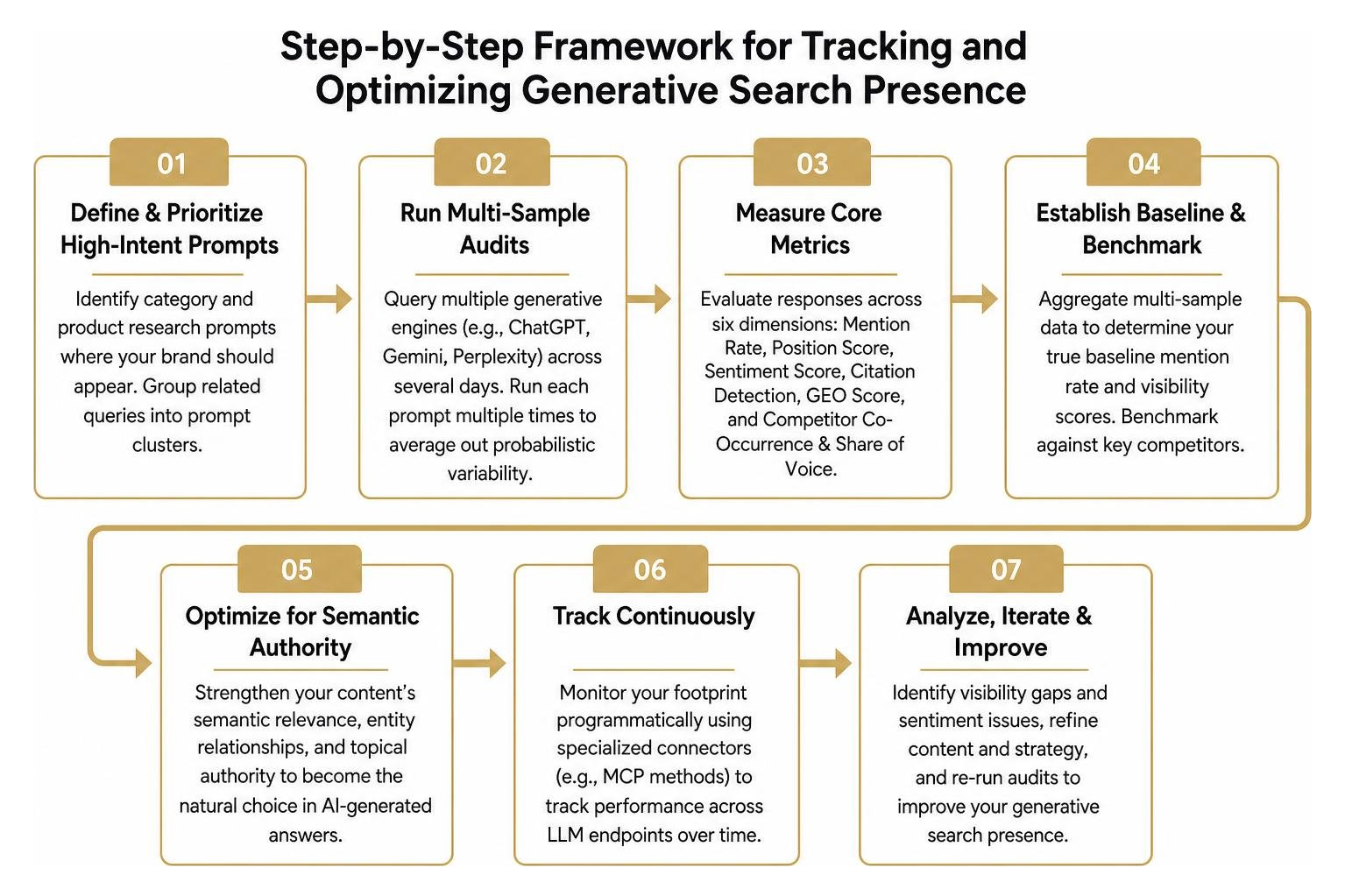
Tracking your footprint across AI engines requires a structured measurement framework. Because generative responses are fluid, simple rank tracking does not tell the full story. We evaluate performance across six core dimensions:
- Mention Rate: The percentage of times your brand appears across a sample of identical or related prompts.
- Position Score: Where your brand appears in the synthesized list. Being mentioned first yields significantly higher click-through rates than appearing fourth or fifth.
- Sentiment Score: The tone and context of the mention (positive, neutral, or negative), assessing whether the engine frames your product as an industry leader or a budget compromise.
- Citation Detection: Whether the engine includes an active hyperlink or citation card directing users back to your domain or trusted third-party reviews.
- Generative Engine Optimization (GEO) Score: An aggregate metric (from 0 to 100) combining mention frequency, prominence, sentiment, and source authority.
- Competitor Co-Occurrence & Share of Voice: The frequency with which your competitors are recommended in place of, or alongside, your brand for high-intent category queries.
A company’s public reputation can account for as much as 63% of its market value. When potential buyers consult AI assistants during product research, low visibility directly impacts revenue pipeline growth. Implementing comprehensive AI optimization strategies ensures that your brand builds the contextual footprint needed to score highly across each of these critical metrics.
Step-by-Step Guide: How to Track and Optimize Your AI Search Footprint
Systematic tracking requires moving from ad-hoc manual queries to an organized, repeatable process.
Conducting Multi-Sample Audits for Accurate AI Search Brand Mentions
A single query in ChatGPT or Gemini represents only one probabilistic path out of many. Because LLMs rely on temperature settings that introduce variability into token selection, a brand might appear in one response but disappear in the next. Relying on a single-shot check creates false confidence or unneeded panic.
To establish an accurate baseline, run prompt clusters across multiple engines over several consecutive days. Multi-sampling averages out probabilistic noise and reveals your true baseline mention rate. For example, if you test a category prompt 20 times across Perplexity and your company appears in 12 answers, your actual baseline mention rate is 60%. Utilizing specialized tools with multi-platform brand tracker capabilities lets you benchmark this data reliably across search platforms, discussion forums, and answer engines.
Detecting Hallucinations and Incorrect Product Data
Generative engines occasionally misstate critical business details, such as quoting discontinued pricing, attributing missing features, or confusing company names. A confident, incorrect AI answer can do more damage than no mention at all, quietly steering high-intent prospects toward competitors.
Set up audit workflows that compare AI-generated summaries against your verified brand profile. When an engine hallucinates inaccurate data:
- Identify the primary source domains the model cites for the erroneous claim.
- Update the structured data, schema markup, and clear factual copy on your own digital properties.
- Conduct digital outreach to correct outdated third-party reviews or directory listings.
- Re-audit the prompt cluster within a 24-hour window to verify if live-retrieval engines have refreshed their contextual cache.
Brands that catch and address misinformation quickly can reduce reputation damage by up to 70% compared to those that let inaccurate statements linger.
Building High-Authority Citations to Secure AI Search Brand Mentions
AI answer engines do not pull facts out of thin air; they rely on digital consensus. To become a recurring citation in LLM answers, your brand must be present across the ecosystem of sources that models consult during retrieval passes.
- Authoritative Community Presence: Discussion platforms like Reddit, industry forums, and specialized communities are heavily indexed by answer engines looking for unbiased user sentiment.
- Third-Party Review Hubs: Consistent review volume and high sentiment scores on trusted software directories and consumer portals provide verification data.
- AI-Citable Owned Content: Structure your content with concise definitions, comparison tables, clear FAQs, and descriptive headings that make it effortless for an LLM to extract factual passages.
- Technical Entity Validation: Implement Organization, Product, and Article schema to establish unambiguous entity relationships in knowledge graphs.

Integrating AI Monitoring Data into Modern Marketing Workflows
AI search brand monitoring should not live in an isolated silo. Connecting generative visibility metrics directly into your marketing operations ensures rapid collaboration across PR, content, SEO, and product teams.
By streaming monitoring events through webhooks into communication channels like Slack or Microsoft Teams, cross-functional teams receive immediate visibility when share of voice shifts.
Real-Time Alerts and Reputation Triage
Consumer expectations have accelerated, with 79% expecting brand responses within 24 hours. When an AI engine begins surfacing negative sentiment or referencing a viral complaint, early detection makes all the difference. Teams responding to emerging reputation challenges within 24 hours can cut reputational damage by approximately 30%.
Configure automated threshold alerts for:
- Sudden drops in category mention rate (e.g., dropping from 60% to below 20%).
- Emergence of negative sentiment descriptors in synthesized summaries.
- Changes in primary source citations that redirect traffic away from owned domains.
Brands that actively monitor sentiment shifts and integrate these insights into customer success workflows report roughly 15% higher customer retention over time.
Competitor Benchmarking and Share of Conversation
Generative search is inherently zero-sum. If an answer engine answers the prompt “What are the top three tools for project management?” with three specific competitors, your absence is a lost opportunity.
Track competitor co-mentions systematically. Calculate your generative share of voice by comparing your total mention count against the aggregate mentions of your competitive set across identical prompt batches. Identify the specific queries where competitors hold 100% share of voice, analyze the sources cited on their behalf, and execute targeted content and PR campaigns to earn placement within those reference domains.
Frequently Asked Questions about AI Brand Tracking
Find answers to common generative search questions below or explore our extended FAQs for additional guidance.
How do AI search engines decide which brands to mention?
Answer engines evaluate a combination of parametric training data, real-time web retrieval, and contextual consensus. When generating an answer, models prioritize brands that exhibit strong entity authority, high citation density across independent third-party sources, clear semantic alignment with the prompt’s intent, and positive community sentiment.
Why are single-shot AI checks inaccurate?
Large language models are probabilistic rather than deterministic. Factors such as temperature settings, slight phrasing differences, and real-time retrieval fluctuations mean that a single query only captures one potential response. Multi-sampling across multiple runs provides a statistically reliable measurement of your true visibility.
What is the cost of auditing brand presence across generative engines?
Costs vary based on depth and automation. Running a basic programmatic audit across multiple models typically costs a fraction of a cent per query execution (averaging around $0.08 per brand-query-platform check, or under $2.00 for a comprehensive 24-check baseline). Enterprise tracking suites and automated monitoring platforms offer scaled subscription tiers depending on query volume, frequency, and real-time alerting features.
Conclusion
The shift from indexed blue links to synthesized AI recommendations represents the biggest evolution in search behavior in decades. Brands that ignore how answer engines perceive them risk disappearing from the consideration set entirely, while those that actively monitor, protect, and optimize their presence capture high-intent buyers at the moment of decision.
By tracking your generative footprint across multiple models, eliminating hallucinations, and systematically earning high-authority citations, you can turn AI search into a dependable engine for customer acquisition. If you are ready to elevate your brand’s presence across ChatGPT, Perplexity, Gemini, and Google AI Overviews, explore our tailored AI optimization services to lead your industry in generative discovery.
