


AI Search Algorithm Tips That Turn Modern Crawlers into Traffic Drivers
Core AI Search Algorithm Tips for Technical Architecture
The most effective AI search algorithm tips focus on four foundations: deliver fully server-rendered HTML so crawlers can read your content immediately, structure copy into modular passages that answer specific questions, implement Schema.org markup to clarify entities, and build external citations that validate your authority. These practices help modern AI crawlers discover, parse, and cite your pages accurately.
Modern search systems rely on advanced language models to synthesize answers rather than just presenting a directory of links. Behind these conversational interfaces are automated crawlers designed to discover, read, and index web pages under strict operational constraints.
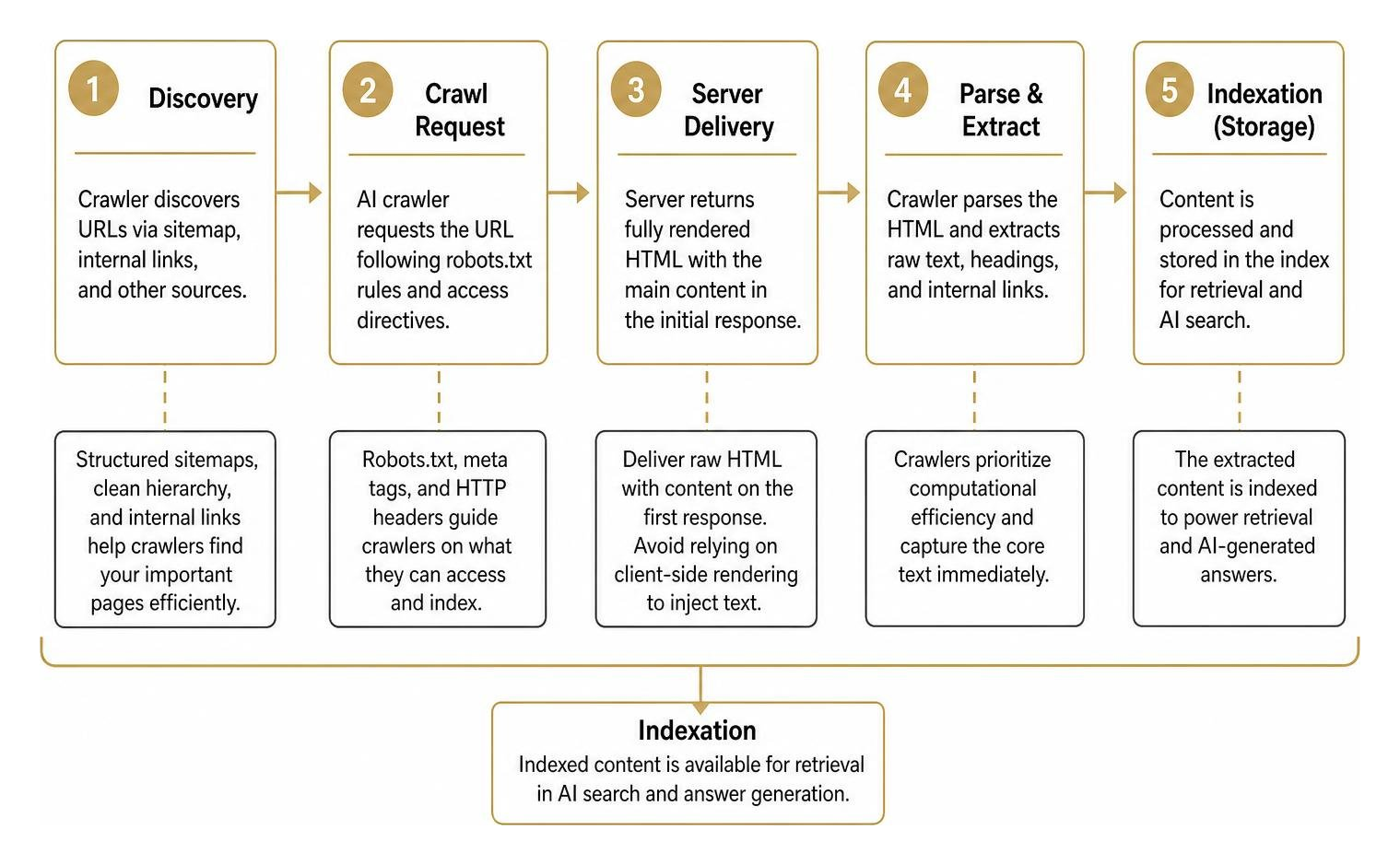
Unlike legacy search spiders that maintain vast rendering farms to process client-side scripts, many AI bots prioritize computational efficiency. When an AI crawler requests a page, it aims to parse the core textual data immediately. If critical information resides behind dynamic client-side rendering frameworks, the crawler may encounter an empty document or incomplete text. Ensuring your server delivers fully rendered HTML on the initial request guarantees that the system captures your insights completely.
Managing technical architecture also requires careful allocation of your site’s crawl budget. A structured XML sitemap updated with accurate modification timestamps helps search engines prioritize new or revised content. When you provide clear pathways through clean hierarchy and internal links, automated systems can navigate deep into your knowledge base without getting trapped in infinite filter loops or redundant URL parameters. You can explore deeper strategies in our AI SEO category to understand how technical foundations influence organic discovery.
Essential AI search algorithm tips for raw HTML rendering
Providing direct access to raw text within the Document Object Model (DOM) is essential for AI indexing. Large language models process textual tokens to generate answers, making the text payload the primary asset of every page.
When constructing pages, ensure that your main content, structural headings, data points, and contextually rich internal links exist in the initial HTML response. Relying on scripts that inject text only after user interaction or client-side execution creates unnecessary friction. Prioritize fast server response times and lightweight page delivery so automated agents can ingest complete documents without timing out.
Managing AI Crawler Directives and Access Control
Directives allow site owners to communicate clear access rules to automated web agents. The standard protocol begins with your robots.txt file, where specific user-agent rules can grant or restrict access to various sections of your site.
Beyond robots.txt, robots meta tags and HTTP response headers offer granular instruction at the individual page level. Keeping your crawl directives organized ensures that indexable, high-value resources remain completely open to discovery while administrative or redundant pages stay out of the crawl queue.
Structuring Web Content for Retrieval-Augmented Generation
Retrieval-Augmented Generation (RAG) is the technical mechanism generative engines use to pull factual data from real-world documents to answer user queries. To be selected during the retrieval stage, your content must be structured specifically for passage extraction.
| Traditional SEO Content Formatting | LLM & AI Engine Extraction Requirements |
|---|---|
| Long introductory paragraphs setting up context | Answer-first formatting with immediate value delivery |
| Broad headings designed primarily for keyword targets | Specific, question-based headings addressing clear intent |
| Scattered factual points across multiple paragraphs | Self-contained, modular passages with complete context |
| Heavy reliance on stylistic narrative phrasing | High semantic density with precise facts and definitions |
| Generic lists without explicit context | Structured tables and clearly labeled bullet points |
Writing in an answer-first format means delivering a concise, direct response immediately beneath a section heading before expanding into nuanced analysis. AI engines scan documents for self-contained passages that directly address specific questions. When a section functions as an independent, logically complete block of information, the algorithm can easily extract and quote it within a synthesized answer.
Advanced AI search algorithm tips for passage extraction
Achieving high visibility in generative answers requires high semantic density. Content that contains dense, verifiable information provides the factual foundation algorithms need to construct accurate responses.
To improve passage extraction, format core concepts using direct definitions, ordered steps, and data-backed statements. When discussing processes or outcomes, include concrete numbers and clear context. Reviewing practical AI search optimization insights helps demonstrate how breaking complex industry topics into clear, extractable passages makes information readily accessible for machine synthesis.
Enhancing Entity Clarity with Structured Schema Data
Structured data serves as a clear interpreter between your human-readable copy and an AI engine’s underlying knowledge graph. Implementing standard Schema.org markup using JSON-LD provides definitive context about what your business is, what products or services you offer, and who authored your material.
Schemas such as Article, Organization, Service, and AboutPage explicitly define the relationships between concepts on your site. This disambiguation prevents algorithms from confusing your brand with similar names, reinforcing your authority across machine-readable knowledge bases.
Building Authority Through Citations and External Mentions
AI search platforms evaluate the overall credibility of information before citing it in a generated response. Algorithms cross-reference claims across multiple sources across the web to ensure accuracy and reduce errors.

A brand that is mentioned, referenced, and validated across independent digital platforms signals high authority to AI algorithms. When external industry publications, community forums, and reputable repositories consistently reference your expertise, generative engines treat your website as an authoritative primary source. You can read more about winning the citation game with brand mentions to see how broad digital signals reinforce authority.
Generating Verifiable Data and Statistical Backing
Generative engines favor content backed by verifiable facts, original research, and clear data points. When an article contains original findings, surveys, or structured calculations, it becomes an indispensable reference for models looking to substantiate their answers.
Presenting statistical evidence within clean tables or distinct lists makes it easy for algorithms to pull that data directly into response panels. Citing reputable sources for external claims further confirms that your content is thoroughly researched, boosting its credibility during automated source selection.
Expanding Digital Footprint Across Community Hubs
Modern AI models pull information from a wide variety of public forums, authoritative directories, and community discussions. Broad brand presence across these platforms establishes natural context around your brand’s expertise.
When real discussions naturally reference your solutions, educational resources, or insights, AI algorithms index that sentiment. This widespread presence ensures that when prospective buyers ask generative platforms for recommendations within your industry, your business is recognized as a known, reputable solution.
Tracking and Measuring Generative Search Performance
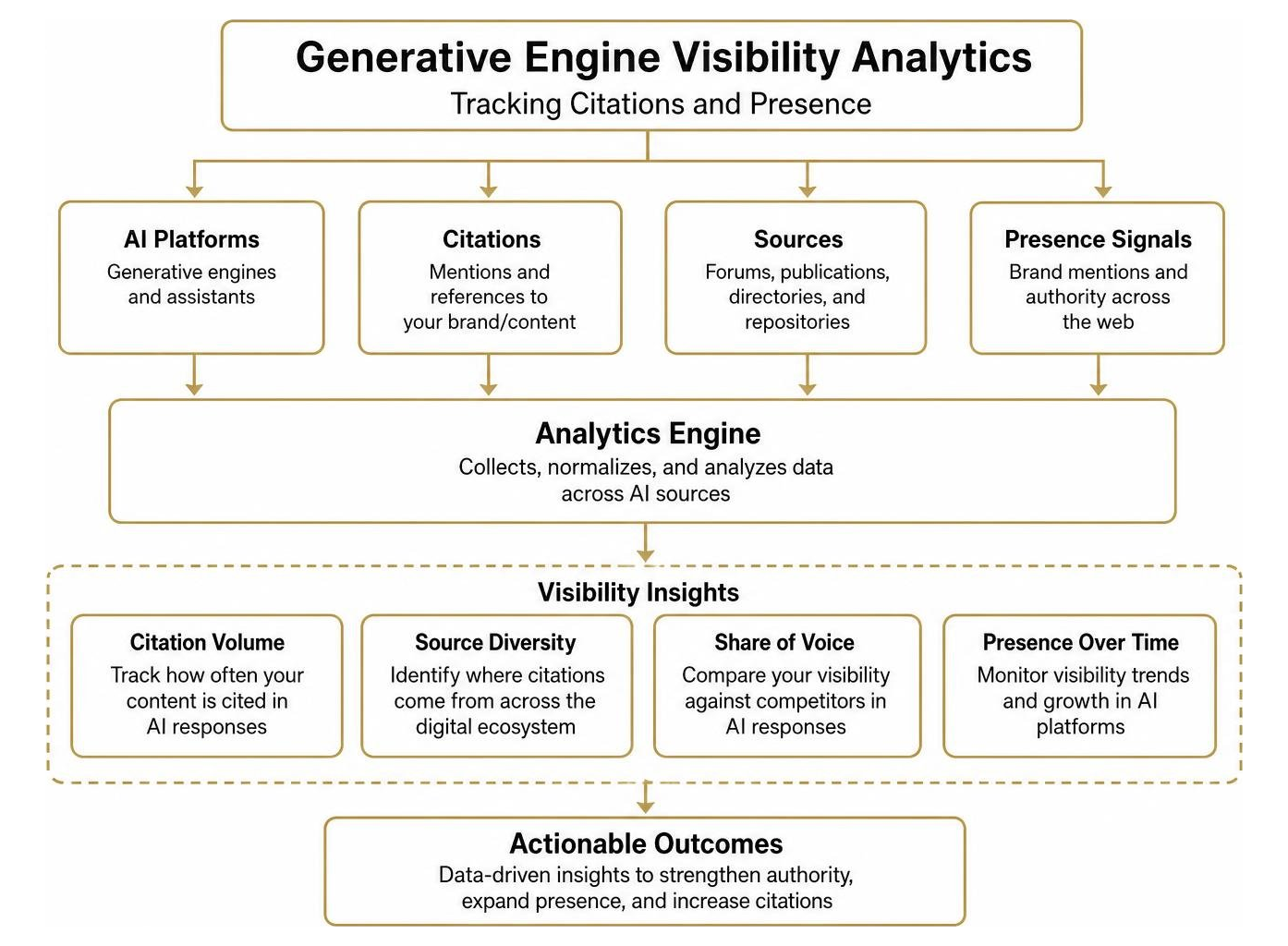
Optimizing for AI platforms requires tracking visibility metrics that go beyond traditional organic rankings. Because generative answers provide synthesized summaries, measuring performance involves monitoring brand citations, referral sources, and presence within conversational answers.

To evaluate your progress, establish baseline measurements across the platforms your target audience uses most frequently. Tracking whether your brand is cited as a supporting source, mentioned in product comparisons, or quoted directly gives you actionable insight into how search algorithms interpret your authority.
Establishing Prompt Monitoring Frameworks
A practical AI measurement framework starts by identifying the exact prompts and queries your prospective customers use throughout their research journey. These include broad educational queries, specific problem-solving questions, and direct vendor comparison prompts.
Testing these prompts systematically across different AI models reveals where your business currently appears and identifies content gaps where competing perspectives are cited instead. Documenting these responses over time tracks shifts in brand visibility as you publish new structured content and expand your digital footprint.
Analyzing Citation Frequency and Brand Sentiment
Beyond raw visibility, the context in which your brand appears within synthesized answers is critical. AI models associate distinct sentiment and descriptive attributes with organizations based on the text they ingest.
Monitoring the tone, accuracy, and descriptive context of AI-generated answers ensures your business is being recommended accurately. When combined with referral tracking from AI interfaces to your website, these metrics illustrate how generative visibility supports real business discovery.
Frequently Asked Questions About AI Search Optimization
How do AI search crawlers differ from traditional search engine bots?
Traditional search bots primarily crawl the web to build an index of complete documents to display as ranked links. In contrast, AI crawlers and retrieval mechanisms focus heavily on finding extractable passages, factual data, and answers that can be combined to answer specific prompts. Furthermore, many AI bots operate with limited client-side rendering capabilities, placing a premium on server-delivered, raw HTML text.
What is the most impactful factor for getting cited in AI answers?
The most impactful factor is providing clear, factual, and easily extractable answers supported by strong third-party validation. Generative models select sources that directly answer user queries without fluff, back their statements with verifiable data or authoritative citations, and maintain a consistent reputation across trusted digital channels.
Is structured schema markup required for AI search engine visibility?
While standard Schema.org markup is not strictly mandatory for an AI model to read text, it is highly beneficial. JSON-LD structured data provides unambiguous signals about your entities, products, authorship, and organization, helping search algorithms map your content accurately within broader knowledge graphs.
Conclusion
The evolution of search toward AI-generated answers presents an exceptional opportunity for forward-thinking organizations. By building a sound technical architecture, organizing content for clear passage extraction, expanding verifiable external citations, and tracking generative presence, businesses can turn modern AI crawlers into sustainable traffic drivers.
At Upskale Marketing, based in Orlando, Florida, we combine deep marketing expertise with advanced strategies in Answer Engine Optimization to help businesses build measurable authority in AI-driven search. AI search optimization is an ongoing discipline of reinforcing relevance, structure, and trust across every digital touchpoint.
To discover how your business currently performs across generative platforms and identify high-impact opportunities for growth, contact us today to schedule your free, data-driven AI evaluation and explore our comprehensive AI optimization services.