

What AI Search Question Answering Means for Your Business
AI search question answering turns a question into a direct response, often drawing on several sources and showing citations. Traditional search usually gives you a list of pages to explore. AI search does more of that work for you, but its answers can still be incomplete or wrong. Check the cited sources when accuracy matters.
For businesses, this changes where visibility happens. A customer may see a recommendation in an AI answer before visiting any website. Clear, useful content and a trustworthy brand presence can help your business become part of that answer.
I’m Scott Brazdo, MBA, founder of Upskale Marketing. After more than 30 years in marketing and branding, I now help businesses approach ai search question answering as a way to earn visibility, not as a shortcut.
How AI Search Question Answering Differs from Traditional Search
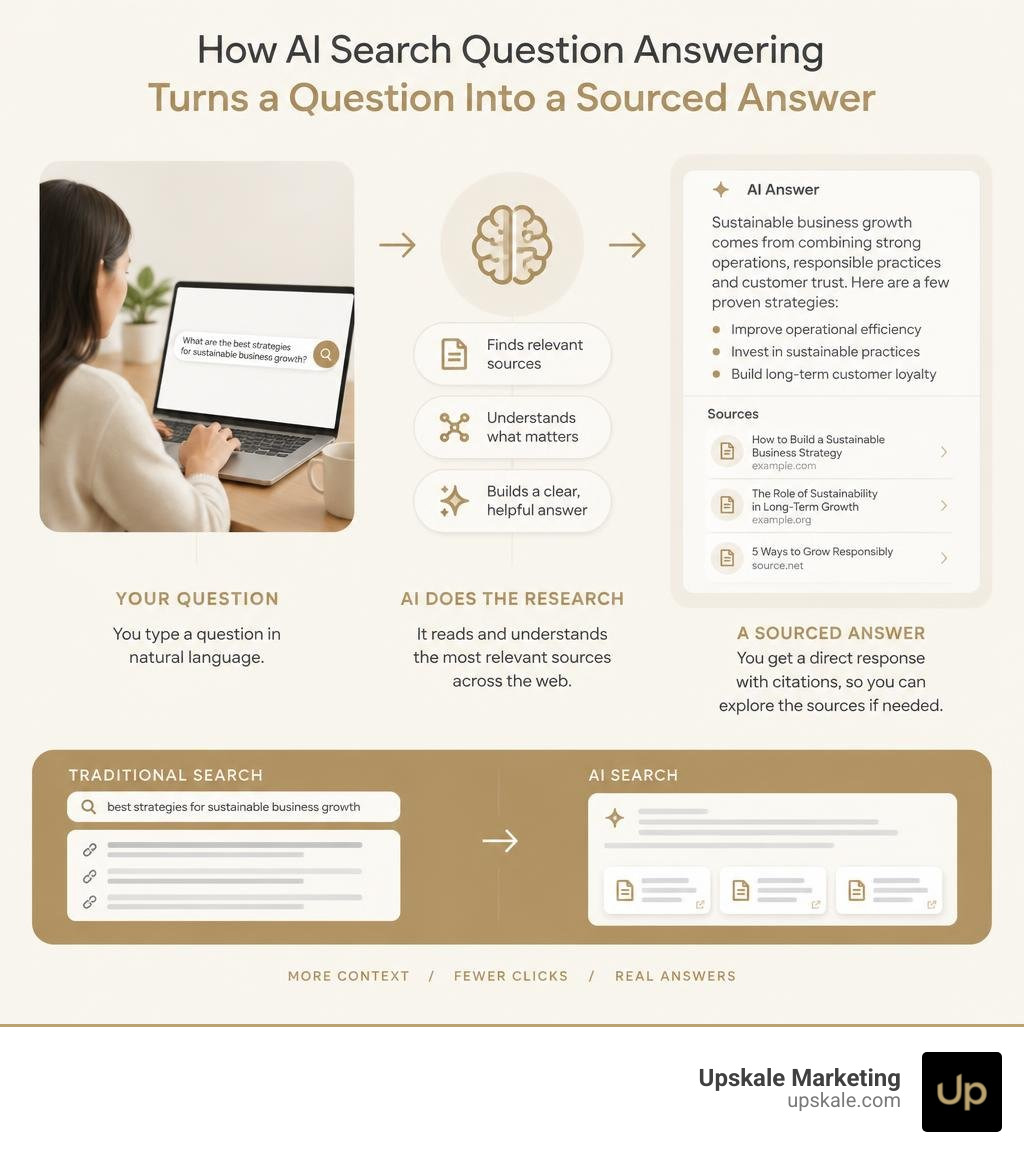
The way people discover information online has undergone a massive structural shift. For decades, traditional search engines operated on an index-and-retrieve model: a user entered keywords, the engine matched those terms against an inverted index, and the result was a page of blue links. The user then had to click through multiple websites, sift through paragraphs, and synthesize their own conclusion.
Modern AI search engines invert that workflow. Instead of acting as index librarians pointing to potential reading material, they act as analytical research assistants. By applying deep semantic comprehension, neural retrieval, and generative summarization, an answer engine reads the most relevant sources across the web and writes a direct, unified answer in natural language.
This evolution is fundamentally reshaping user behavior. With zero-click searches exceeding 58% across major search platforms, users increasingly satisfy their informational needs directly within the AI-generated interface. When clicks do happen, they come from highly qualified users seeking deeper evaluation, validation, or commercial action.
To thrive in this environment, brands must embrace generative search engine optimization to ensure their insights and solutions are synthesized into these authoritative answers.
| Dimension | Traditional Keyword Search | Generative AI Question Answering |
|---|---|---|
| Primary Output | Ranked list of ten blue links with text snippets | Comprehensive, synthesized direct answer with citations |
| Retrieval Mechanism | Lexical indexing and keyword density matching | Semantic embeddings and neural vector search |
| User Effort | High: manual clicking, reading, and synthesizing | Low: automated analysis across multiple sources |
| Handling of Complex Queries | Struggles with nuanced, multi-part, or conversational prompts | Excels at intent resolution and multi-turn context |
| Traffic Dynamics | Distributed click-throughs across top-ranking organic links | High zero-click rate; clicks carry significantly higher intent |
The Shift from Keyword Indexing to Direct Answer Synthesis
In traditional search, matching exact terms was the primary driver of visibility. If a customer searched for enterprise customer management software, search crawlers scanned title tags, headers, and body copy for those exact phrases.
In conversational search, systems parse the underlying intent of full-sentence queries. A user might ask: “Which customer management platform best handles automated contract renewal alerts for a mid-sized healthcare provider?”
An AI engine identifies the entities (healthcare, mid-sized, contract renewals, customer platforms) and evaluates source material based on factual relevance rather than keyword frequency. It extracts specific features from product documentation, user reviews, and case studies, synthesizing them into a direct comparison. This makes preparing web pages for conversational AI an essential discipline for modern organizations.
Paraphrase Precision, Recall, and Intent Handling
One of the greatest operational breakthroughs of neural search is its mastery of paraphrase matching and query intent. Traditional lexical search systems frequently suffer from false negatives—failing to return an authoritative page simply because the author used different terminology than the searcher.
AI search utilizes transformer-based sentence embeddings that map concepts into a shared vector space. By performing semantic k-nearest neighbor (k-NN) retrieval, neural search engines recognize that “how to halt recurring subscription billing” and “steps to cancel auto-renewal” represent identical user intent.
In standardized paraphrase evaluation benchmarks, AI-driven semantic retrieval nearly doubles precision and multiplies recall compared to legacy text search. Because the engine reliably identifies conceptual alignment, it elevates true positive matches while filtering out irrelevant, keyword-stuffed pages.
How Modern AI Search Engines Process Queries and Retrieve Information
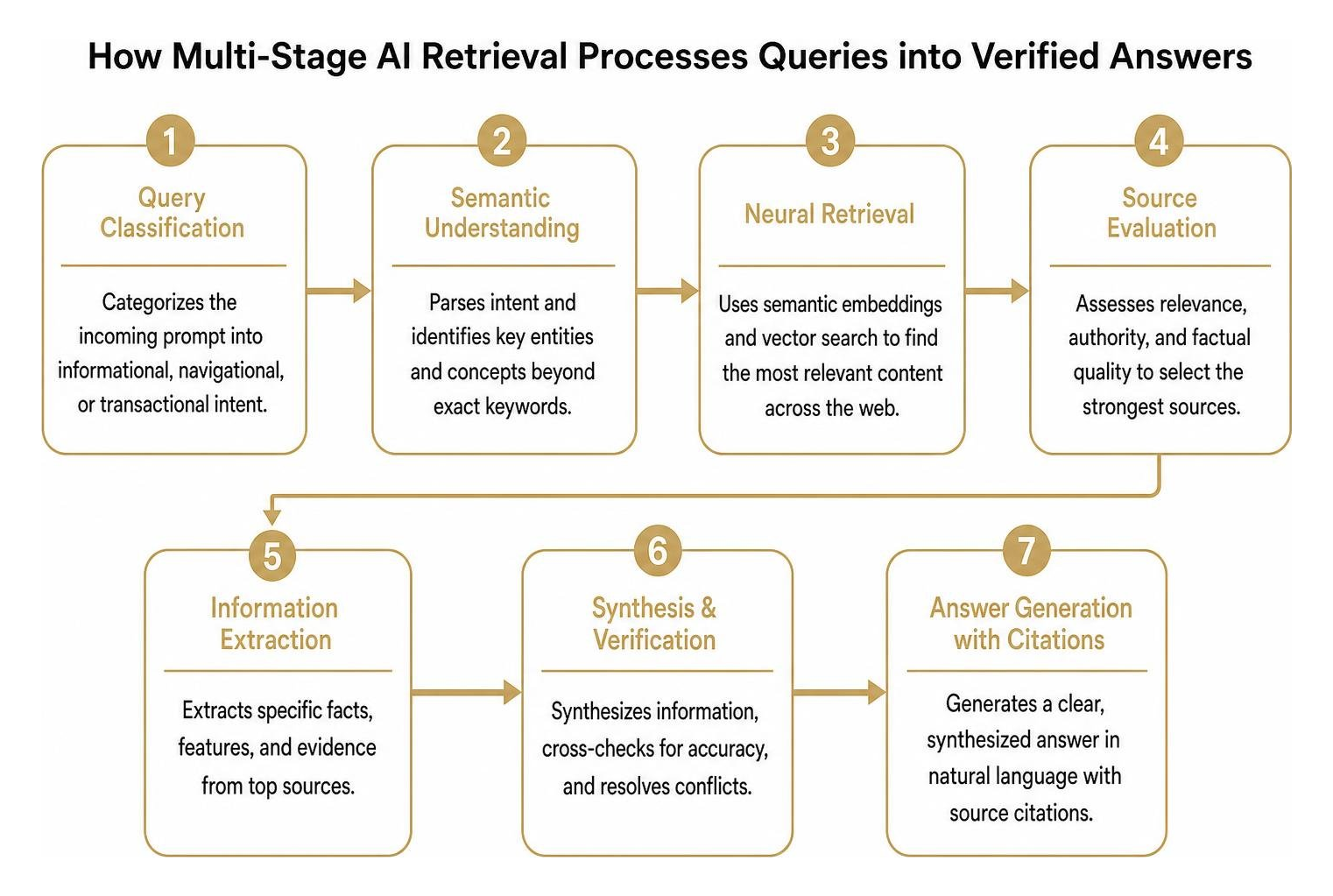
When a user submits a question to a generative engine, the system initiates a multi-stage pipeline designed to parse intent, query the broader web, verify facts, and generate a clear answer.
The process begins with query classification. Advanced models categorize incoming prompts into three primary buckets:
- Informational Queries: Inquiries seeking knowledge, definitions, comparisons, or multi-step troubleshooting. These trigger full generative syntheses.
- Navigational Queries: Direct requests to reach a specific destination or login portal, which prioritize direct links over lengthy prose.
- Transactional Queries: High-intent commercial searches where users want pricing tables, product availability, or checkout access.
Understanding how engines classify these intents helps marketing teams deploy effective AI search algorithm strategies that align content structures with engine expectations.
Multi-Stage Neural Retrieval and Semantic Embeddings
Generating a factual answer requires more than running a prompt through a static language model. Modern engines follow a rigorous, multi-stage retrieval architecture:
- Dense Retrieval: The raw query is converted into a mathematical vector representation. The system scans billions of web documents indexed as dense embeddings to pull an initial pool of candidate pages.
- Cross-Encoder Reranking: Because initial vector retrieval prioritizes speed over deep analysis, a secondary cross-encoder model evaluates the candidate documents alongside the original query. This stage assesses contextual depth, source credibility, and topical authority.
- Context Extraction: The highest-ranked passages are isolated and passed into the model’s context window for synthesis.
Grounding Answers with Real-Time Web Data and RAG
Static language models suffer from knowledge cutoffs and the risk of hallucination—generating plausible-sounding statements that lack factual basis. Modern answer engines resolve this through Retrieval-Augmented Generation (RAG).
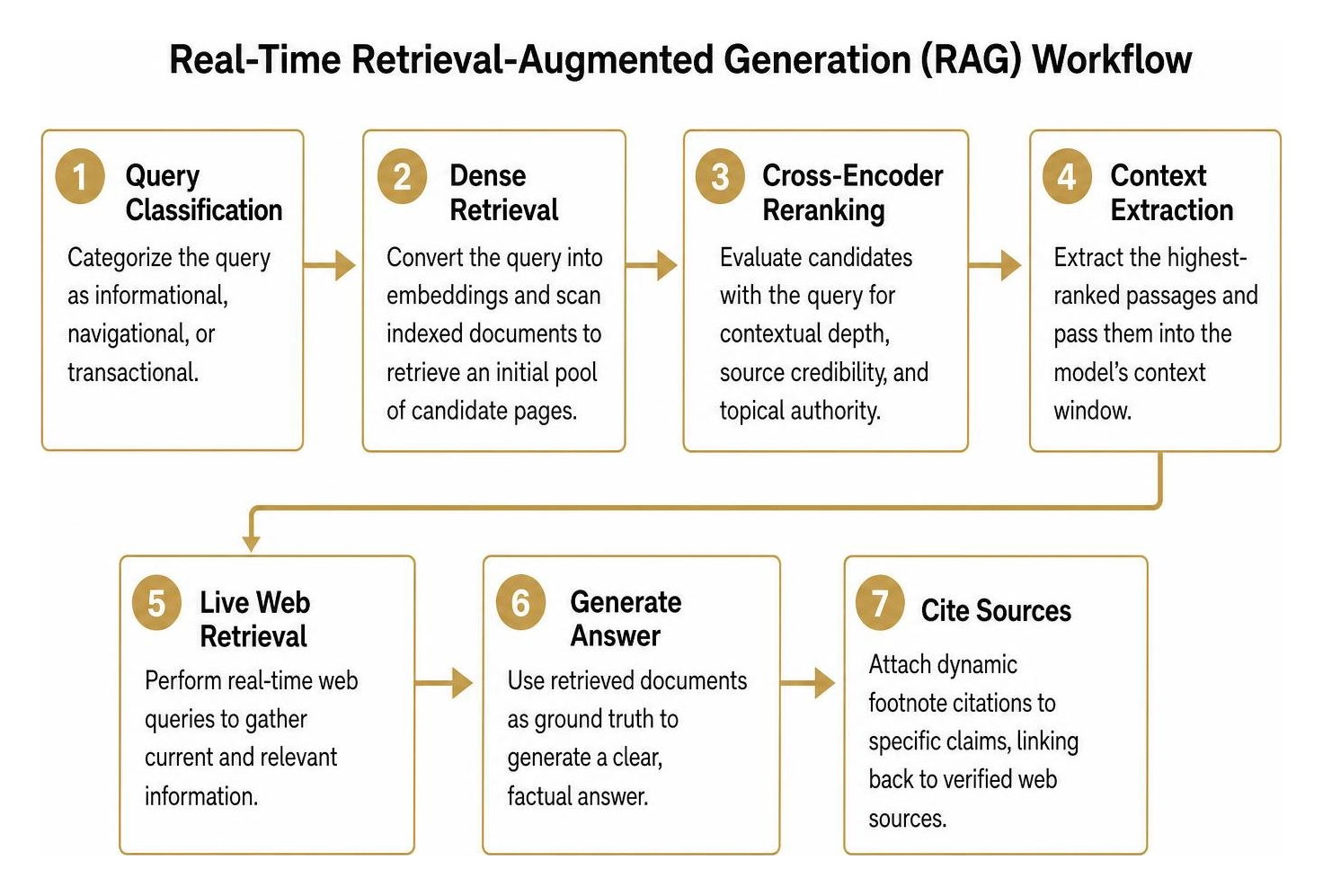
In a RAG pipeline, the engine performs live web queries to gather real-time data before composing an answer. The language model is strictly instructed to generate its final output using the retrieved documents as ground truth.
During synthesis, the engine attaches dynamic footnote citations to specific claims, anchoring assertions directly to verified web sources. This real-time grounding ensures answers reflect current market realities while giving users a transparent audit trail back to authoritative creators.
Key Technologies Powering AI Search Question Answering
The seamless delivery of conversational search results is made possible by the convergence of several complex technologies working in parallel.

- Transformer Architectures: Self-attention mechanisms enable models to understand relationships between words across long passages, resolving ambiguous references and complex phrasing.
- Vector Databases & Embedding Models: Specialized neural networks translate unstructured web copy into high-dimensional vectors, enabling real-time semantic similarity scoring across petabytes of text.
- Deep Neural Rerankers: Secondary scoring algorithms that assess document reliability, freshness, and topical depth before final synthesis occurs.
- Dynamic Context Windows: Expanded token capacity that allows engines to analyze dozens of extensive reference documents simultaneously without losing track of nuanced source details.
Understanding these technical systems is critical when mastering enterprise AI search strategy across complex multi-channel organizations.
Foundational Architectures for Question Answering in AI Search
The core strength of question answering in AI search lies in how large language models interact with external retrieval layers. Rather than relying solely on pre-trained weights, answer engines use parameter-efficient retrieval wrappers.
When a query enters the system, the model does not attempt to guess an answer from memory. Instead, it acts as an analytical processor: it reads the structured passages retrieved by the neural ranker, reconciles differing viewpoints across multiple publications, eliminates redundancy, and outputs an objective summary. This separation between knowledge storage (the live web index) and linguistic reasoning (the language model) is what makes modern AI search both reliable and capable of handling real-time events.
The Role of Custom Question Answering in Enterprise Applications
Beyond public web search engines, organizations are deploying custom question answering (CQA) architectures across internal datasets, customer portals, and proprietary technical libraries.
Using cloud-native enterprise AI search tools like Microsoft Foundry, businesses ingest thousands of technical manuals, internal policy documents, and customer service logs into secure, private knowledge bases. These systems incorporate metadata filtering, role-based access controls, and multi-turn conversational memory.
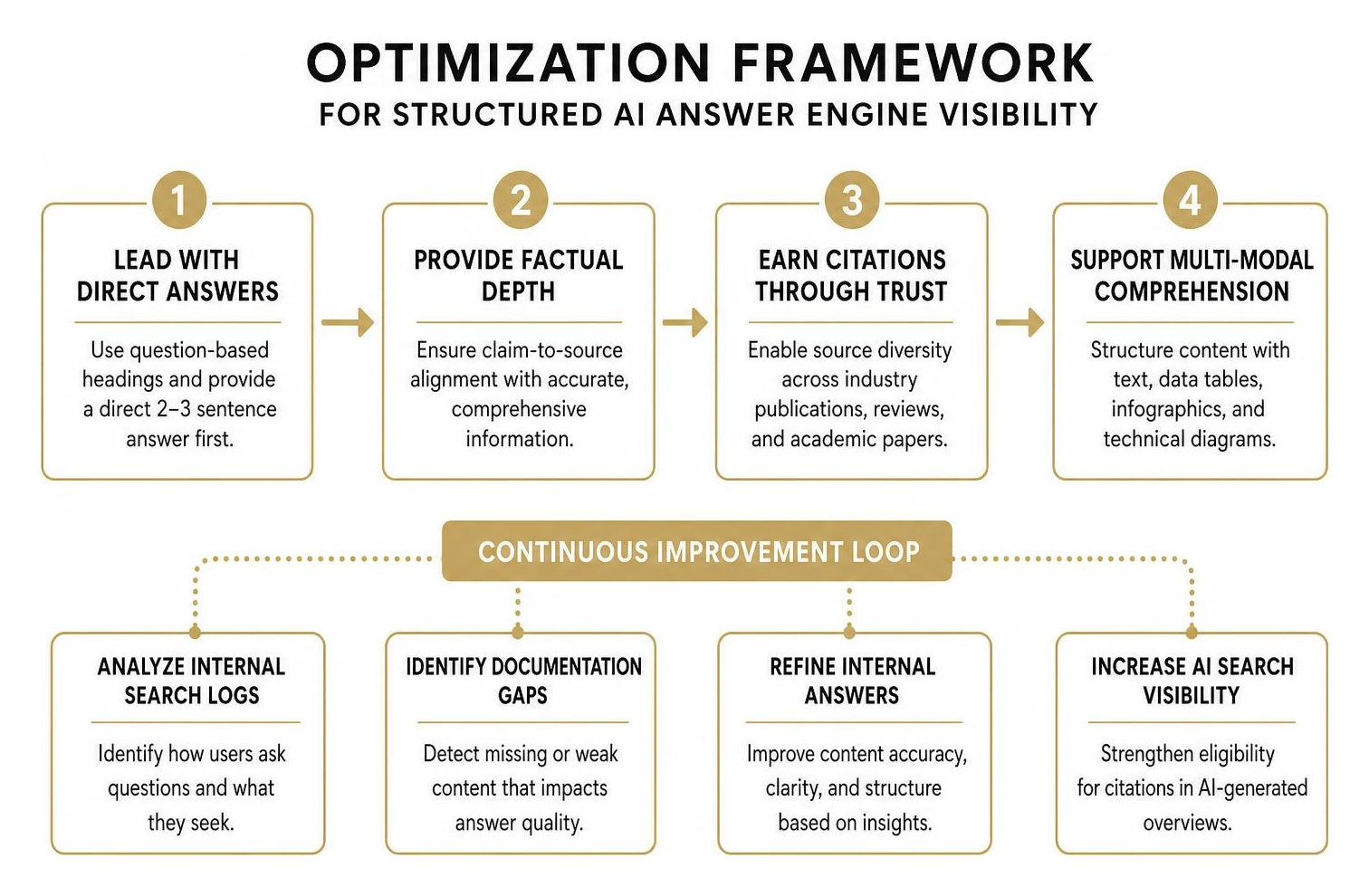
By analyzing internal search logs through active learning loops, enterprise systems continuously identify documentation gaps, refining their internal answers over time. To explore these enterprise mechanisms further, review our AI search optimization insights.
Evaluating the 2026 AI Search Landscape and Performance Benchmarks
The generative search landscape has matured into a competitive ecosystem defined by rigorous performance benchmarks, verification standards, and diverse deployment architectures.
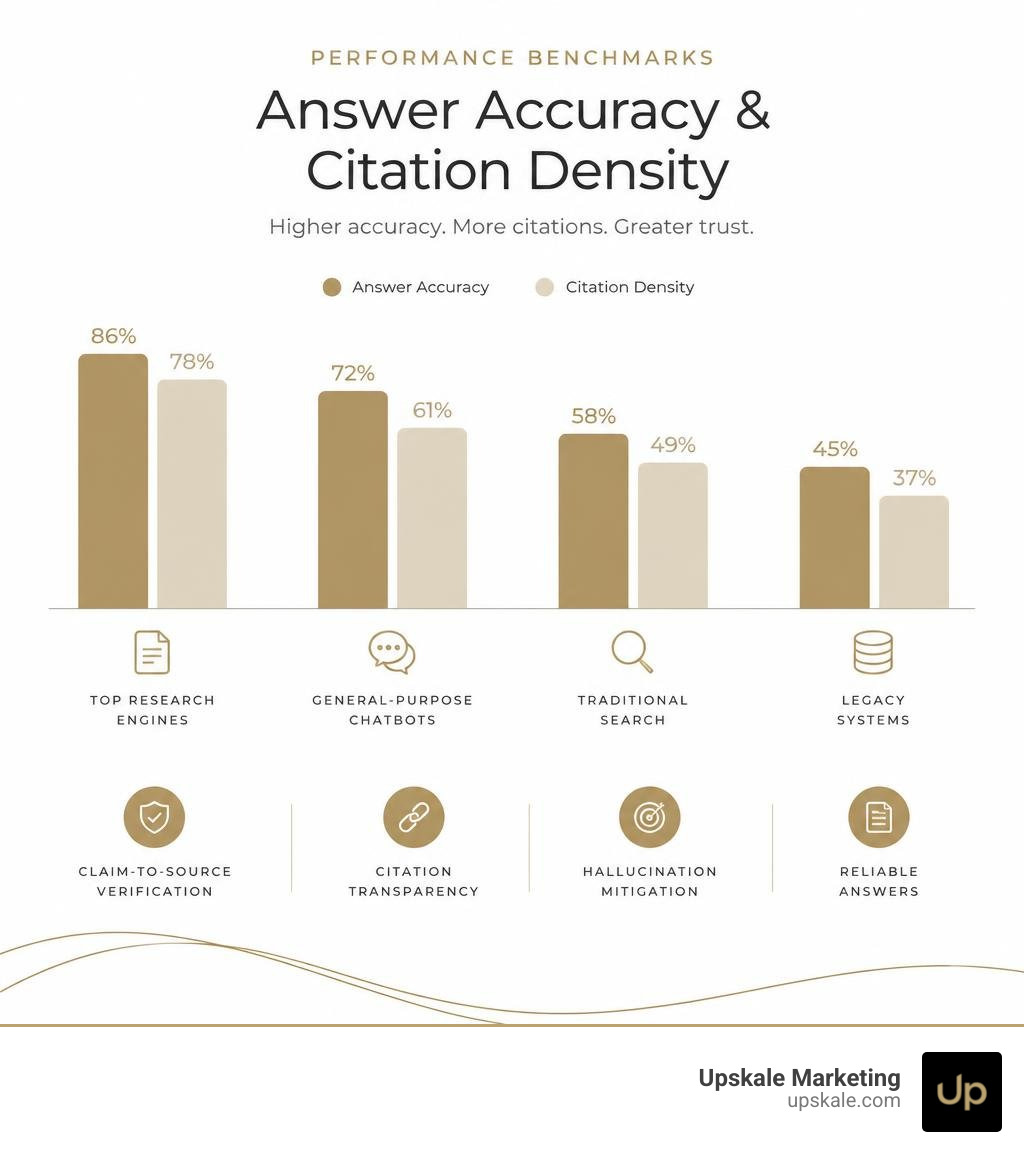
Models are evaluated on standardized benchmarks like Massive Multitask Language Understanding (MMLU), where top-tier research engines achieve accuracy ratings exceeding 86%, substantially outperforming general-purpose conversational chatbots.
Benchmarks, Citations, and Factual Verification
In research and commercial search, accuracy is paramount. A compelling writing style is useless if the underlying facts are fabricated. Consequently, modern platforms are judged primarily on their citation transparency and hallucination mitigation:
- Claim-to-Source Verification: Top answer engines calculate explicit factual alignment scores, ensuring that every sentence in a generated overview corresponds directly to an accessible, authoritative URL.
- Source Diversity: Rather than relying on a single website, leading platforms synthesize perspectives from across industry publications, independent reviews, and academic papers to deliver balanced, multi-faceted overviews.
- Multi-Modal Comprehension: Advanced engines parse and answer questions using text, embedded data tables, infographics, and technical diagrams within source documents.
Cloud Platforms vs. Local Edge Inference and Data Privacy
While cloud-based answer engines dominate consumer search, a parallel movement toward private, local edge inference has gained momentum among privacy-conscious enterprises and developers.
Using lightweight language models ranging from 135 million to 4 billion parameters, modern browser environments can run neural search pipelines entirely on local hardware using WebGPU. When paired with open-source metasearch aggregators like SearXNG in self-hosted environments, these tools allow organizations to perform deep retrieval-augmented question answering over sensitive documents without sending proprietary data to third-party cloud APIs.
Practical Strategies to Optimize for AI Search Visibility
Earning consistent citations within AI-generated overviews requires a deliberate pivot from traditional keyword placement toward Answer Engine Optimization (AEO). AI crawlers do not award visibility based on repetition; they select sources that provide the clearest, most authoritative, and most readily extractable answers.
To systematically build your visibility, review our tactical generative engine optimization roadmap.
Actionable Optimization for AI Search Question Answering Visibility
To ensure your brand’s digital assets are prioritized by generative models during live RAG retrieval, focus on clarity, structure, and factual depth:
- Lead with Direct Answers: Structure key landing pages and articles with clear, question-based headings (H2 and H3 tags). Immediately follow each heading with a direct, comprehensive 2-to-3 sentence answer before expanding into supporting nuances.
- Incorporate Extractable Data Formats: AI models excel at parsing structured information. Present product comparisons, feature lists, and technical data using clean markdown tables and ordered lists.
- Implement Robust Schema Markup: Use detailed JSON-LD structured data (including FAQPage, Article, Organization, and Product schemas) to help crawlers understand your content’s semantic entities without ambiguity.
- Adopt Modular Subheadings: Break long-form guides into self-contained conceptual blocks. Each section should address a single aspect of the topic completely, making it easy for an AI to quote your passage as an excerpt.
For deeper technical execution steps, explore our guide on optimizing for AI overviews.
Structuring Content for the Two-Track Web and Generative Crawlers
The digital ecosystem has bifurcated into a “two-track web”: content must deliver an engaging, visually rich experience for human readers while offering an efficient, machine-readable architecture for AI retrieval crawlers.
To maximize your performance across both tracks, establish strong digital signals across the broader web:
- Demonstrate Unquestioned E-E-A-T: Highlight real-world Experience, Expertise, Authoritativeness, and Trustworthiness. AI search engines strongly favor content authored by verified practitioners with verifiable credentials over anonymous summaries.
- Build Broad Entity Authority: Generative engines evaluate what the rest of the web says about your company. Cultivate brand mentions, industry citations, and independent reviews across trusted third-party platforms to teach LLMs your brand story.
- Establish Cross-Platform Presence: Consistency across industry publications, business databases, and digital ecosystems is vital for building authority across AI discovery platforms.
- Capture High-Intent Referral Traffic: When users click on citations within AI answers, they are looking for validation and next steps. Ensure your linked resources provide clear, intuitive pathways that turn AI engine mentions into organic traffic.
Frequently Asked Questions About AI Search Question Answering
How does AI search question answering handle real-time citations and source verification?
AI search engines manage real-time citations through Retrieval-Augmented Generation (RAG). When a user submits a query, the system first retrieves live, high-ranking pages from its web index.
The language model is then instructed to synthesize an answer derived directly from those retrieved passages. As it generates each claim, the system anchors the text to the originating URL, displaying clickable source footnotes alongside the answer for immediate verification.
What is the difference between traditional SEO and Answer Engine Optimization (AEO)?
Traditional SEO focuses on optimizing web pages to rank in the top positions of search engine results pages (SERPs) for specific target keywords, primarily measuring success through rank position and direct organic clicks.
Answer Engine Optimization (AEO) focuses on structuring your brand’s data, insights, and authority so that generative models extract, synthesize, and cite your content directly within AI-generated answers. AEO builds entity-level authority and clear semantic answers rather than chasing keyword frequency alone.
How can enterprise organizations deploy custom question answering securely?
Enterprise organizations deploy custom question answering by implementing private RAG pipelines hosted within secure cloud tenancies or on-premise infrastructure.
These architectures ingest internal documents (such as technical manuals, HR policies, and CRM data) into private vector databases. By enforcing strict role-based access control (RBAC), metadata filtering, and zero-data-retention agreements with model providers, enterprises allow employees and customers to query proprietary knowledge without exposing confidential data to public training sets.
Conclusion
The transition from blue-link search engines to conversational AI answer engines represents the most consequential evolution in digital discovery in over two decades. As search engines increasingly answer questions directly, brand visibility is no longer just about where you rank on a traditional results page—it is about whether your business is trusted, understood, and cited by the generative models guiding consumer and enterprise decisions.
Navigating this changing landscape requires a clear, strategic focus on building real authority, structuring your content for machine comprehension, and establishing authentic digital signals across your industry.
At Upskale Marketing, we help businesses understand their current standing in generative search and build sustainable visibility across AI-driven platforms. If you want to see how your brand currently appears in generative discovery and identify opportunities for improvement, contact us to schedule a comprehensive, data-driven AI evaluation. Learn more about partnering with Upskale Marketing to scale your AI search visibility today.