

How to Choose a Digital Marketing Agency for Social Media
Selecting the right digital marketing agency for social media requires looking far beyond aesthetic feeds, creative vanity metrics, or arbitrary posting schedules. Organizations need a strategic growth partner capable of demonstrating how social engagement translates into measurable commercial outcomes, qualified sales leads, and enduring brand equity. When vetting potential agency partners, decision-makers must examine how prospective teams conduct audience research, produce platform-native creative, handle real-time community engagement, manage targeted paid amplification, and establish multi-touch attribution models.
Modern social channels also influence broader consumer perception, brand discovery, and organic visibility across search ecosystems. An experienced agency understands how social interactions feed into comprehensive search, email, and revenue operations to build sustainable market presence.
I am Scott Brazdo, MBA, and I bring more than thirty years of practical marketing leadership to this evaluation guide. Having founded, grown, and directed marketing teams across diverse sectors, I have assembled the core questions, operational standards, and strategic benchmarks that help business leaders identify true agency partners who deliver verifiable commercial value.
Use this comprehensive framework to navigate the agency selection process with clarity and measurable confidence.
What to Look for in a Digital Marketing Agency for Social Media
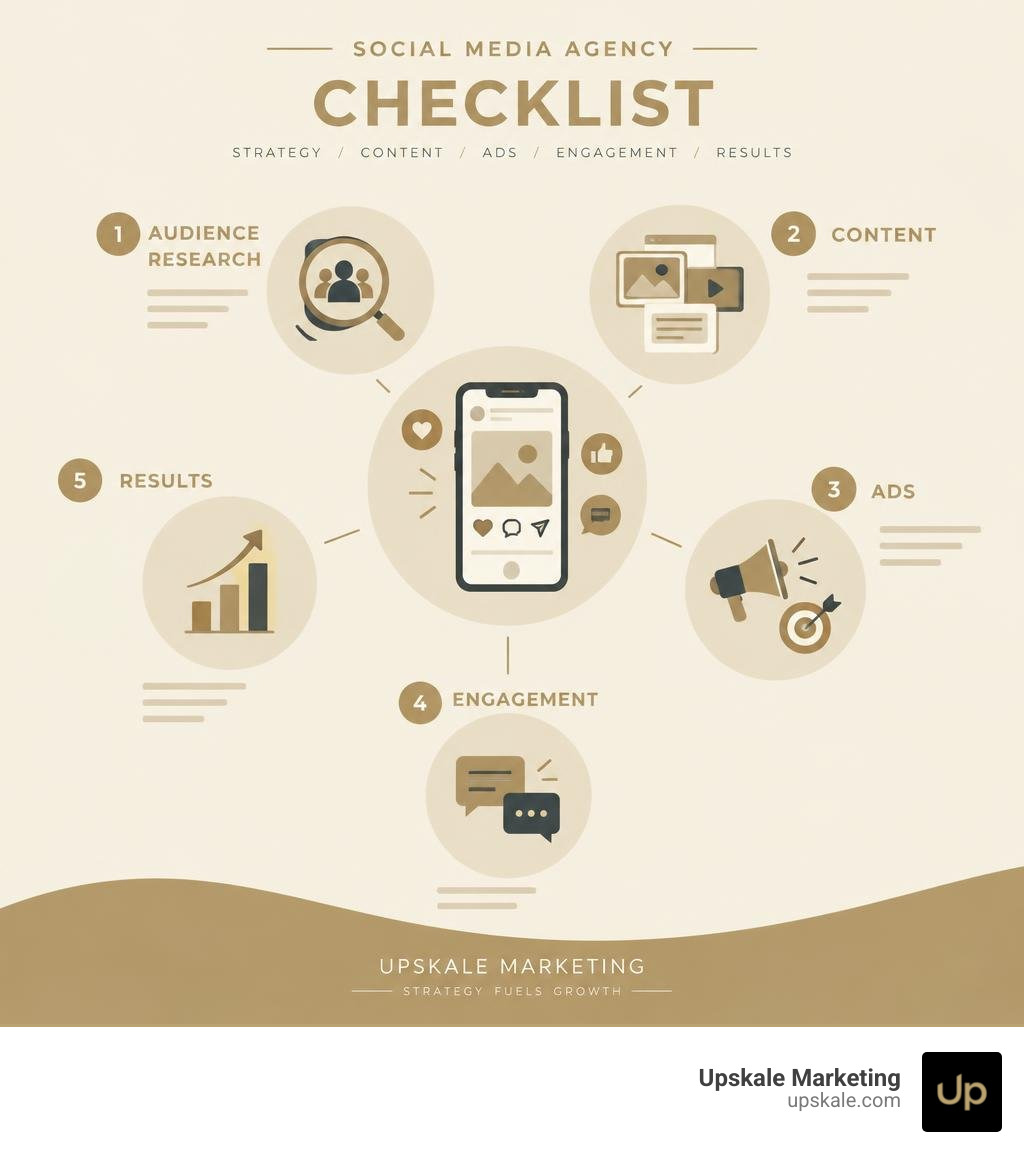
Selecting an agency partner requires looking past vanity metrics. Over 77% of small businesses utilize social channels to promote their products and services, yet many struggle to extract tangible commercial value. Modern social management is no longer just about publishing daily updates; it is a discipline grounded in audience research, active social listening, rigorous data analytics, and nuanced platform expertise. Achieving consistent commercial growth demands a coordinated strategy that converts passive attention into qualified buyer engagement and measurable business opportunities.
When evaluating a partner, businesses generally weigh specialized boutique firms against broader full-service digital organizations. Understanding how these distinct agency models operate ensures strategic alignment with your overarching growth objectives and operational resources.
| Evaluation Factor | Specialized Boutique Agency | Full-Service Marketing Agency |
|---|---|---|
| Primary Focus | Deep platform specialization, creative agility, niche culture | Cross-channel integration, multi-disciplinary execution |
| Strategic Breadth | Social-first storytelling, community management, creator partnerships | Unified search, paid media, email integration, and web alignment |
| Speed & Production | Rapid short-form video production and trend adoption | Structured editorial workflows tied to cross-channel campaigns |
| Measurement Scope | Platform engagement lift, social conversion paths, brand sentiment | Full-funnel attribution, multi-touch customer acquisition, lifetime value |
Core Capabilities of a Digital Marketing Agency Social Media Team
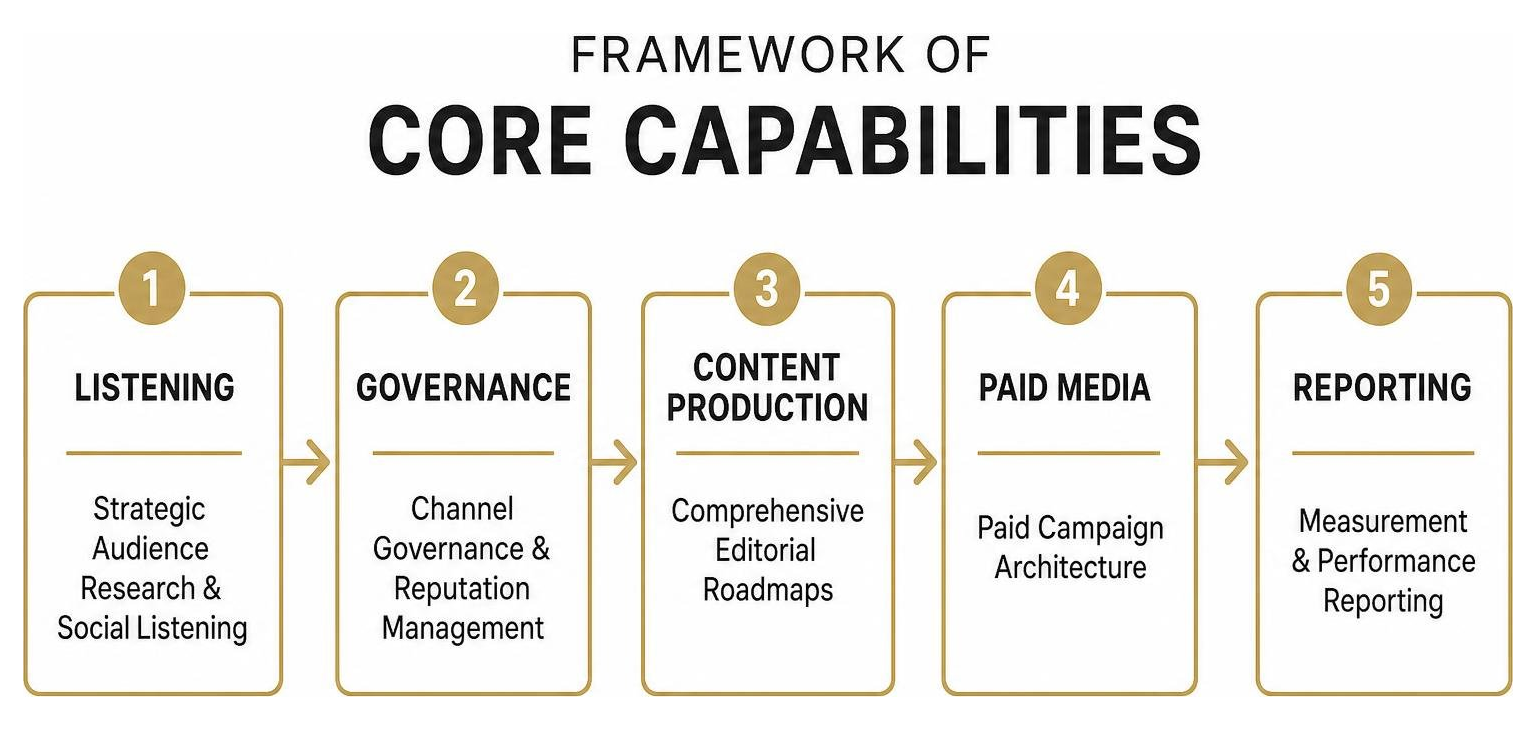
A dedicated agency team delivers five foundational capabilities that establish sustainable digital authority and drive audience retention:
- Strategic Audience Research & Social Listening: Mapping where your target buyers spend time, decoding their discussions, evaluating pain points, and monitoring competitor movements across platforms.
- Channel Governance & Reputation Management: Maintaining brand consistency across profiles while safeguarding customer sentiment. Over 93% of consumers report that online reviews and public feedback influence their purchasing decisions.
- Comprehensive Editorial Roadmaps: Formulating structured content calendars that balance educational insights, entertaining narratives, brand positioning, and promotional messaging across diverse funnel stages.
- Community Moderation & Engagement: Actively replying to inquiries, nurturing customer advocates, facilitating valuable conversations, and addressing customer concerns in real time.
- Paid Campaign Architecture: Designing targeted ad campaigns that lower customer acquisition costs while amplifying organic wins across high-intent audience segments.
Creative Content Production and Platform-Native Storytelling
Publishing uniform creative across every platform no longer works. Each channel possesses its own audience expectations, algorithmic rules, and formats. Top agencies focus on short-form video, user-generated content (UGC), and responsive visual design tailored for platforms like TikTok, Instagram Reels, LinkedIn, and YouTube Shorts.

Effective agencies build streamlined content production pipelines to capture fleeting cultural trends while respecting brand guidelines. By producing platform-native creative, they drive higher engagement, enhance brand recall, and capture attention in crowded feeds. They continuously test diverse hooks, optimize narrative pacing, and structure messaging to retain viewer attention across various digital touchpoints.
Furthermore, experienced creative teams analyze retention curves, emerging audio trends, and thumbnail click-through rates to refine future asset production systematically. This iterative feedback loop ensures that every piece of published media serves a distinct commercial purpose while reinforcing your core brand messaging.
Ultimately, high-performing visual assets bridge the gap between initial brand discovery and long-term customer loyalty, transforming feed scrollers into invested advocates.
How Top Agencies Drive Measurable Social Media ROI
An experienced digital marketing agency establishes sophisticated attribution models to connect social performance directly to commercial revenue, qualified sales leads, customer retention, and measurable brand equity across every customer touchpoint.
Performance Media, Paid Amplification, and Conversion Tracking
Organic reach remains a vital foundation, but paid amplification ensures reliable distribution to high-intent audiences.

Leading teams implement precise server-side tracking, custom pixel setups, and robust multi-touch attribution structures. They conduct continuous creative testing across demographic, behavioral, and interest-based cohorts, actively reallocating budgets toward top-performing variations to maximize return on ad spend (ROAS) and lower customer acquisition costs.
These rigorous data-driven paid strategies ensure every marketing dollar delivers transparent commercial accountability, clear pipeline contribution, and measurable business growth rather than unverified impressions.
Creator Partnerships and Influencer Marketing Execution
Influencer and creator collaborations have shifted from simple product placements to structured, performance-driven partnerships. Industry data shows that 89% of marketers find influencer marketing generates comparable or superior ROI relative to traditional channels.
Agencies identify verified creators who align with brand values, negotiate usage rights, manage contract terms, and oversee affiliate programs. Furthermore, with live commerce growing rapidly and roughly 70% of Gen Z consumers purchasing through live interactive broadcasts, agencies help brands tap into direct social selling.
By integrating authentic creator endorsements with structured conversion-focused funnels, agencies help businesses expand qualified brand reach while driving measurable acquisition performance.
Aligning Social Media with Modern Digital Growth Channels
Social channels cannot operate in isolation. They serve as essential strategic inputs across a company’s broader digital marketing ecosystem, informing audience research, content creation, and multi-channel acquisition workflows.
Integrating a Digital Marketing Agency Social Media Strategy with Search and AEO
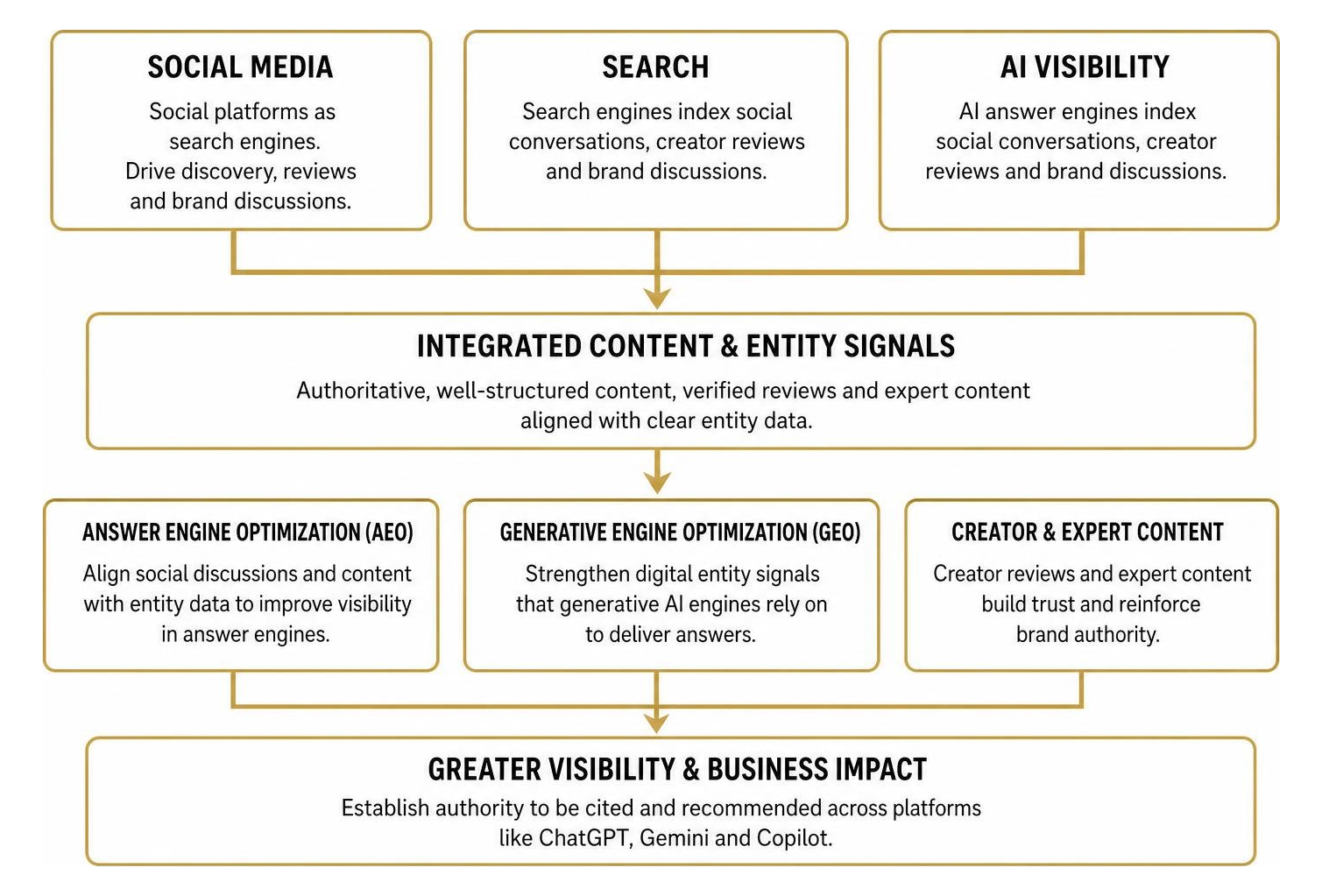
Social media plays a major role in modern search discovery. Consumers increasingly use social platforms as search engines to find direct answers, brand reviews, and product recommendations. At the same time, major search engines and generative artificial intelligence platforms actively index social conversations, creator reviews, and brand discussions to evaluate credibility.
When a digital marketing agency social media team produces authoritative, well-structured content, it strengthens the digital entity signals that AI answer engines rely on. Answer Engine Optimization (AEO) and Generative Engine Optimization (GEO) represent the natural evolution of online visibility, moving beyond simple keywords toward semantic relevance and verified source authority. AI search platforms prioritize brands that demonstrate consistent topical leadership, authentic community validation, and clear conceptual relationships across the web.
By aligning social discussions, verified customer reviews, and expert commentary with clear entity data, brands establish the contextual authority necessary to be cited and recommended across generative engines like ChatGPT, Gemini, and Copilot.
Multi-Channel Funnel Coordination Across PPC, Email, and Organic Search
Coordinating social media with email workflows, pay-per-click (PPC) campaigns, and traditional search optimization creates a fully synchronized, highly responsive, and friction-free buyer journey across every commercial touchpoint:
- Email & SMS Alignment: Social engagement captures top-of-funnel prospects, feeding high-performing automated sequences. Because email yields an average return of $36 for every $1 spent, connecting social lead generation to automated email nurturing dramatically improves customer acquisition efficiency and lifetime value.
- Search Synchronization: High-performing social topics reveal valuable conversational queries and emerging audience concerns that inform comprehensive content development across organic search channels, ensuring consistent topical coverage.
- Audience Retargeting: Prospects who interact with organic social posts, educational reels, or creator campaigns are retargeted through focused PPC campaigns with personalized messaging to finalize transactions and shorten sales cycles.
This unified multi-channel architecture ensures that audience attention generated on social media is efficiently captured, nurtured, and converted into measurable business revenue.
Frequently Asked Questions About Agency Social Media Services
How do agencies measure return on investment for social campaigns?
Agencies evaluate return on investment by tracking both direct and assisted conversions across the entire buyer journey. Key performance indicators include customer acquisition cost (CAC), return on ad spend (ROAS), cost per qualified lead (CPL), conversion rates, and pipeline revenue generated from social referrals. Beyond direct last-click attribution, experienced teams evaluate engagement lift, brand sentiment trends, organic search correlation, and cross-channel assisted conversions to determine total commercial impact and capital efficiency.
Advanced agencies also deploy multi-touch attribution to understand how early social touches influence high-value sales cycles over time.
What is the difference between a boutique agency and a full-service agency?
A boutique agency specializes deeply in creative production, community engagement, influencer management, and platform-specific execution, offering nimble turnarounds and highly focused campaigns. In contrast, a full-service agency manages social media alongside broader disciplines like technical search engine optimization, paid search advertising, email automation, web development, and generative answer engine positioning, ensuring that every digital marketing channel operates as a unified, revenue-generating growth engine.
How does social media presence impact visibility in AI search engines?
AI search models evaluate third-party consensus, brand citations, entity relationships, and public sentiment across digital channels to determine source authority and topical relevance. An active social footprint—characterized by authentic community discussions, expert leadership commentary, and verified creator reviews—provides the persistent digital signals AI engines analyze to judge organizational credibility. When a business demonstrates sustained topical authority across social channels, it significantly improves its likelihood of being surfaced, cited, and recommended in generative AI search responses.
This cross-channel validation helps generative models connect brand entities directly to specific industry solutions during search queries.
Conclusion: Selecting the Right Partner for Sustainable Growth
Choosing an agency requires finding a partner that looks beyond surface-level metrics to drive measurable commercial revenue, audience trust, and lasting brand relevance. As consumer discovery continues to evolve across dynamic social feeds, search engines, and generative AI platforms, your social footprint must actively build entity trust and topical authority across every customer touchpoint. A coordinated strategy bridges creative storytelling with rigorous data-driven performance to ensure sustainable commercial expansion.
At Upskale Marketing, we help businesses build measurable digital authority, optimize multi-channel performance, and position their brands as top authoritative recommendations across modern AI search platforms. If you are truly ready to evaluate how your brand footprint performs in today’s dynamic discovery landscape, schedule a free, data-driven AI evaluation with our strategic team today to uncover actionable opportunities for sustainable commercial growth.