

How Accounting Firms Can Show Up in AI Search
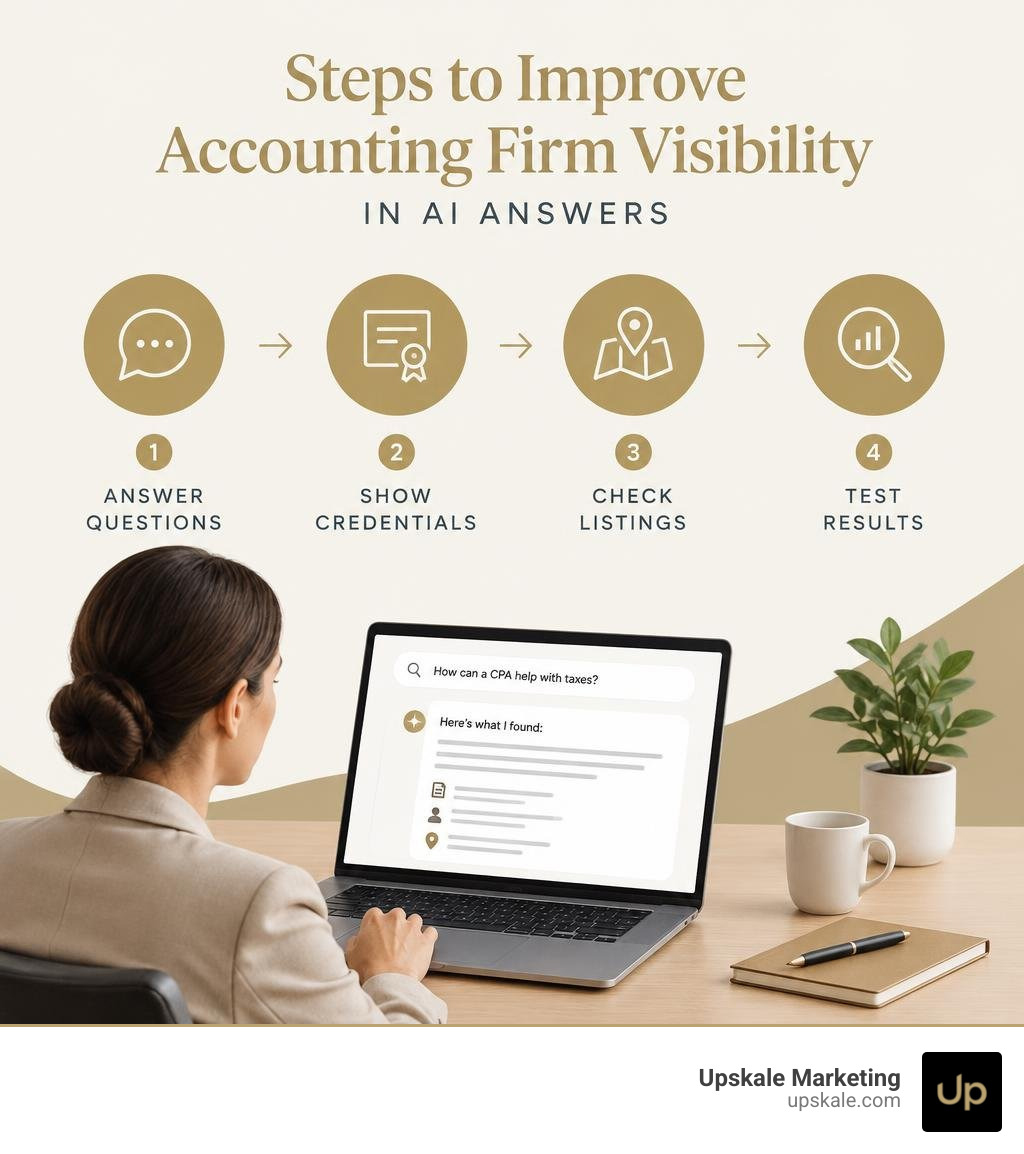
AI search optimization for accounting firms starts with clear, useful answers. Give each core service its own page, answer the questions clients ask before hiring a CPA, and show who reviewed your tax and accounting advice. Keep your business details accurate across your website, Google Business Profile, and professional listings. Then test client-style questions in AI search tools to see whether your firm appears and which sources those tools use.
This work builds on traditional SEO. The goal is not just to rank a page, but to help an AI answer describe your firm accurately and, when relevant, recommend it.
I’m Scott Brazdo, MBA, founder of Upskale Marketing. I bring more than 30 years of marketing and brand strategy experience to ai search optimization for accounting firms, helping practices build the clear, credible online presence this guide covers.
Understanding the Shift from Traditional SEO to Generative Engine Optimization
For years, digital marketing for certified public accountants followed a predictable playbook: target high-volume keywords, optimize title tags, earn backlinks, and fight for a spot on page one of Google. Today, that discovery model is transforming. With 64% of Google searches ending without a click, prospective clients are finding answers directly within AI Overviews, ChatGPT, Gemini, and Microsoft Copilot rather than browsing a list of blue links.
This fundamental shift from search engine results pages (SERPs) to curated conversational answers requires Generative Engine Optimization (GEO). While traditional SEO aims to drive raw web traffic to indexed URLs, generative search focuses on entity authority, extraction readiness, and consensus across digital sources.
Understanding how AI optimization works allows firms to move from passive keyword targets to structured data sources that Large Language Models (LLMs) trust.
| Strategic Factor | Traditional SEO Approach | Generative Engine Optimization (GEO) |
|---|---|---|
| Primary Goal | Rank on page one for specific keywords | Get cited and recommended in AI-generated answers |
| Target User Experience | Driving clicks to individual web pages | Providing direct, verifiable answers in zero-click environments |
| Content Structure | Long-form copy with targeted keyword density | Answer-first formatting with schema, bulleted takeaways, and clear definitions |
| Authority Signals | Inbound backlink quantity and domain rating | Entity clarity, practitioner credentials, reviews, and cross-web consensus |
| Discovery Mechanism | Keyword crawlers matching search queries | LLMs synthesizing information across the broader source graph |
Why AI Search Optimization for Accounting Firms Replaces Traditional SEO
Traditional search tools function like an index at the back of a massive library. If a business owner searches for corporate tax planning, the engine points them to pages containing those terms. Generative AI, however, acts as a research assistant. It reads the books, cross-references sources, evaluates the authors’ credentials, and synthesizes a direct response.
When prospective clients ask an AI model, “Who is the best CPA for a medical practice navigating state compliance?”, the model does not produce ten generic links. It selects three to five reputable firms that demonstrate verified industry experience.
To stay visible, accounting practices must shift their focus from ranking algorithms to building answer-ready resources. Reviewing our AI search optimization insights reveals that visibility in modern search depends on how easily machines can extract, verify, and cite your firm’s specific knowledge.
How AI Search Engines Choose Which CPA Firms to Recommend
Large language models evaluate potential recommendations through a combination of structured data extraction, credential verification, and external consensus. Because financial advice falls under strict accuracy expectations, AI platforms enforce high scrutiny when surfacing accounting professionals.
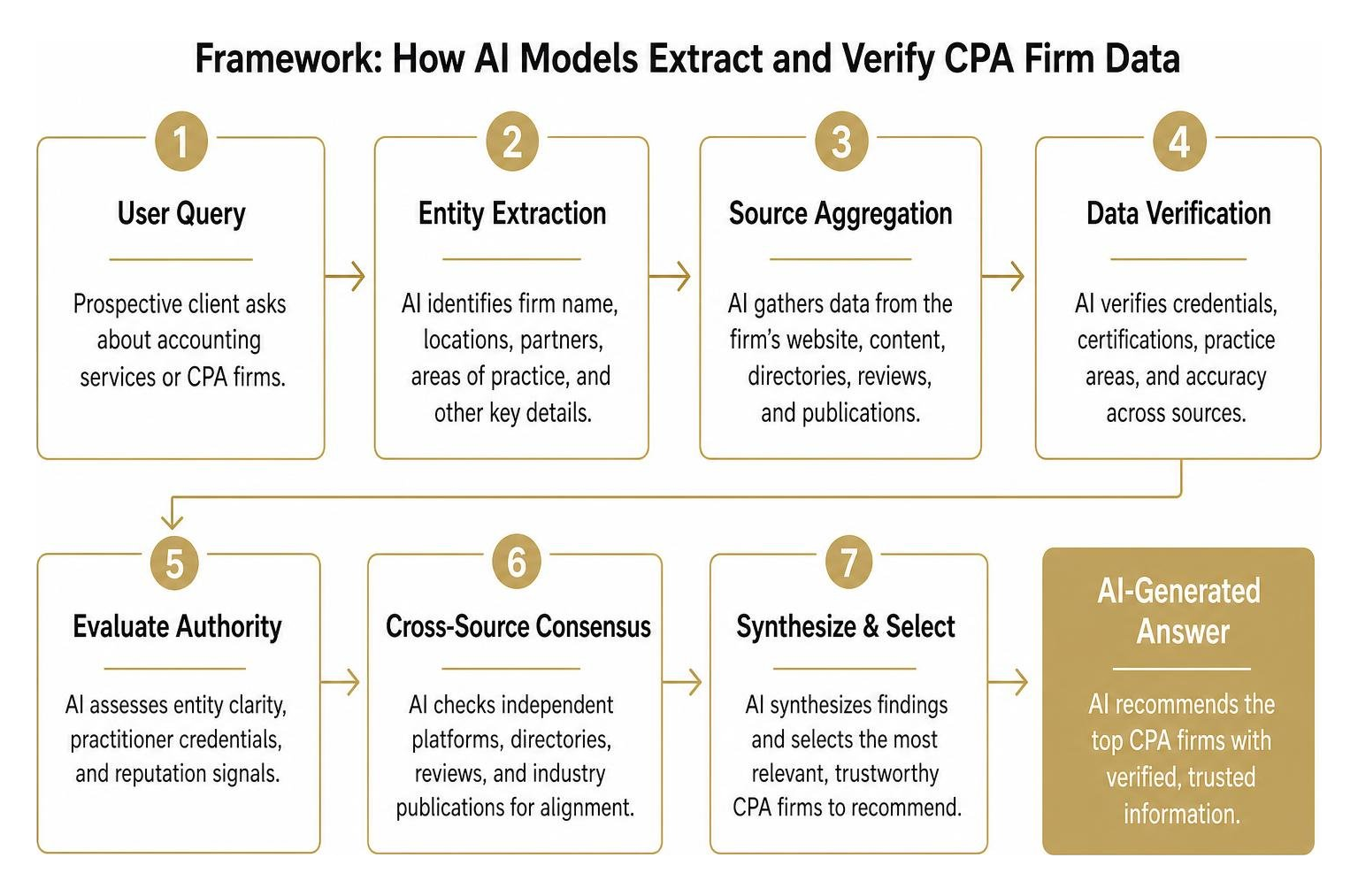
When an AI engine processes a query for accounting services, it evaluates several foundational layers:
- Entity Clarity: Can the model clearly identify your firm name, physical office locations, verified partners, and specific areas of practice without conflicting data?
- Authoritativeness: Are your articles, guides, and tax strategies attributed to certified professionals with verifiable credentials?
- Consensus Across the Source Graph: Do independent platforms, local business directories, client reviews, and industry publications confirm your firm’s reputation?
By mastering an AI search strategy, firms ensure their services are clearly understood and consistently recommended by AI models.
The 2026 Tax Reset and the Decline of Generic Firm Websites
The financial landscape has entered a pivotal era. The expiration of major Tax Cuts and Jobs Act (TCJA) provisions—commonly known as the 2026 tax reset—has fundamentally altered corporate deductions, individual tax brackets, estate tax exemptions, and Qualified Business Income (QBI) rules.

This regulatory shift creates a massive surge in demand for proactive advisory services. Business owners and high-net-worth individuals are no longer querying basic compliance questions; they are asking AI platforms complex planning questions. Websites featuring vague, generic service lists like “Tax Preparation, Bookkeeping, and Payroll” fail to provide the context AI models need to recommend them.
Capturing High-Value Advisory Demand After the 2026 Tax Reset
Generic tax preparation is increasingly viewed as a commodity. In contrast, strategic advisory services command premium fees and build lasting client relationships.
To capture prospective clients seeking guidance on the 2026 tax reset, firms must provide direct, structured answers to high-intent questions:
- QBI Deduction Changes: How should pass-through entities restructure operations to preserve tax efficiency?
- Estate and Gift Tax Thresholds: What proactive gifting strategies protect family assets against lower exemption limits?
- Individual and Corporate Bracket Resets: Which year-end acceleration strategies mitigate shifting income tax liabilities?
- Roth Conversion Strategies: How can high-earning individuals manage tax bracket adjustments through phased retirement conversions?
Publishing precise analyses on these topics positions your firm as an authoritative resource that AI models can reference when responding to complex user queries.
Niche Authority: How Specialized and Boutique Firms Outperform Generalists
In generative search, small and boutique accounting practices hold a distinct advantage over sprawling generalist firms. AI models favor deep, contextually relevant expertise over broad, surface-level claims.
Consider a business owner asking ChatGPT, “What should a veterinary practice look like when structuring partner buy-ins?” A local or boutique firm that has published dedicated guides on veterinary accounting, equipment depreciation, and partnership equity will consistently earn the AI recommendation over a larger regional firm that merely lists “General Accounting” on its homepage.
Exploring strategic AI SEO insights shows that establishing clear client avatars and niche service hubs builds the deep topical authority search models reward.
A Step-by-Step Blueprint for AI Search Optimization for Accounting Firms
Transforming an accounting firm’s online footprint into an AI-ready digital asset requires a structured, deliberate approach. This process centers on clear communication, technical accuracy, and consistent authority signals across every channel.
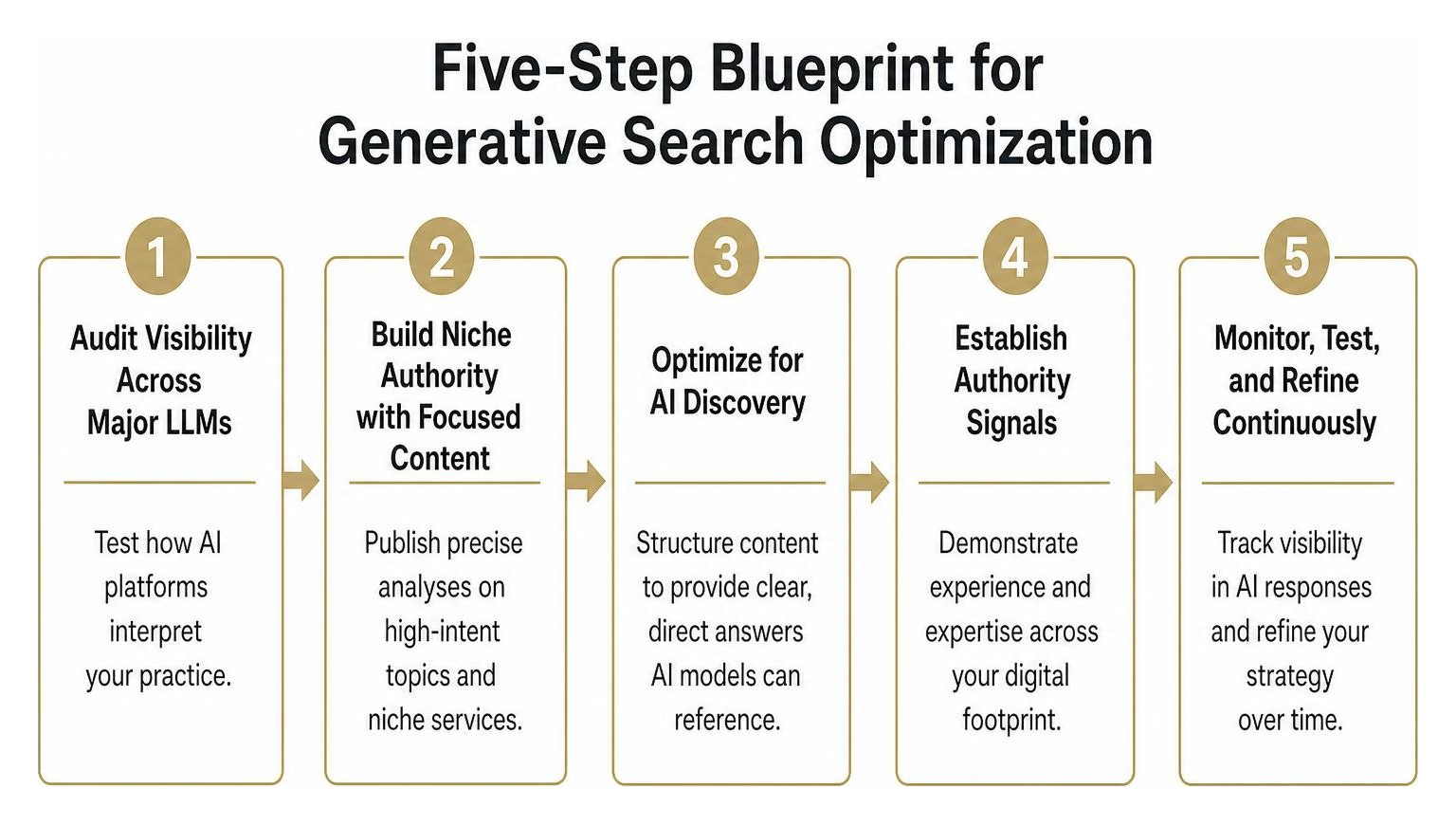
Step 1: Auditing and Testing Firm Visibility Across Major LLMs
Before updating your content, determine how AI platforms currently interpret your practice. You can assess your visibility by querying major platforms with conversational prompts that your ideal clients use:
- “Who are reputable CPA firms specializing in real estate development?”
- “Which accounting practices provide fractional CFO services for manufacturing businesses?”
- “What should a business look like when choosing a tax advisor for the 2026 tax reset?”
Review the generated responses carefully:
- Is your firm mentioned by name?
- Does the engine accurately represent your core services and partner credentials?
- Which competitor firms are cited, and what web sources did the AI use to substantiate its answer?
Identifying these gaps establishes a clear baseline for your optimization strategy.
Step 2: Restructuring Service Pages and Content for AI Answer Extraction
AI models prefer content that provides quick, direct answers supported by professional depth. To make your website easy for machines to parse, structure your core service pages using an answer-first approach.
- Direct Opening Summaries: Place a concise 40-to-60-word summary directly beneath the main heading of each service page to define the offering, who it serves, and its primary business benefit.
- Question-Based Headings: Replace creative titles with natural-language questions that real clients ask during discovery calls.
- Structured Data and Schemas: Implement technical markup such as
FAQPage,LocalBusiness, andOrganizationschemas so AI crawlers can cleanly extract key details. - Verified Authorship: Include author bios, CPA licensing numbers, professional associations, and editorial review notes on all educational articles.
Applying AI content strategy basics and integrating practical techniques to stand out in AI Overviews ensures your content is formatted for rapid machine extraction and human clarity.
Step 3: Strengthening Local Entities, Google Business Profiles, and Review Signals
Local context remains a key factor in AI recommendations. When prospective clients seek accounting help, AI engines balance topical expertise with physical proximity and third-party validation.
Google Business Profile (GBP) signals account for roughly 32% of local pack ranking factors, while client reviews represent approximately 20%. To maximize these signals:
- Maintain Precise NAP Consistency: Verify that your firm’s legal name, office address, and primary telephone number are identical across your website, state CPA societies, local chambers of commerce, and business directories.
- Utilize Secondary Categories: Select your primary category carefully (such as “Certified Public Accountant”) and add relevant secondary classifications like “Tax Consultant,” “Bookkeeping Service,” or “Financial Planner” to capture broader query intent.
- Establish a Proactive Review System: Encourage satisfied clients to leave detailed feedback. An overwhelming 98% of people read online reviews for local professional services, and 88% of prospective clients prefer firms that regularly reply to feedback over those that leave reviews unacknowledged.
Measuring Answer Engine Impact Beyond Traditional Website Traffic
Because AI platforms often provide comprehensive answers directly in the search interface, firms cannot measure success using traditional website visits alone. A prospective client might read an AI summary recommending your firm, visit your office directly, or pick up the phone without ever landing on your blog.

Key Metrics to Track AI Search Optimization for Accounting Firms
To accurately measure your digital presence, monitor modern engagement and visibility indicators:
- AI Overview and Citation Presence: Track how frequently your firm’s URLs and brand name are cited as source references in AI-generated answers.
- Direct and Brand-Search Volume: Watch for increases in prospective clients searching specifically for your firm name or managing partners.
- Inquiry Source Attribution: Ask new prospective clients during intake calls exactly how they discovered your firm, noting mentions of conversational AI tools.
- High-Intent Conversion Rates: Focus on conversion efficiency over raw traffic volume. Professional service sites typically see a 6.1% median conversion rate, with well-optimized practices reaching upwards of 14.1%.
When evaluating partners to assist with this process, review our guide on evaluating AI optimization providers to ensure their tracking metrics align with true business growth.
Evaluating Agency Deliverables and AI Search Readiness
As marketing methodologies evolve, accounting leadership must ensure their digital investments produce tangible authority assets rather than short-lived keyword tactics. Reliable optimization focuses on durable fundamentals: technical schema deployment, author identity verification, and multi-channel entity alignment.
Firms seeking external support should examine AI SEO package deliverables to understand what strategic implementation looks like in practice.
Frequently Asked Questions About AI Search for Accountants
How does an accounting firm test if it appears in AI search results?
To test your visibility, query major generative engines (such as ChatGPT, Google Gemini, and Perplexity) using realistic, multi-sentence client scenarios rather than simple keywords. Ask questions such as, “Which CPA firms in my area handle complex trust and estate planning?” or “Recommend an accounting firm that works with mid-market manufacturing companies.” Take note of whether your firm appears in the narrative recommendation and examine the citations to see which directories, publications, or website pages the AI referenced.
Why are online reviews more critical for AI search than traditional search?
In traditional search, reviews primarily influence local map rankings and click-through rates. In generative search, AI models analyze the text, sentiment, and specific details contained within reviews to evaluate firm credibility. When clients mention specific services in their reviews—such as successful audit representation or strategic tax planning—the AI incorporates that context into its knowledge base, confirming that your firm delivers on its stated expertise.
Can a local CPA firm compete with national accounting networks in AI answers?
Yes. AI engines prioritize relevance, geographic proximity, and deep niche authority over sheer company size. A local boutique firm with clear service pages, strong client reviews, verified practitioner credentials, and detailed local business listings will frequently earn the primary recommendation for regional or niche-specific queries over national networks with generic branch pages.
Conclusion
The evolution from keyword-driven search to conversational AI answers marks a fundamental change in how clients discover, evaluate, and select professional financial advisors. As traditional search traffic yields to zero-click answers, accounting practices that rely on generic websites and outdated marketing tactics risk becoming invisible to prospective clients.
Winning in this landscape requires building structured authority: establishing clear entity profiles, publishing expert-led answers to regulatory challenges like the 2026 tax reset, and maintaining a consistent presence across trusted digital sources.
At Upskale Marketing, based in Orlando, Florida, we help accounting practices navigate this transition. We combine decades of brand strategy experience with advanced Answer Engine Optimization to help your firm earn top recommendations across major AI platforms.
If you are ready to evaluate how generative engines view your practice, schedule a free AI evaluation with our team. We provide a straightforward, data-driven assessment showing where your firm currently stands in AI search, how your practice appears across major LLMs, and the practical steps needed to turn generative search into a reliable growth channel. Partner with Upskale Marketing to dominate generative search and position your practice for long-term discovery.