


An Essential Guide to AI Content Strategy Basics
What Is an AI Content Strategy and Why Do Traditional Plans Fail?
An effective AI content strategy is not just about writing faster. It is an operational framework that connects audience intent, business intelligence, brand identity, and generative discovery into an integrated publishing model.
Many organizations struggle with AI adoption because they simply attach new tools to outdated editorial calendars. Research shows that 87% of marketers now use AI somewhere in their day-to-day workflow, yet 84% still run generic marketing campaigns. While 87% report improvements in speed and productivity, only 39% say their AI-generated content actually performs better in terms of engagement and business growth.
This disconnect highlights the importance of the 10/20/70 rule in digital transformation: AI success depends 10% on the underlying algorithms, 20% on your technology stack and data foundation, and 70% on your people and organizational processes. When teams focus solely on the tools while ignoring their core workflows, the quality of their output inevitably declines.
To build sustainable digital authority, marketing teams must focus on operational orchestration rather than raw output volume. This means establishing structured editorial guardrails and learning how to teach large language models how to tell your brand story across modern discovery channels.
The Bolt-On Trap and Generative Search Shifts
The “bolt-on trap” occurs when a team uses generative tools to speed up drafting without changing their underlying topic selection, editorial standards, or quality checks. Because AI makes baseline text virtually free to produce, it has flooded the web with surface-level content. In fact, 56% of marketers report that the internet is saturated with generic AI copy, and 65% of consumers note that they are actively learning to spot and ignore it.
At the same time, the search ecosystem is undergoing a structural shift. The expansion of conversational answer engines has reshaped traditional organic search. Publishers and brands are seeing direct click-through rates decline significantly on queries where AI-generated answers appear, dropping to around 8% compared to roughly 15% on standard search result listings. With publishers anticipating search referral traffic to decline by more than 40% over the coming years, simply scaling keyword-stuffed articles is no longer an effective approach.
When search engines update their helpfulness and quality evaluation systems, sites that rely on unedited, mass-produced text often face severe visibility losses—frequently seeing organic search traffic drop by 40% to 90%. Overcoming this challenge requires moving beyond commoditized drafting and implementing practical techniques to stand out in AI Overviews that emphasize genuine depth and first-party perspective.
Core Pillars of an Effective AI Content Strategy
To build an editorial engine that performs across conversational answers and traditional search, organizations need a strategy built on four core pillars:
- Audience Intelligence Over Keyword Lists: Move away from isolated search volume numbers and focus on deep audience intent. Analyze sales conversations, support inquiries, and customer feedback to address the real objections, frustrations, and decisions your buyers face.
- Unified Business Data: Connect your content planning to internal CRM trends, proprietary data points, and operational insights so every asset reflects actual business knowledge rather than generic web summaries.
- Modular Content Architecture: Build high-value foundational assets that can be repurposed into varied formats—such as executive briefs, short-form video scripts, newsletters, and FAQ modules—ensuring consistent coverage across multiple touchpoints.
- Editorial Governance and Voice Protection: Establish clear boundaries for where automated tools are permitted and where human editorial judgment is strictly required, maintaining a consistent brand tone and ensuring factual precision.
By integrating these operational pillars into your publishing model, your organization can effectively navigate shifts in digital discovery and succeed in winning the generative search era.
The Human Edge: What AI Makes Cheap vs. What Remains Irreplaceable

Generative models excel at pattern recognition, data synthesis, and rapid textual formatting. However, because they rely on existing training data, they naturally produce commoditized, predictable answers when asked to write from scratch.
A study evaluating creative problem-solving across more than 100,000 humans alongside advanced generative models found that the top 10% of human thinkers consistently and significantly outperformed every AI model on nuanced, creative tasks. This highlights the importance of the 30% rule for content operations: humans must retain at least 30% of the editorial process—focusing on strategic direction, lived experience, creative taste, and rigorous editing—while delegating repetitive drafting and structuring to automated systems.
| Operational Task | Made Cheap & Scalable by AI | Irreplaceable Human Capability |
|---|---|---|
| Ideation & Brainstorming | Broad topic ideation, keyword grouping, and audience question expansion | Identifying contrarian industry points of view and unique commercial angles |
| Outlining & Structuring | Generating hierarchical headings, standard frameworks, and metadata | Designing custom narrative flows and aligning themes directly with business strategy |
| Drafting & Writing | Drafting introductory overviews, definitions, and standard explainers | Injecting anecdotes, nuanced perspective, and brand voice |
| Data & Evidence | Aggregating public market statistics and summarizing existing industry reports | Conducting original customer research, proprietary surveys, and data analysis |
| Review & Quality Control | Checking basic grammar, tone consistency, and schema structure validation | Verifying technical accuracy, evaluating editorial quality, and managing brand safety |
| Repurposing & Distribution | Converting long-form articles into social posts, email teasers, and summaries | Facilitating executive community discussions, podcasts, and relationship building |
Building Your Protect List to Create Unignorable Content
To ensure your brand stands out in an environment dominated by generic copy, every organization should maintain a defined “protect list”—a non-negotiable set of editorial elements that must always come from human expertise:
- Original Data and Research: Studies show that automated text includes original research in only 4% of cases, compared to 38% for human-led assets—nearly a tenfold gap. Publishing original surveys, performance data, or industry analyses makes your content inherently unignorable.
- Demonstrated Sweat Equity: Document real-world product usage, implementation timelines, and operational challenges. Answer engines and discerning readers prioritize sources that demonstrate actual experience over theoretical advice.
- Qualified Expert Judgments: Include direct analysis from seasoned professionals explaining the why behind critical business decisions.
- Transparent Flaw Disclosure: Highlight the limitations, edge cases, and drawbacks of specific tools or strategies. AI-generated summaries rarely disclose nuanced flaws, making honest evaluations a powerful trust builder.
Focusing on these irreplaceable human elements helps protect your brand against traffic commoditization while establishing high-signal authority. To explore how these dynamics shape modern discovery, review our comprehensive AI search optimization insights.
How to Redesign Your Content Workflow in 5 Actionable Steps
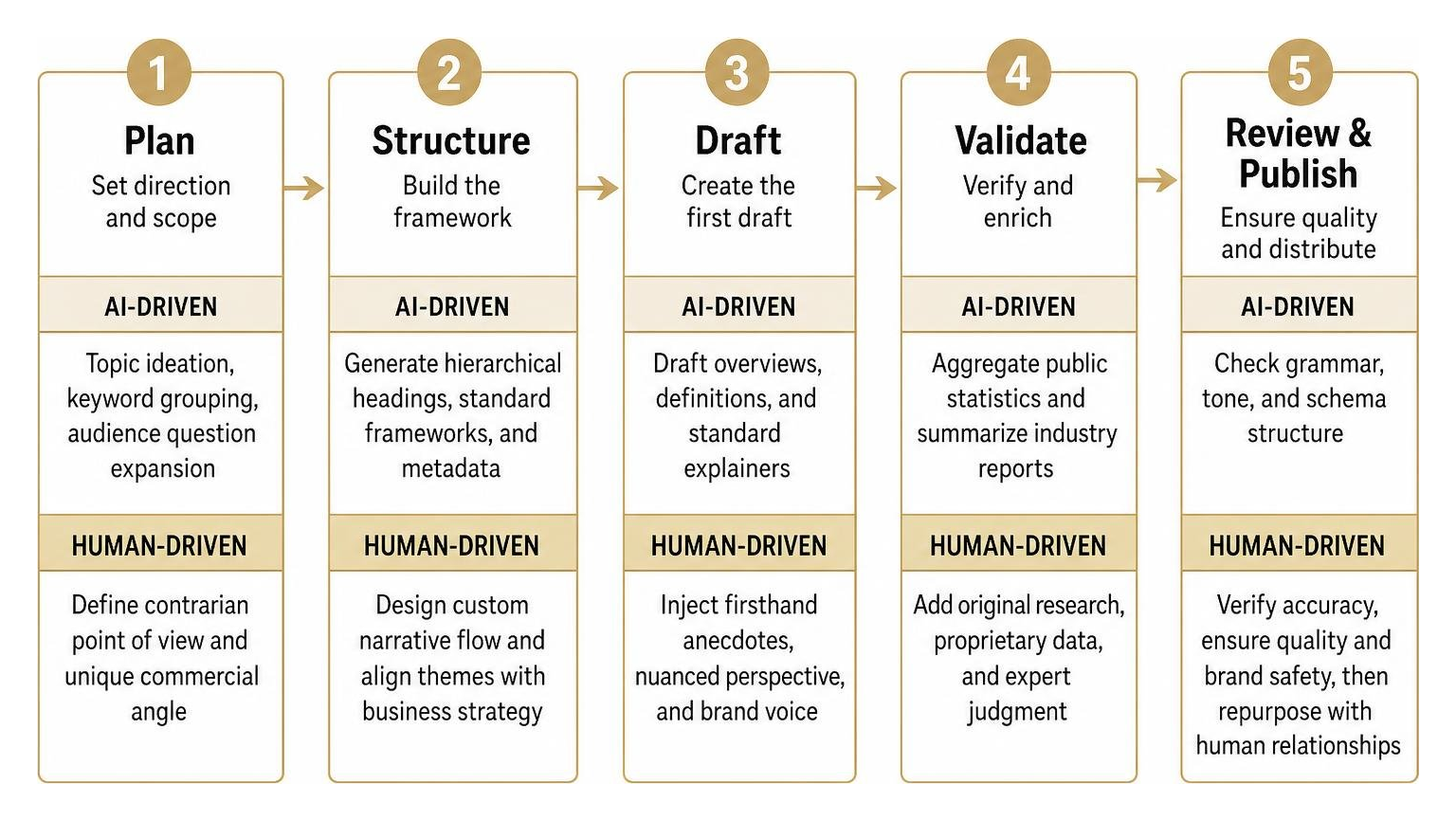
According to McKinsey, only 6% of organizations are genuine AI high-performers, and the primary factor separating them from the rest is a willingness to redesign their operational workflows around the distinct capabilities of their tools and teams.
Simply asking a generative tool to create finished articles rarely produces lasting business value. Teams need an operational model that clearly separates automated efficiency from human judgment.
How to Execute Your 5-Step AI Content Strategy
To build an editorial workflow that delivers both operational efficiency and high quality, apply these five core steps:
- Audit Your Current Time Allocation: Review your existing publishing lifecycle. Calculate how many hours your team spends on initial research, drafting, technical formatting, and editing. Identify the repetitive, manual tasks that can be streamlined with automation to free up time for strategic work.
- Define Your Protect List and Editorial Boundaries: Establish explicit organizational standards for where automated tools can be used and where human input is mandatory. Require original data, expert commentary, and insights for every foundational piece of content.
- Rebuild the Workflow Around Task Specialization: Separate the content lifecycle into distinct, sequential stages. Use AI systems to analyze audience questions, organize transcripts, create initial structural outlines, and generate modular distribution snippets. Assign human strategists and subject matter experts to lead angle development, original research, nuanced editing, and factual verification.
- Standardize on a Focused Set of Specialized Tools: Avoid adopting disparate tools without clear governance. Select a single, dedicated platform for each operational need—such as audience research, structural outlining, and metadata generation—and maintain consistent prompting guidelines across your team for at least 90 days.
- Measure Outcomes Across Both Human and AI Metrics: Track operational efficiency, reader engagement, conversion impact, and visibility across conversational engines. Regularly audit your content library to update underperforming assets and retire outdated material.
Applying this structured framework allows your team to publish distinctive content consistently. You can explore additional best practices in our dedicated section on actionable AI SEO methods.
Optimizing for Answer Engines: Becoming a Source Rather Than Just Ranking

Digital discovery is evolving from a system based solely on ten blue links into a dynamic, conversational ecosystem. Leading answer engines do not simply index pages for exact-match keywords; they evaluate the semantic relationships between concepts, analyze entity authority, and synthesize direct answers for users.
In this environment, the goal of content marketing expands beyond ranking in a specific position to earning citations as an authoritative source in AI-generated answers. Answer engines prioritize sources that offer clear factual context, verified data points, and distinct points of view that cannot be easily summarized into generic advice.
To build meaningful visibility across conversational search engines, organizations must align their publishing with modern AI marketing and search optimization practices that emphasize deep topical authority and verifiable expertise.
Balancing Human User Experience with AI Engine Parsability
Optimizing for modern answer engines does not mean creating mechanical, robotic content. In fact, large language models are specifically trained to identify and surface material that provides clear, accessible value to human readers.
To balance technical parsability with a compelling user experience:
- Implement Clear Structured Data: Use appropriate schema markup (such as Article, FAQ, and Organization data) to help search systems understand the entities, authors, and relationships on your pages.
- Organize Content in Logical Topic Clusters: Build comprehensive content hubs that connect foundational guides to granular subtopics, demonstrating comprehensive subject matter authority.
- Incorporate Multi-Modal Formats and Transcripts: Add video discussions, audio clips, and detailed transcripts. Multi-modal assets provide rich, authentic context that text-only generative models cannot easily duplicate.
- Structure Direct Answers and Scannable Subheadings: Use question-focused subheadings followed by clear, direct explanations. This format helps both human readers quickly find answers and conversational engines extract accurate citations.
- Prioritize Deep Engagement Signals: Design your content to encourage meaningful user interactions, such as deep scroll depth, low bounce rates, and direct return visits, all of which signal genuine editorial value.
Measuring Success: Moving from Vanity Metrics to AI Share of Voice
Traditional performance metrics like raw page views and superficial clicks are no longer sufficient to evaluate content success. In a landscape where users frequently find answers directly within AI interfaces, content teams must track deeper indicators of brand authority and revenue impact.
CMOs currently allocate roughly 15.3% of their total marketing budgets to AI initiatives, yet only 30% report that their teams are fully prepared to scale these programs and measure real commercial return. Sustainable growth requires moving away from vanity metrics toward full-funnel attribution and conversational discovery tracking.
Modern KPI Framework for Generative Discovery
To assess the true business impact of your editorial efforts, monitor performance across three primary categories:
- AI Share of Voice and Citation Frequency: Track how frequently your brand, proprietary frameworks, and executive insights appear as cited references in conversational search queries. Earning consistent citations across high-intent queries is a strong leading indicator of digital authority.
- Engagement and Consumption Quality: Measure active time on page, deep scroll depth, and interaction with modular elements like tables, videos, and interactive tools to ensure your content delivers real value.
- Pipeline and Commercial Attribution: Use multi-touch attribution to monitor how content assets influence assisted conversions, lead quality, and closed-won deals across your CRM.
Frequently Asked Questions About AI Content Strategy
What is the difference between AI content creation and an AI content strategy?
AI content creation focuses primarily on the mechanics of writing faster—using generative models to produce drafts, outlines, or social snippets.
An AI content strategy, by contrast, is a comprehensive operational plan. It determines what to publish, analyzes audience intent, integrates first-party business data, establishes brand governance, and redesigns team workflows to build long-term digital authority and drive revenue.
Will using AI for content creation harm search engine performance?
Using AI tools during the drafting or research process does not inherently harm search performance. Search algorithms are designed to evaluate the helpfulness, accuracy, and overall quality of content, regardless of how it was produced.
However, publishing unedited, mass-produced AI text without human verification, original research, or unique perspective often leads to severe visibility drops under modern search quality systems.
How do you track brand citations across AI search platforms?
Tracking brand visibility in conversational search involves monitoring your share of voice across relevant industry prompts, tracking source citations within AI Overviews, and measuring referral traffic from conversational platforms.
Teams should regularly evaluate whether their proprietary frameworks, data points, and executive perspectives are being surfaced as trusted recommendations for high-intent queries.
Conclusion
Building a resilient digital presence requires an editorial approach that embraces modern efficiency without sacrificing human depth. By establishing a clear separation between automated tasks and irreplaceable human insights, your organization can build a durable competitive moat that thrives alongside evolving search behaviors.
At Upskale Marketing, we combine deep marketing expertise with advanced search optimization strategies to help businesses build sustainable visibility and authority across modern discovery platforms. If you are ready to evaluate how your brand appears across conversational search engines and identify practical opportunities for growth, explore our specialized AI optimization services and schedule a free, data-driven AI evaluation with our team today.