


AI SEO Packages: Realistic Deliverables and Provider Red Flags
What to Look for in AI SEO Packages
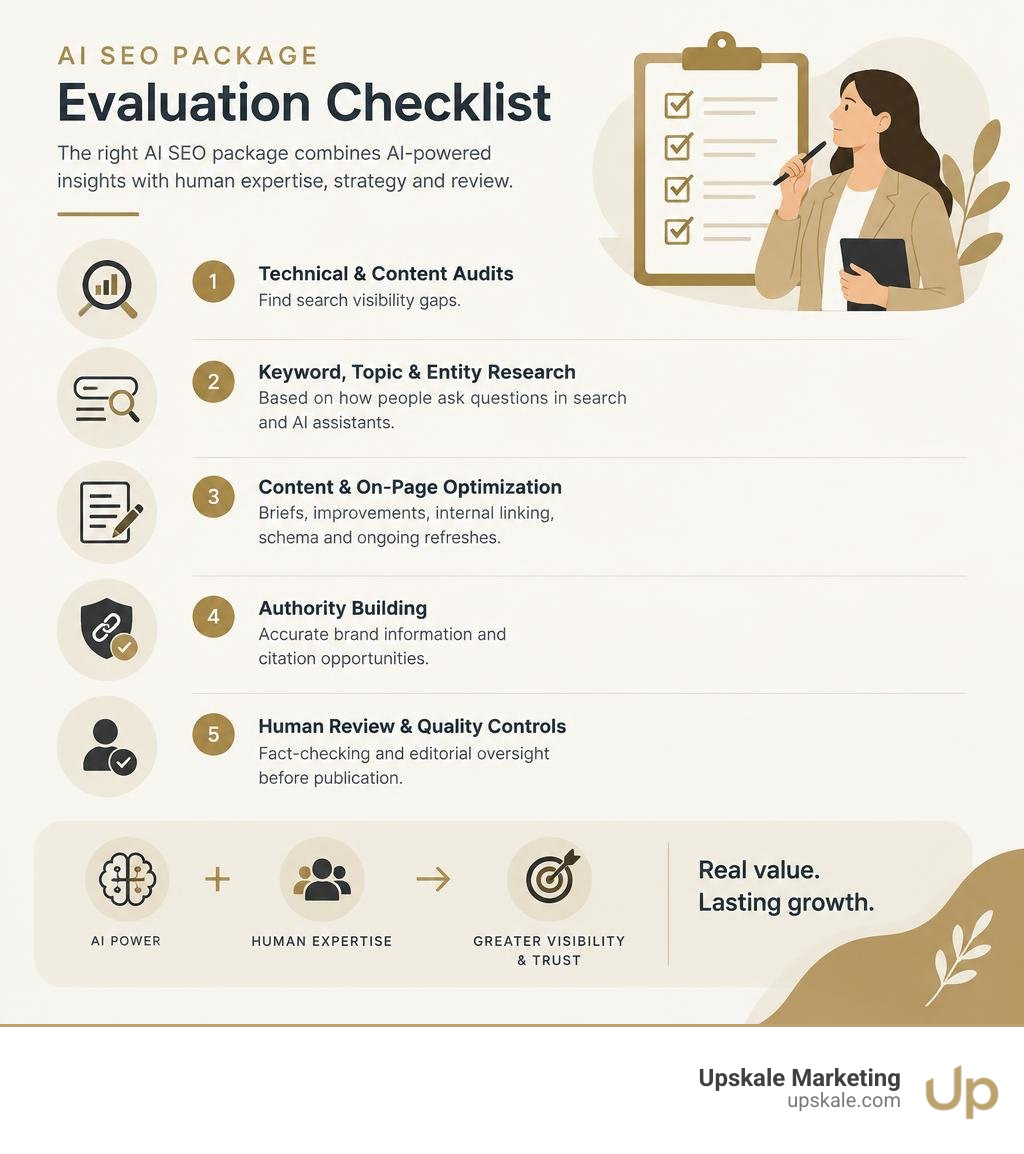
The best AI SEO packages combine AI-powered research and automation with human strategy, editorial review, and clear proof of work. Before choosing a provider, ask to see the actual deliverables:
- Technical and content audits that identify search visibility gaps.
- Research into keywords, topics, and entities—the people, places, organizations, and concepts relevant to your business—based on how people ask questions in search and AI assistants.
- Content briefs, page improvements, internal linking, schema markup (structured code that describes page information for search systems), and ongoing refreshes.
- Authority-building work, including accurate brand information and citation opportunities.
- Human fact-checking and quality controls before anything is published.
This is not simply traditional SEO with an AI writer attached. A useful package should help your company become easier for Google and generative search tools to understand, trust, and recommend. AI can speed up research, grouping related search questions, drafting, and monitoring. It cannot replace subject expertise, original experience, or careful review.
Be cautious of packages that promise instant rankings, publish pages at scale without editorial oversight, or focus on making content “undetectable.” Search engines reward helpful, people-first content, not tricks designed to hide how a draft was made. The important question is whether the work adds real value and reflects credible experience.
I am Scott Brazdo of Upskale Marketing. Our team brings decades of experience in marketing, branding, and strategy. I help companies evaluate and build AI SEO packages that strengthen authority, improve AI-search visibility, and support durable growth.
Core Deliverables to Expect in Modern AI SEO Packages
Modern search optimization has moved well beyond simple keyword density targets and static monthly blog posts. As search behavior shifts toward conversational queries and AI-driven answer engines, the structure of search deliverables must evolve accordingly.
AI Optimization is the broader discipline of improving the content, authority, and digital signals that help AI systems discover and understand a business. Answer Engine Optimization (AEO) focuses on making information useful for systems that answer customer questions directly. Generative Engine Optimization (GEO) focuses on visibility in AI-generated answers, including relevant mentions and citations. These approaches overlap with traditional SEO rather than replace it.
AI visibility is the observable result: whether, where, and how accurately your business appears in answers to relevant customer questions. For example, a local service business wants its services and location accurately represented when someone asks which provider fits their needs. Clear content helps systems interpret that information; credible business information and authority signals can support trust. Monitoring mentions, citations, and accuracy helps a business assess its current position and identify opportunities, but no approach guarantees a recommendation.
A useful package connects research, an understanding of customer questions, and content improvements. When evaluating providers, ask what each deliverable does and how it supports your business goals.
| Traditional SEO Deliverables | Modern AI-Driven Deliverables | Strategic Advantage |
|---|---|---|
| Keyword lists based on monthly search volume | Related topics grouped around customer questions and the reasons people ask them | Helps content address natural-language searches and AI prompts |
| Periodic manual technical site audits | Automated site checks that flag technical issues for review | Can help teams identify barriers to search systems accessing and indexing pages sooner |
| Blog posts focused mainly on target keywords | Connected resources that explain a topic, relevant organizations, and key concepts | Helps readers and search systems understand the site’s subject expertise |
| Internal links added individually | Tools that suggest links between related pages, with human review | Helps visitors and search systems discover related information |
| Page titles and descriptions | Page titles and descriptions supplemented by structured data describing the page | Can help search systems interpret page information; it does not guarantee use in an AI answer |
Essential Technical and Content Deliverables in AI SEO Packages
A useful optimization plan combines a technically sound website with helpful content. In our work developing AI search optimization insights, we emphasize the importance of making pages accessible to search systems and providing clear, relevant information.
Essential deliverables include:
- Grouping Keywords by Customer Intent: Related search questions are grouped by topic and by what the customer wants to learn or do. This helps teams plan content that answers related questions clearly.
- Content Templates: Reusable page layouts can support resources such as location-specific guides or product comparisons. They help maintain consistent design, but each page still needs accurate, useful information and editorial review.
- Relevant Internal Links: AI tools can suggest links between related pages for human review. Useful links help readers and search systems discover related content; they do not automatically give a new page authority.
- Schema Markup: Structured code can describe an organization, product, or question-and-answer page. Accurate markup can help search systems interpret page information, but does not guarantee that an AI platform will use it.
- Page Titles and Summaries: Clear titles, descriptive headings, and concise summaries help explain a page’s purpose. Search platforms decide what to display in results and AI-generated answers.
Strategic Authority Building and Citation Management
Traditional search algorithms rely heavily on hyperlinks to evaluate credibility, but generative search engines look at a broader digital footprint. Answer engines look across directories, industry databases, and digital publications to determine if your brand is an established authority.

To succeed across conversational search platforms, brands must focus on winning the citation game with AI search brand mentions. This work involves systematically claiming, standardizing, and optimizing your brand’s presence across authoritative sources.
When your organization is consistently cited as a subject-matter expert across third-party industry platforms, those references can support your brand’s credibility and its chances of being cited in AI-generated answers.
How AI SEO Differs from Traditional SEO Services
Traditional search engine optimization includes tasks such as keyword reporting, link outreach, and content creation. These foundational elements still matter. AI SEO adds tools for researching customer questions, improving content, and monitoring search visibility.
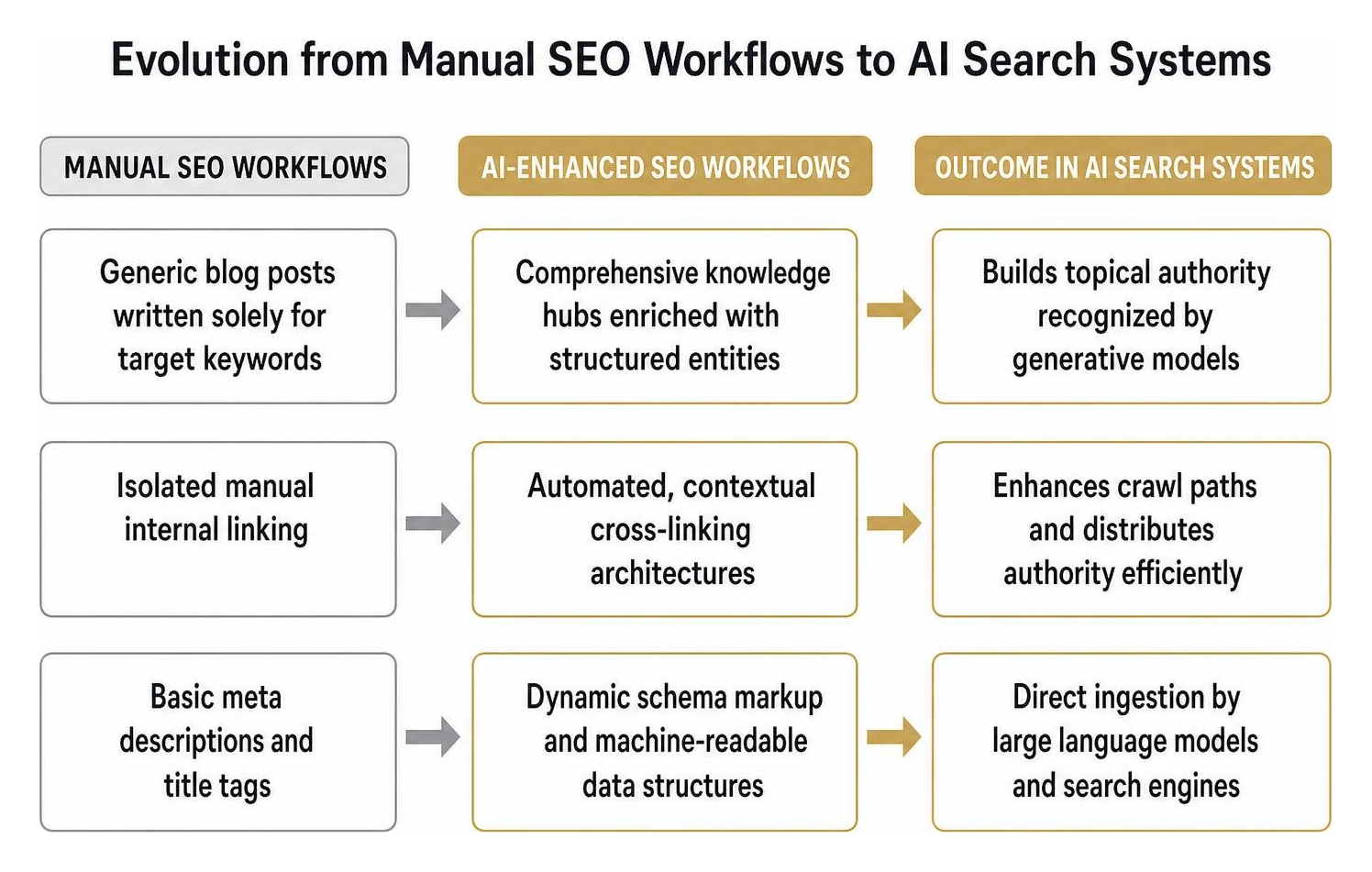
AI-assisted research can supplement historical search-volume data by exploring related topics, everyday language, and follow-up questions customers may ask. Clear content can make relevant information easier for search systems to find and interpret, but it does not guarantee inclusion in an answer.
Ongoing Monitoring and Content Updates
Manual reviews can delay the discovery of ranking changes or technical errors. Automated monitoring can help teams spot issues sooner.
Ongoing monitoring can check existing pages and compare their search performance with changes in customer questions. When gaps emerge—such as missing subtopics, outdated citations, or broken or outdated internal links—tools can flag them for human review. Regular monitoring and human review can help teams keep information current and address technical issues.
Entity Optimization for Generative Engines
Generative search systems can use information about real-world entities—people, places, concepts, and organizations—and the relationships between them when retrieving information and generating answers.
Entity optimization focuses on building these explicit connections. By combining descriptive structured data with clear, natural language explanations, we help generative engines better understand what your business does, who leads it, and what problems it solves. Clear business information can help search systems assess relevance when a user asks for a recommendation, but does not guarantee that your business will be selected.
Evaluating Scope and Deliverables Across Service Tiers
Not every business requires the same depth of implementation. A local service enterprise with a single location has different needs than a multi-regional organization or an e-commerce platform managing thousands of product variations. Understanding the operational components across different tiers in our AI SEO category ensures that you select an engagement model aligned with your growth objectives.

Comparing Scope Across Different AI SEO Packages
When reviewing service proposals, examine how resources are allocated between technical website improvements, content production, and strategic advice:
- Foundational Tier: May cover technical website improvements, structured data describing the business, grouping related customer questions, and correcting inconsistent business information. This supports businesses establishing their presence in AI search.
- Growth Tier: May add content templates with editorial review, tools that suggest relevant internal links, connected resources covering key topics, and work to improve accurate mentions in relevant industry directories.
- Enterprise Tier: May include ongoing automated monitoring, structured maps of relationships among products and business information, updates across large content libraries, connections to internal systems, and monitoring of brand mentions.
Quality Guardrails and Human-in-the-Loop Safeguards
A key difference between useful AI packages and poor implementations is the presence of strict editorial guardrails. Automated language models excel at processing data and organizing concepts, but they lack experience, brand perspective, and real-world judgment.
Every stage of content development must incorporate human-in-the-loop verification. Experienced human editors review every piece of technical data, refine the brand voice, check for factual inaccuracies, and infuse authentic expertise before anything goes live. These reviews help reduce low-quality outputs and keep content helpful and aligned with your brand values.
Red Flags to Watch for When Choosing a Provider
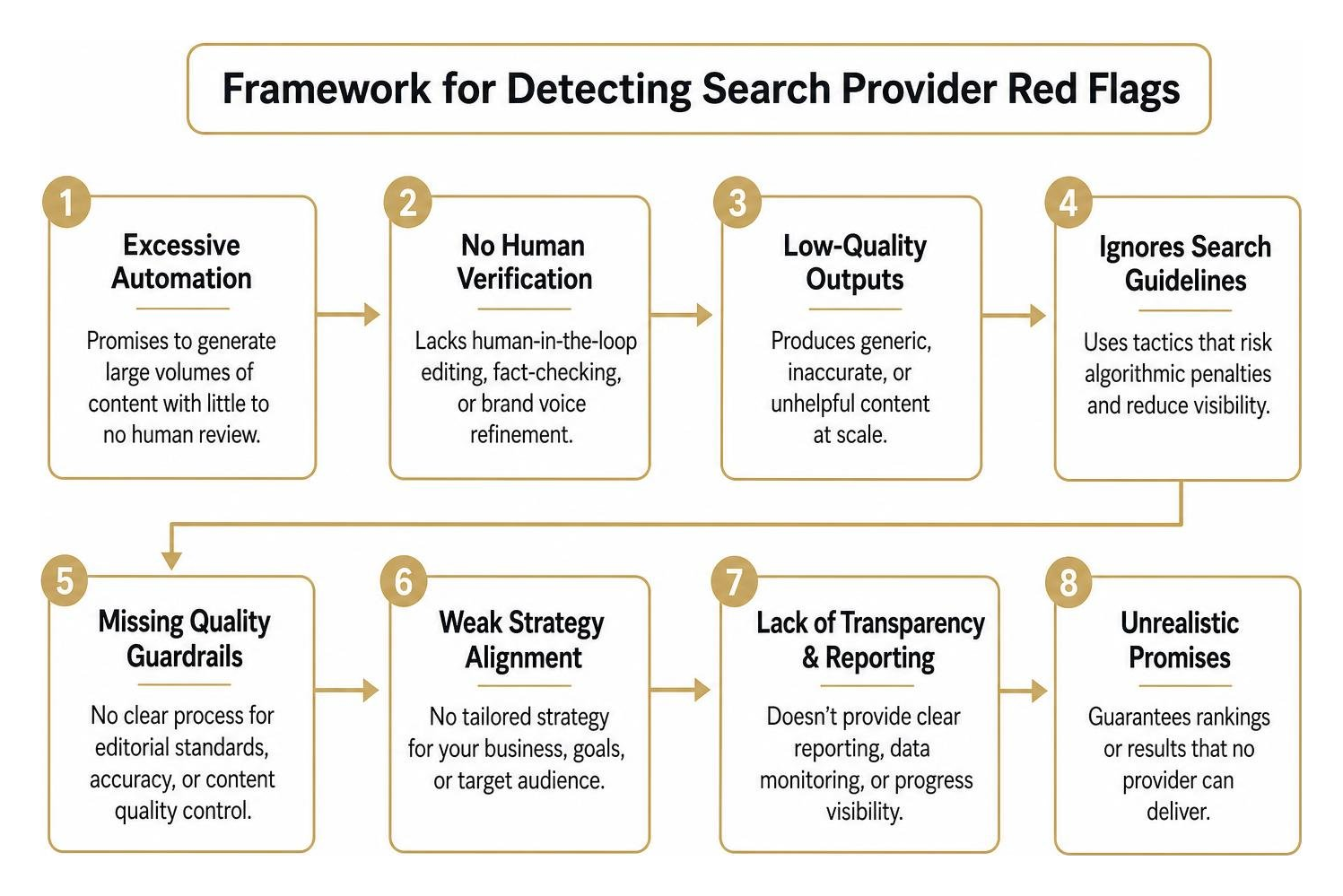
When evaluating an AI SEO provider, look beyond the amount of content or automation offered. Recognizing common provider red flags can help you avoid low-value work and wasted resources.
Automated Spam vs Verified People-First Content
A major warning sign is any provider offering to generate hundreds of unedited blog posts per week using purely automated scripts. Search engines explicitly design their ranking algorithms to filter out unhelpful, mass-produced content that lacks real utility.
Low-quality automation often exhibits common issues:
- Repetitive sentence structures and filler phrasing.
- Broad, generic explanations that never provide actionable answers.
- Inability to address nuanced, specialized customer questions.
- Lack of original research, proprietary data, or unique perspectives.
Sustainable growth requires people-first content. True optimization uses technology to uncover search intent and organize topics, while using human insight to deliver depth and practical value.
Hallucination Risks and Lack of E-E-A-T Adherence
Generative AI models are designed to predict language patterns, which means they can occasionally generate plausible-sounding falsehoods—known as hallucinations. If a provider relies solely on automated generation without source-based verification, they risk publishing inaccurate statistics, false claims, or broken technical instructions.
Publishing unverified information undermines your Experience, Expertise, Authoritativeness, and Trustworthiness (E-E-A-T). Trustworthy services check factual claims against reliable sources and review content against search engine quality guidelines. Fact-checking reduces errors, but does not by itself establish compliance with every guideline.
Frequently Asked Questions about AI Search Services
Reviewing common operational questions helps clarify how modern search optimization delivers long-term business value. You can explore additional answers to common technical queries on our FAQs page.
What is typically included in comprehensive AI SEO packages?
A comprehensive package may include technical website checks, clear descriptions of the business and related concepts, schema markup, related customer questions grouped by topic, reviewed content templates, relevant internal links, and accurate brand information across credible sources. It should also include human editorial oversight to check factual accuracy and brand alignment across published materials. Confirm which deliverables are included in the proposal.
How do AI optimization services maintain search engine compliance?
Responsible optimization follows applicable search engine guidelines, including helpful-content guidance; editorial review alone does not guarantee compliance. Services prioritize user-focused answers, verified factual accuracy, and structured data standards. Combining automated research with thorough human editorial review can help teams produce useful content rather than automated spam.
How quickly do AI search optimization strategies yield results?
Timelines depend on your site’s established authority, how often search systems revisit it, market competition, and its technical condition. Search systems can discover and process technical changes and schema updates as they revisit pages, while building authority across generative answer engines is an ongoing effort. There is no universal timetable for visibility or citation gains; ongoing tracking is needed to assess changes in your business’s results.
Conclusion
Search is changing as AI-generated answers become more common. As traditional search engines integrate these answers and users turn to conversational AI assistants for product and service recommendations, businesses should consider how their information appears across these platforms. A useful response combines clear business information, credible content, appropriate automation, and human review to support visibility in modern search.
At Upskale Marketing, an Orlando, Florida AI optimization agency, we help brands establish relevance and earn top recommendations across generative platforms like ChatGPT, Gemini, and Copilot. We combine decades of strategic marketing expertise with modern search methodologies to turn AI discovery into a durable growth channel for your business.
Ready to see how your brand appears across conversational search platforms? Schedule your free, data-driven AI evaluation with Upskale Marketing today to evaluate your current digital signals and discover clear opportunities for sustainable search visibility.