
The Definitive Guide to Effective ChatGPT Optimization
What Is ChatGPT Optimization and Why Does It Matter in 2026?
ChatGPT optimization encompasses two complementary disciplines: refining how your organization prompts and utilizes AI models internally, and structuring your digital presence so generative engines surface and cite your business. As search behaviors shift toward conversational discovery, optimizing for generative systems has become a core business requirement.
The scale of this shift is undeniable. ChatGPT processes over 2.5 billion queries every day. With AI search traffic surging 155% in 2025 alone, user habits have fundamentally pivoted away from ten blue links toward direct synthesis. Furthermore, 80% of consumers now rely on zero-click answers in at least 40% of their searches. When users encounter an AI overview, only 8% click through to a traditional organic result, compared to 15% who click when no AI summary is present.
Yet, for businesses that earn citations, the upside is substantial: early data reveals that AI visits convert at two to three times the rate of traditional organic channels. Understanding how to navigate this landscape is essential for winning the next era of generative search engine optimization.
Technical Foundations of ChatGPT Optimization
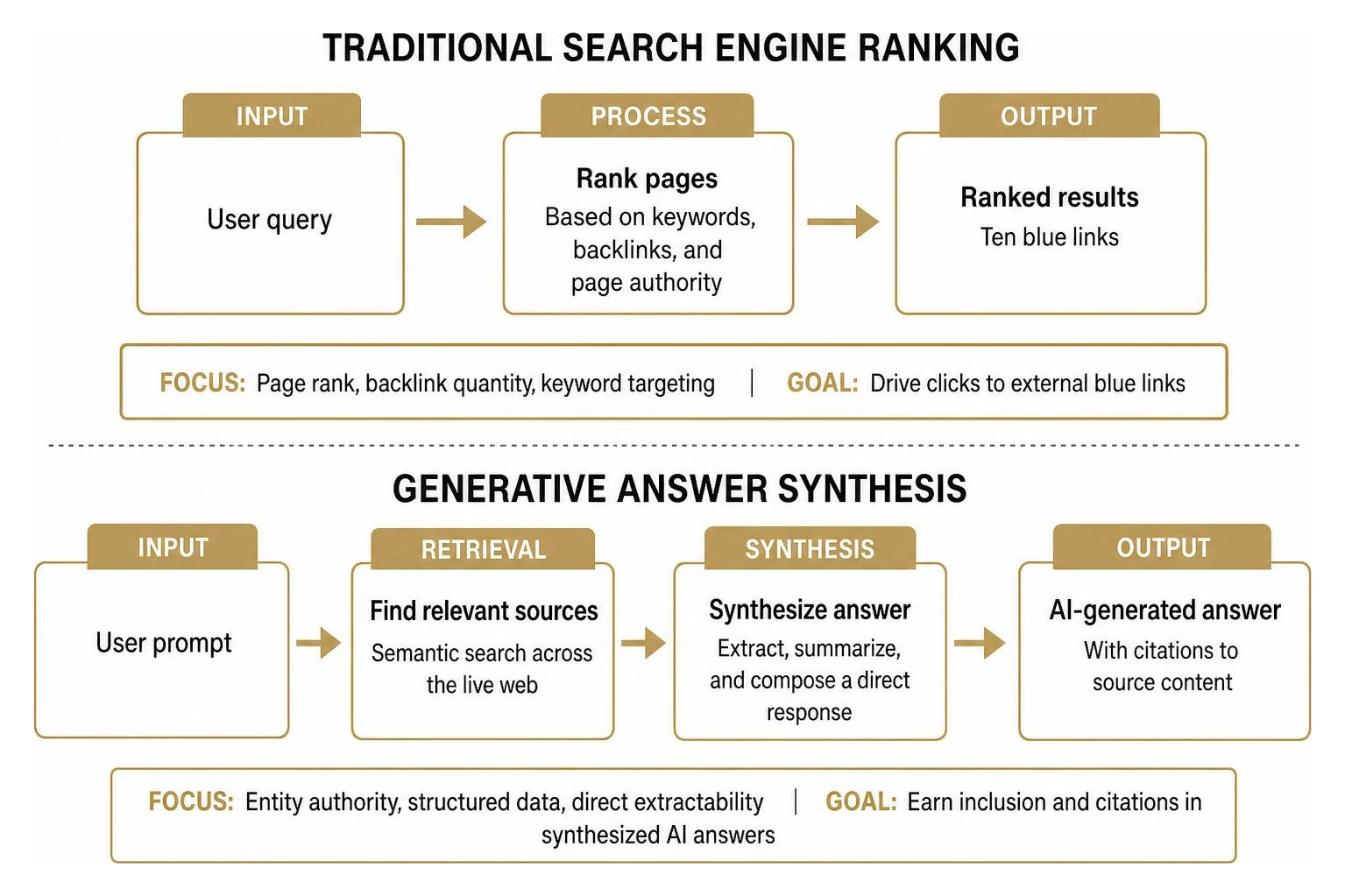
Generative models rely on two primary mechanisms to answer user prompts: parametric memory and live web retrieval. Parametric memory consists of the knowledge baked directly into model weights during pre-training and fine-tuning. Live web retrieval occurs when an engine dynamically queries the web to pull fresh context into the prompt window before synthesizing an answer.
When a query triggers retrieval, neural search algorithms evaluate candidate pages not merely by keyword frequency, but through semantic parsing. The engine breaks down content into vector embeddings, assessing semantic relationships, direct factual statements, and contextual clarity. If your content lacks clear entity definitions or hides answers behind dense prose, the neural parser simply moves to a clearer source.
Understanding Model Retrieval and Bing Indexing
For live web search, ChatGPT relies heavily on Microsoft Bing’s organic index. Research indicates that 87% of ChatGPT citations match Bing’s top 10 organic results, while only 56% match Google’s top 10. Consequently, technical discoverability on Bing directly governs your visibility within OpenAI’s ecosystem.
Live retrieval is executed by specialized crawlers like OAI-SearchBot, which browses the web to fulfill user search queries, whereas GPTBot crawls data for model training. Ensuring proper crawler access in your robots.txt file is paramount. Furthermore, citation sharing across platforms is remarkably fragmented: only 14% of top-cited sources are shared concurrently across ChatGPT, Perplexity, and Google AI Overviews. Optimizing for AI discovery requires catering to distinct parsing and indexing behaviors across engines.
Core Prompt Engineering and Token Efficiency Strategies
Effective utilization of ChatGPT begins at the prompt layer. Model outputs reflect the structural clarity of their inputs; vague inputs yield generic, unfocused answers.
Frameworks for Prompt Optimization and Context Management
To consistently extract high-value answers, every operational prompt should address six core dimensions:
- Clarity: State the core objective unambiguously without conflicting directions.
- Audience: Specify the exact reader or user demographic, including their technical proficiency.
- Format: Define the required output structure, such as JSON, Markdown tables, or bulleted executive summaries.
- Constraints: Set explicit boundaries, including word counts, excluded terms, or tone rules.
- Examples: Provide few-shot demonstrations showing sample inputs alongside ideal outputs.
- Success Criteria: Establish explicit benchmarks the output must meet to be considered complete.
When managing extended conversations, context drift can degrade output quality. Inserting periodic summaries or explicitly asking the model to recap its active parameters ensures conversational memory remains intact during complex tasks.
Practical Token Management and Cost Reduction
Token efficiency directly impacts both API expenses and response latency. In production environments, unoptimized context windows inflate operating costs without improving output quality.
- Implement Pre-Summarization: Condense background documents before feeding them into downstream analysis prompts.
- Set Explicit Output Limits: Use the
max_tokensparameter to prevent verbose, runaway responses. - Batch Homogeneous Requests: Group similar classification or extraction tasks into a single structured API call.
- Prune System Prompts: Eliminate redundant conversational filler from system instructions.
A standard request using advanced models can cost roughly $0.03 per 1,000 tokens. Reducing token usage by 20% across 10,000 monthly enterprise requests yields tangible savings while accelerating inference speeds.
Technical Levers: Fine-Tuning, Prompting, and RAG Architectures
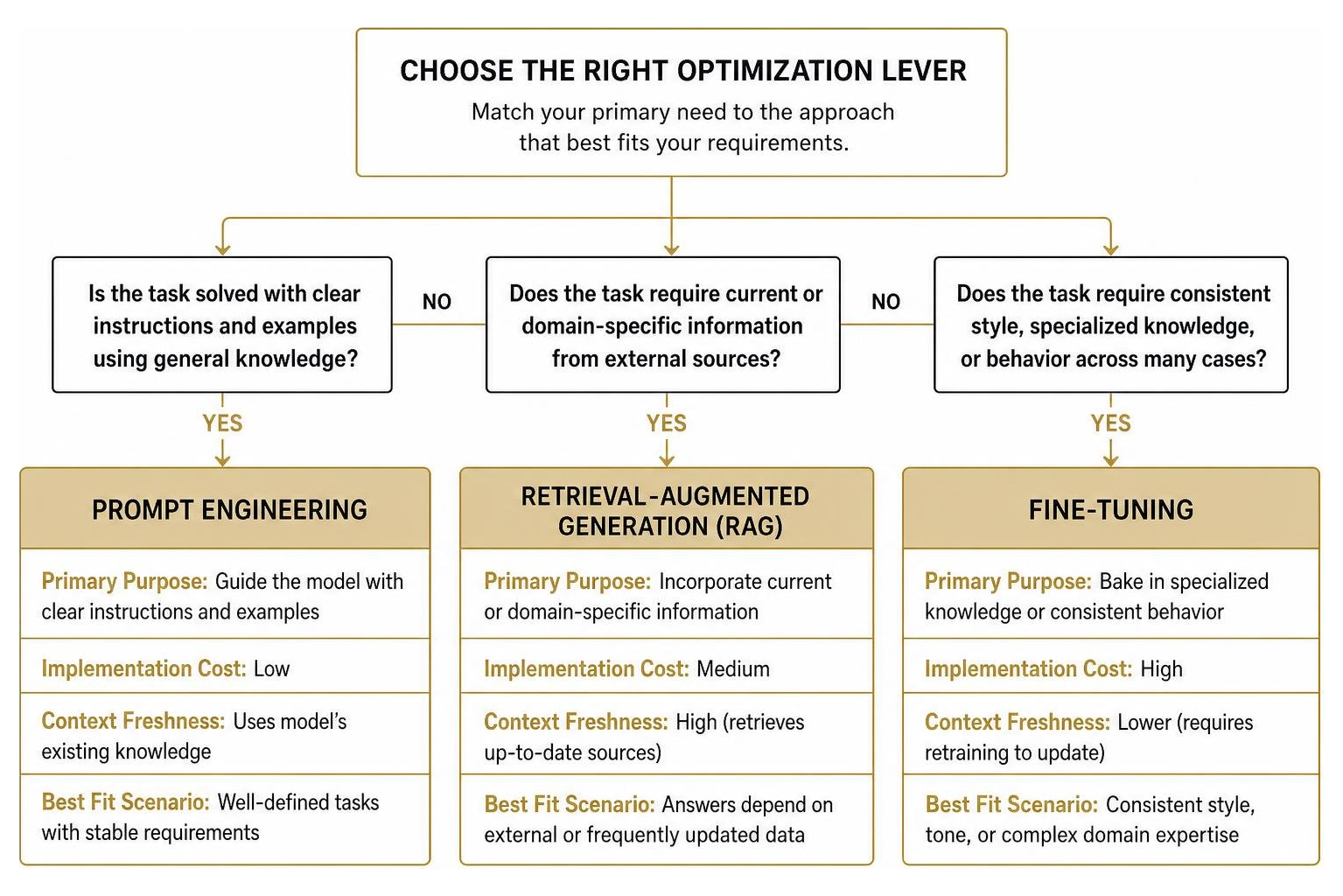
When engineering internal AI workflows, organizations must decide between prompt engineering, Retrieval-Augmented Generation (RAG), and fine-tuning.
Comparing Prompt Engineering, Fine-Tuning, and RAG
Each optimization approach addresses distinct functional requirements regarding accuracy, context, and operational complexity.
| Optimization Lever | Primary Purpose | Implementation Cost | Context Freshness | Best Fit Scenario |
|---|---|---|---|---|
| Prompt Engineering | Guiding tone, formatting, and task logic | Minimal | Real-time (in-prompt) | Ad-hoc tasks, drafting, rapid prototyping |
| Retrieval-Augmented Generation (RAG) | Injecting private or dynamic data | Moderate | Dynamic / Live | Knowledge bases, documentation Q&A |
| Model Fine-Tuning | Inculcating specialized behavior and style | High | Static (training cutoff) | High-volume structured outputs, domain style |
Empirical benchmarks highlight these functional differences. In standard linguistic evaluations:
- A base model using zero-shot prompting achieved a BLEU score of 62.
- Adding three-shot prompt examples raised the BLEU score to 70.
- Fine-tuning a standard model on 1,000 domain-specific examples achieved a BLEU score of 78, outperforming few-shot prompts on larger base models.
- Fine-tuning an advanced model reached a BLEU score of 87.
However, layering RAG onto a fine-tuned model without proper tuning can sometimes introduce noise, occasionally dropping accuracy scores (for instance, from 87 down to 83 in benchmark tests). Choose RAG when missing knowledge is the core bottleneck, and fine-tuning when consistent behavioral formatting is required.
Determining Accuracy Break-Even and Production Feasibility
Achieving production readiness requires evaluating the cost of failure against automated savings. For instance, in automated customer support workflows, an accuracy threshold of roughly 81.5% often represents the financial break-even point where operational deflection outweighs human review costs. Incorporating automated evaluation frameworks alongside Human-in-the-Loop (HITL) escalations ensures edge cases are handled safely.
Content Architecture to Secure ChatGPT Citations and Brand Visibility
For businesses seeking to appear in AI recommendations, web content must be architected for machine extractability.

To explore actionable formatting approaches, review our guide on techniques to stand out in AI Overviews.
Answer-First Formatting and Semantic Triples for ChatGPT Optimization
Generative search engines value clarity and immediate extractability. Studies show that the first 30% of a webpage generates 44.2% of all LLM citations, while the middle 40% accounts for 31.1%, and the final section produces just 24.7%.
To maximize visibility:
- Adopt Question-Led Headings: Craft H2 and H3 tags as natural language queries.
- Provide Direct 40–60 Word Answers: Place a concise, direct summary immediately below each heading.
- Use Semantic Triples: Write clear Subject-Predicate-Object sentences (e.g., “Upskale Marketing delivers Answer Engine Optimization”). Natural phrasing consistently outperforms outdated keyword stuffing, which tests show performs 10% worse in AI discovery environments.
Structured Data, FAQPage Schema, and Crawl Accessibility
Structured data bridges human prose and machine comprehension. Pages leveraging FAQPage schema achieve three times as many ChatGPT citations compared to unstructured plain text.
Furthermore, combining clean schema with inline factual citations increases source selection rates by approximately 40%. Ensure your site uses:
- Validated
FAQPage,HowTo, andArticleJSON-LD schema. - Explicit
authoranddateModifiedproperties to signal content freshness. - Server-side static HTML rendering rather than client-side JavaScript, ensuring neural crawlers ingest full text cleanly.
Brand Positioning and Category Authority in AI Responses
AI models assess external credibility before recommending a company. Data indicates that 82% of all AI citations originate from earned media and third-party mentions rather than owned corporate claims.
Moreover, branded search volume serves as the single strongest predictor of LLM citation frequency, showing a 0.334 correlation that surpasses traditional backlink counts. Brands that establish distinct categories and earn coverage across authoritative industry publications naturally dominate AI recommendations. Learn how to teach large language models how to tell your brand story to cement your market authority.
Measuring Performance, LLM Visibility, and Avoiding Common Pitfalls
Optimizing for generative engines requires new analytics metrics that reflect synthesis rather than simple rank tracking.
Tracking Citations, Referral Traffic, and AI Share of Voice
Traditional rank trackers cannot capture whether an AI model recommends your brand during a conversational session. Modern visibility measurement requires monitoring specific AI discovery metrics.
| Traditional SEO Metric | Generative Engine Optimization Metric | Strategic Focus |
|---|---|---|
| Keyword Rank (Pos. 1–100) | Citation Frequency & Inclusion Rate | Presence in synthesized answer sources |
| Search Volume (Impressions) | Prompt-Level Exposure & Share of Voice | Percentage of industry queries surfacing your brand |
| Organic Click-Through Rate | Referral Conversions from AI Engines | Tracking high-intent traffic via GA4 channel groups |
| Total Backlink Count | Third-Party Corroboration & Entity Clarity | Depth of earned media coverage in training datasets |
By setting up dedicated tracking for referral channels in GA4 and monitoring regional AI share of voice, marketing leaders can turn AI search into a predictable growth channel. For deeper context on performance analytics, explore our AI search optimization insights.
Critical Mistakes in Generative Engine Optimization
Avoid these common technical and strategic pitfalls:
- Blocking Discovery Bots: Disallowing
OAI-SearchBotin yourrobots.txtstrips your site from real-time citation retrieval. - Relying on Vague Promotional Language: Unsubstantiated marketing claims fail semantic validation; models prioritize verifiable facts and statistics.
- Neglecting Entity Disambiguation: Inconsistent brand names, addresses, or product terminology across digital touchpoints confuse entity resolution graphs.
- Ignoring Multi-Engine Indexing: Focusing solely on Google algorithms while neglecting Bing indexing ignores where the vast majority of ChatGPT retrieval occurs.
Frequently Asked Questions About ChatGPT Optimization
What is the difference between traditional SEO and ChatGPT optimization?
Traditional SEO focuses on earning high rankings on search engine results pages to capture direct clicks. ChatGPT optimization (part of Answer Engine Optimization) focuses on structuring content, schema, and brand entities so large language models select, synthesize, and cite your business directly within AI-generated answers.
Which schema markup types generate the highest ChatGPT citations?
FAQPage schema generates roughly 3x more citations than unstructured text by clearly defining questions and direct answers. Article schema with complete dateModified properties and HowTo markup also substantially improve machine extractability.
How does prompt length affect token costs and output accuracy?
Longer prompts consume more context window tokens, increasing API costs and latency. While providing necessary context and few-shot examples improves output accuracy, bloated system instructions can introduce ambiguity and dilute core instructions.
Conclusion
As conversational interfaces become the primary gateway for digital discovery, optimizing your business for generative AI is essential for sustainable growth. Earning top recommendations across platforms like ChatGPT, Gemini, and Microsoft Copilot requires a disciplined strategy centered on entity authority, semantic content structure, and technical extractability.
At Upskale Marketing, we combine decades of branding and marketing expertise with advanced Answer Engine Optimization strategies to help businesses establish authority and capture high-converting AI-driven traffic.
To discover how your brand currently performs across generative platforms, schedule a free, straightforward, data-driven AI evaluation with Upskale Marketing today, or explore our comprehensive AI optimization strategies to learn more.