


A Practical Guide to Evaluating AI Optimization Providers
Understanding the Scope of Modern AI Optimization Services
When evaluating AI optimization services, focus on providers that combine platform-neutral measurement, human-led content accuracy, crawlability readiness, and evidence-based methodologies. These criteria help you identify partners who can improve how generative models such as ChatGPT, Gemini, and Copilot retrieve, interpret, and cite your brand.
As artificial intelligence engines reshape how audiences discover information, the mechanics of digital visibility are undergoing a profound evolution. Today, generative models synthesize information dynamically rather than simply indexing blue links. Navigating this shift requires a deliberate approach to Answer Engine Optimization (AEO) and Generative Engine Optimization (GEO).
AI search visibility centers on ensuring your organization’s core facts, products, and brand narrative are accurately retrieved, interpreted, and cited when users query generative platforms. These platforms rely on sophisticated information extraction pipelines that prioritize clear entities, authoritative sourcing, and structured clarity over repetitive keyword patterns.
Understanding how to position your brand effectively involves several fundamental areas:
- Content Comprehensibility: Structuring informational assets so large language models can parse context without ambiguity.
- Technical Accessibility: Ensuring modern search bots and AI crawlers can seamlessly access your digital assets by optimizing for modern AI search algorithms.
- Entity and Brand Authority: Establishing clear relationships between your brand, leadership, industry topics, and key solutions across trusted web environments.
- Measurement and Iteration: Continuously evaluating how generative answer engines reference your organization, identifying gaps where information is outdated or omitted entirely.
Modern AI optimization is not a static tweak or a collection of superficial shortcuts. It represents an ongoing discipline that aligns traditional domain authority with the unique data-ingestion requirements of generative models.
Approaches That Can Improve AI Search Visibility
Earning consistent citations across answer engines requires clear, reliable information design. Generative systems use complex synthesis techniques to evaluate which sources provide the most contextually relevant, accurate, and comprehensive answers.
To improve AI search presence, organizations focus on several proven digital strategies:
- Clear, Well-Structured Information: Presenting direct, well-defined answers to core consumer questions using logical subheadings, direct summaries, and semantic clarity.
- Entity and Brand Clarity: Ensuring your organization’s identity, services, and locations are clearly documented without contradictory facts across digital channels.
- Credible Sourcing and Factual Backing: Grounding key claims in verifiable data, research, or documented case studies, which signals reliability to synthetic extraction models.
- Seamless Crawlability: Maintaining clean technical architectures that eliminate indexing friction for retrieval bots.
- Answer-Focused Content Hubs: Developing comprehensive resources tailored to specific informational queries, addressing nuanced sub-topics thoroughly.
- Cross-Platform Visibility Tracking: Periodically assessing how key prompts across various generative platforms synthesize your brand narrative.
One-Time Audits vs. Ongoing Optimization
When evaluating external support, decision-makers often weigh the benefits of a single baseline assessment against sustained, ongoing optimization programs. While an initial audit highlights immediate structural gaps, continuous management provides the adaptability needed as generative models update their training data and real-time retrieval methods.
| Feature / Dimension | One-Time Audit | Ongoing Optimization Program |
|---|---|---|
| Primary Scope | Snapshot assessment of current AI mentions and technical readiness | Continuous refinement of brand entities, content hubs, and citations |
| Visibility Mapping | Baseline identification of current gaps and prompt outputs | Routine tracking across multiple generative platforms and emerging queries |
| Content Updates | Static recommendations for existing pages | Proactive, iterative content enhancements aligned with changing user prompts |
| Technical Adjustments | One-time checklist of crawlability and schema fixes | Ongoing monitoring of site accessibility as platform crawlers evolve |
| Reporting Cadence | Single delivery report | Regular, transparent reporting tracking mention trends and source citations |
| Strategic Adaptability | Limited to the assessment date | Adapts quickly as AI search engines update retrieval architectures |
While a one-time audit provides a helpful starting point, sustained programs ensure your digital footprint remains authoritative and visible over time.
Evaluating Core Domains and Business Outcomes
Measuring success in AI search requires looking beyond traditional organic ranks. Generative engines do not output simple ten-blue-link pages; they produce synthesized answers, often drawing from multiple sources simultaneously. As a result, measuring impact requires evaluating citation frequency, context quality, and the accuracy of synthesized brand narratives.
Organizations focusing on structured presence often see measurable improvements in source citations and contextual authority by using proven techniques for AI search optimization.
Content and Technical Readiness for AI Search
Before an answer engine can cite your organization, it must be able to read, interpret, and contextualize your content. Readiness spans both structural information design and foundational site health:
- Information Architecture: Content must flow logically, using clear heading hierarchies, concise introductory definitions, and scannable lists that generative engines can easily parse.
- Topical Breadth and Depth: Covering subjects thoroughly helps establish topical authority, increasing the likelihood that AI engines view your domain as an authoritative reference point.
- Source Credibility: Articles backed by clear authorship, accurate references, and verified data earn stronger trust signals.
- Accessible Tooling and Workflows: Teams often implement accessible tools for search optimization to ensure their publishing workflows consistently maintain high structural and semantic standards.
AI Search Visibility Measurement
Evaluating your standing across generative answer engines requires tracking distinct visibility metrics:
- Brand Mentions in Synthesized Answers: The frequency with which your company appears when users ask open-ended questions about your industry or category.
- Linked Source Citations: Whether the generative platform provides direct footnote links back to your original source materials.
- Contextual Sentiment and Accuracy: Ensuring that when an AI tool discusses your brand, it accurately describes your services, capabilities, and locations.
- Query Coverage: The percentage of relevant commercial and informational queries within your niche where your brand is included as a recommended solution.
- Downstream Referral Activity: Monitoring referral traffic originating from generative interfaces that support interactive source browsing.
Cross-Functional Readiness and Implementation
Sustained visibility in generative search is not isolated to technical teams. It thrives when content creators, subject matter experts, and executive leaders collaborate seamlessly. Editorial review processes ensure every published asset meets internal accuracy standards while addressing common audience questions. By coordinating content updates across marketing and operations, organizations ensure their public digital assets reflect their true capabilities.
The 4-Stage Evaluation and Optimization Framework
Navigating generative engine optimization requires a structured, phased approach rather than disjointed tactics. Establishing a consistent framework helps teams identify gaps, implement structural improvements, and monitor changes systematically, which is essential when winning the next era of generative search engine optimization.
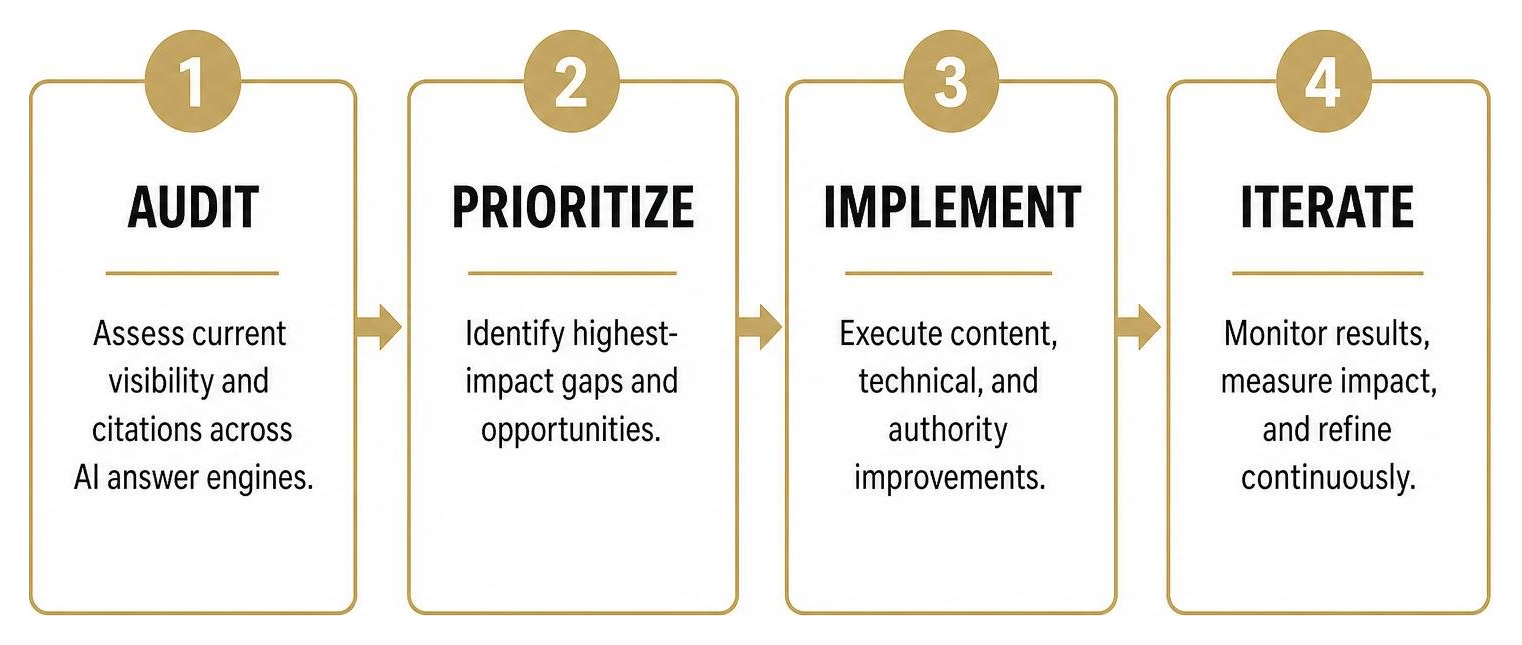
Audit and Baseline Visibility Mapping
The journey begins with an objective assessment of your current digital footprint:
- Prompt Inventory Assessment: Querying diverse informational and transactional prompts across leading answer engines to understand how your brand is represented.
- Citation Analysis: Identifying which third-party sites, directories, or direct pages are currently sourced when generative engines discuss your industry.
- Content Gap Identification: Locating critical product, service, or conceptual topics where competitors are referenced instead of your business.
- Technical Crawl Audit: Checking that technical configurations allow AI bots to efficiently discover and parse high-value pages.
Continuous Monitoring and Improvement
Generative AI models are not static. Platforms update their retrieval algorithms, refine real-time web search capabilities, and refresh underlying training data on an ongoing basis.
Continuous optimization ensures that your content evolves alongside these shifts:
- Periodic Prompt Re-Testing: Tracking changes in brand presence across standard prompt clusters month over month.
- Iterative Content Refinement: Updating existing resource hubs with fresh data, updated references, and expanded answers to maintain high contextual authority.
- Fact-Checking and Discrepancy Correction: Identifying instances where answer engines hallucinate or mischaracterize company details, then strengthening public-facing entity signals to correct the narrative.
How to Select the Right Provider for Your Organization
Choosing an optimization partner requires careful evaluation of their philosophy, methodology, and transparency. A reliable partner will focus on sustainable authority building rather than speculative workarounds. When reviewing options, reviewing an objective buyer comparison for AI visibility helps clarify the capabilities that matter most for long-term growth.
What to Look for in AI Search Optimization Services
When vetting potential providers, focus on partners who demonstrate clear communication, structured workflows, and realistic perspectives:
- A Commitment to Data Privacy: Ensure the provider works with public-facing digital assets and respects internal data privacy protocols without requiring sensitive internal data access.
- Platform-Neutral Evaluation: Look for providers who measure performance across all primary answer engines rather than focusing on a single tool.
- Realistic, Evidence-Based Goals: Ethical providers explain that AI search visibility is earned through content authority and clear digital signals, avoiding misleading promises of guaranteed placement.
- Seamless Collaboration: The right partner should complement your existing internal teams, working within your current content management systems and technical setups without requiring expensive overhauls.
- Transparent Reporting: Clear reporting should detail specific visibility trends, brand mention frequencies, and citation improvements over time.
Frequently Asked Questions About AI Optimization
How do providers maintain the accuracy and quality of content?
Experienced providers rely on robust editorial review standards and human-led fact-checking. Optimization focuses on clarifying existing corporate knowledge and verifying sources rather than generating unverified assertions. By reviewing all published claims against primary sources and clear organizational facts, content remains precise, dependable, and aligned with your business standards.
Can AI search optimization be applied without replacing existing infrastructure?
Yes. AI search optimization focuses on refining information architecture, entity clarity, schema, and content depth. These enhancements integrate seamlessly into your existing website, content management system, and marketing architecture. A complete rebuild or infrastructure replacement is rarely necessary to achieve meaningful visibility improvements.
How long does it take to assess AI search visibility?
An initial visibility audit can typically establish a clear baseline within a few weeks, cataloging where your brand currently appears across key queries and identifying immediate content gaps. However, observing measurable shifts in how generative models synthesize your brand narrative is an iterative process that compounds over time as platforms refresh indexes and ingest updated content signals.
Conclusion
The shift toward generative search represents a major evolution in how customers discover businesses and evaluate solutions. As traditional search interfaces evolve into direct answer engines, building a strong presence requires clear entity design, deep content authority, and ongoing measurement.
At Upskale Marketing, based in Orlando, Florida, we combine extensive marketing leadership with specialized expertise in answer placement and AI search visibility. We help forward-thinking organizations ensure their expertise is accurately represented across modern generative platforms, turning AI search into a dependable growth driver.
To understand where your organization currently stands and identify key opportunities to expand your digital authority, visit our AI search optimization page and schedule your free, data-driven AI evaluation with our team today.