


Building Unshakeable Brand Authority Across Modern AI Discovery Platforms
How to Build Brand Authority Across AI Platforms
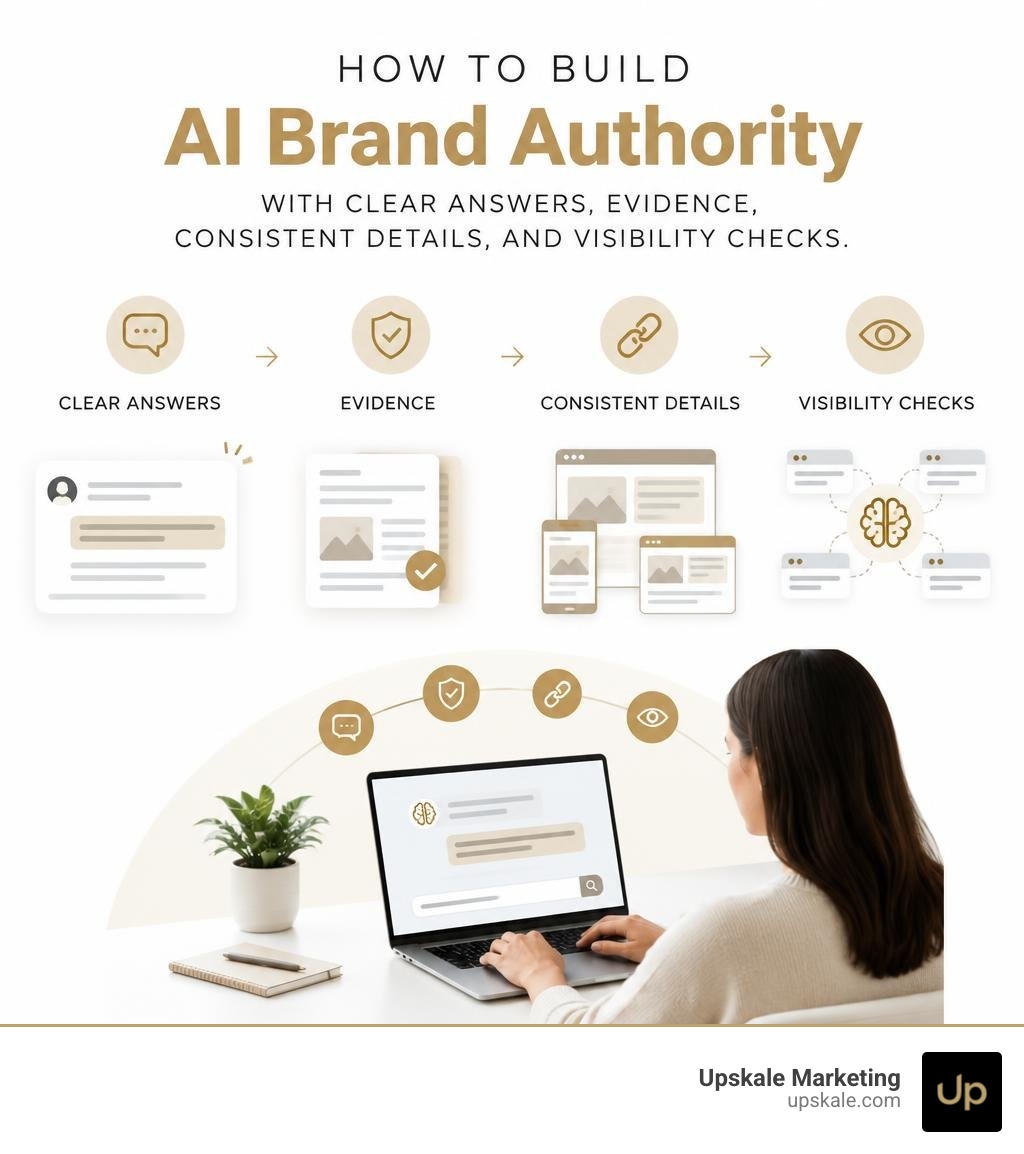
To build brand authority across AI platforms, make it easy for people and AI tools to understand what your business does and why they can trust it. Publish clear answers to your customers’ questions. Back up important claims with real experience and evidence. Keep your business details consistent across your website and other trusted sources, then check where your brand appears in AI answers.
This goes beyond earning a top search ranking. AI platforms can draw on different sources and give different answers to the same question. A strong brand needs to be easy to find, understand, and cite across more than one platform.
I’m Scott Brazdo, MBA, founder of Upskale Marketing. After more than 30 years in marketing and branding, I now help businesses strengthen their ai platform brand authority as customers change how they search.
How Brand Visibility and Citations Differ Across Major AI Platforms
AI discovery does not behave like a single, predictable search engine. In traditional search, optimizing for Google often guaranteed strong visibility across alternative crawlers. In the generative landscape of October 2026, different large language models (LLMs) and answer engines use wildly different mechanisms to retrieve, synthesize, and cite brand information.
Recent benchmark research reveals stark contrasts in how platforms feature brand assets:
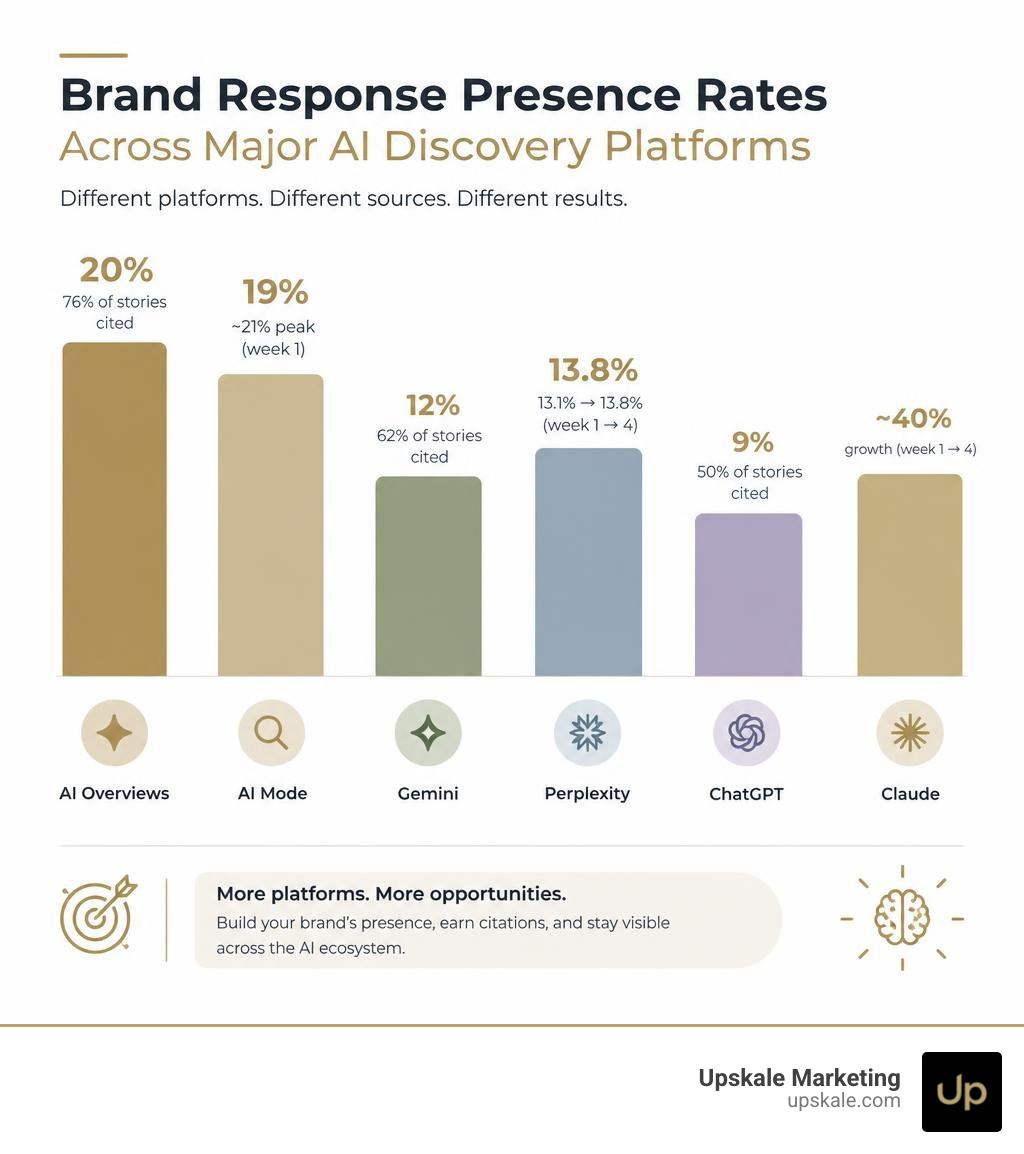
- Google AI Overviews: Leads the industry with an average response presence rate of 20%, showing brand content citations across 76% of analyzed brand stories.
- Google AI Mode: Demonstrates an average response presence rate of 19%, often experiencing an immediate spike up to 21% within the first week of content publication before stabilizing near 18% over the following month.
- Claude: Exhibits powerful long-term authority accrual. While initial citations may start modest, response presence rates grow by roughly 40% between Week 1 and Week 4, with nearly 90% of tracked stories gaining visibility over time.
- Perplexity: Operates as the most consistent baseline, moving steadily from 13.1% presence in Week 1 to 13.8% in Week 4, serving as a reliable benchmark for search-grounded retrieval.
- Google Gemini: Averages a 12% response presence rate, citing brand assets across 62% of queries.
- ChatGPT: Records an average response presence rate of just 9% and appears in only 50% of brand stories, despite commanding one of the largest active user bases.
Understanding these discrepancies is vital for mastering AI search brand mentions across diverse user interfaces.
Platform-Specific Citation Behaviors and Retrieval Mechanics
Why does a brand dominate Google AI Overviews while remaining virtually invisible inside ChatGPT? The answer lies in the underlying architecture of each platform.
Google’s generative systems—including AI Overviews and AI Mode—are directly tethered to its core web index. They inherit established organic search ranking systems, domain trust metrics, and freshness algorithms. When a business already holds solid search visibility, Google’s generative layers readily extract and credit that material.
In contrast, platforms like ChatGPT rely more heavily on foundational training weights combined with selective browsing plugins. Unless a query explicitly triggers real-time search or the brand is deeply embedded within the model’s core pre-trained weights, it defaults to generalized answers without attribution.
Perplexity relies on active Retrieval-Augmented Generation (RAG), constantly querying live web indexes to build dynamic citation sidebars. Claude utilizes sophisticated contextual evaluation, processing authoritative, long-form educational material with increasing confidence over multi-week observation windows.
| AI Platform | Avg Response Presence | Presence Across Stories | Citation Behavior & Growth Pattern |
|---|---|---|---|
| Google AI Overviews | 20% | 76% | High immediate citation; directly reflects organic index authority |
| Google AI Mode | 19% | 70% | Early spike (21% Week 1), stabilizing to ~18% by Week 4 |
| Claude | 16% | 54% | Strong compound growth; presence increases ~40% over 4 weeks |
| Perplexity | 13% | 69% | Highly stable baseline (13.1% to 13.8% over 30 days) |
| Google Gemini | 12% | 62% | Moderate presence tied to Google ecosystem signals |
| ChatGPT | 9% | 50% | Lower direct citation rates; highly dependent on prompt framing |
Data shows that high-performing assets—stories achieving over 20% average presence across the board—perform well everywhere. They average over 40% on Google platforms, 36% on Claude, and 30% on Perplexity. True authority creates a rising tide across every model.
Core Frameworks to Build AI Platform Brand Authority
Traditional SEO focuses on keywords, backlinks, and technical crawlability. While those fundamentals remain foundational, achieving visibility across generative engines requires adapting to generative search engine optimization.
LLMs do not evaluate pages purely on keyword density. They are probabilistic neural networks designed to predict the most accurate, contextually relevant, and trusted sequence of information. To become the source an AI chooses to cite, your digital footprint must establish semantic clarity and brand consensus.
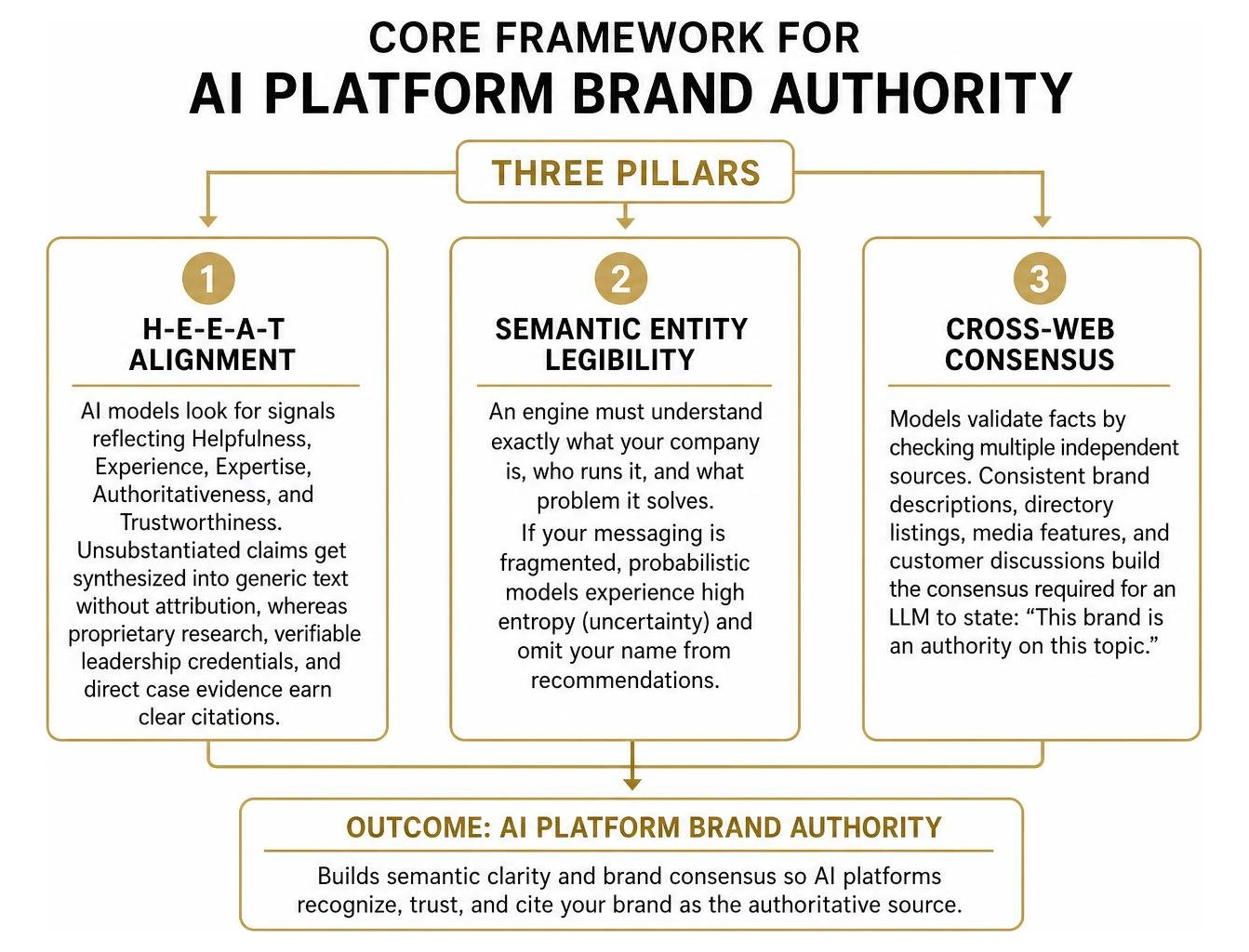
This framework relies on three pillars:
- H-E-E-A-T Alignment: AI models actively look for signals reflecting Helpfulness, Experience, Expertise, Authoritativeness, and Trustworthiness. Unsubstantiated claims get synthesized into generic text without attribution, whereas proprietary research, verifiable leadership credentials, and direct case evidence earn clear citations.
- Semantic Entity Legibility: An engine must understand exactly what your company is, who runs it, and what problem it solves. If your messaging is fragmented, probabilistic models experience high entropy (uncertainty) and omit your name from recommendations.
- Cross-Web Consensus: Models validate facts by checking multiple independent sources. Consistent brand descriptions, directory listings, media features, and customer discussions build the consensus required for an LLM to state: “Upskale Marketing is an authority on this topic.”
Structuring Machine-Readable Content and Brand Knowledge
To earn citations, your web assets must be easy for automated crawlers and context windows to ingest. When a generative model extracts information, it favors modular, highly organized text.
- Answer-First Formatting: Place direct, definitive answers at the immediate beginning of sections. Providing a clear 40- to 50-word summary allows an AI engine to lift that paragraph directly into an answer block or featured overview.
- Structured Schema Markup: Implement robust JSON-LD markup across your site, including Organization, Article, FAQPage, and HowTo schemas. These machine-readable layers explicitly define your entity attributes to search crawlers without ambiguity.
- Clear Information Architecture: Use logical header hierarchies (H2, H3), clean lists, and comparative tables. This structure reduces extraction errors during RAG operations.
Taking the time to teach large language models how to tell your brand story ensures that when your business is cited, the output accurately reflects your values, services, and differentiators.
Optimizing for Voice Search and Zero-Click Discovery
Voice search and zero-click AI responses have reshaped consumer behavior. Around 1 in 5 people worldwide use voice search, with over 1 billion voice searches conducted every month. Approximately 41% of all voice search answers stem directly from featured snippets and top-tier concise answer blocks.
When users receive spoken answers through smart devices or read concise AI summaries on mobile screens, they rarely click through to an underlying URL. This makes brand placement within the answer itself paramount.
To capture these positions, employ targeted techniques to stand out in AI Overviews:
- Target natural, conversational long-tail phrasing that reflects how humans speak rather than how they type.
- Implement Speakable schema markup where appropriate to signal to voice assistants which sections of text are optimized for audio delivery.
- Incorporate your brand name organically alongside proprietary processes and definitive answers, ensuring your name is spoken aloud during synthesized voice responses.
How to Measure and Scale Your AI Visibility Strategy
Because generative discovery does not rely exclusively on traditional web traffic, businesses must evolve how they track performance. Measuring AI visibility requires monitoring brand presence within synthetic answers, conversational recommendation frequency, and downstream branded search activity.

Enterprises evaluating their tech stack often explore specialized tools; our breakdown of AI visibility solutions for enterprise teams outlines how organizations monitor brand sentiment and citation presence across varied language models.
Measuring AI Platform Brand Authority and Visibility Metrics
To understand your true market position, move beyond basic ranking positions and monitor these modern metrics:
- Response Presence Rate: The percentage of relevant industry queries where your brand is cited, linked, or named within the AI-generated answer.
- Voice Search Citation Rate: How frequently your content serves as the spoken answer source across smart speakers and voice-enabled assistants.
- Voice-to-Action & Assisted Conversions: Measurable customer actions—such as direct phone calls, map requests, or quote submissions—that occur immediately following an answer engine discovery.
- Post-Search Branded Query Volume: Increases in direct brand searches in traditional engines following an initial zero-click AI summary exposure.
Gaining actionable AI search optimization insights allows you to see which content types earn sustained citations over time and which require better factual reinforcement.
Scaling AI Platform Brand Authority for Small Businesses
Small and midsize businesses often assume that large enterprise corporations will monopolize generative AI citations. In practice, agile businesses possess distinct advantages in Answer Engine Optimization (AEO).
AI models prioritize relevance and contextual depth over sheer domain size. A small, focused business can dominate AI citations by:
- Owning Hyper-Specific Long-Tail Topics: Rather than targeting broad industry terms, answer specific, complex customer questions that enterprise competitors ignore.
- Highlighting Direct Practitioner Experience: Share genuine case studies, local insights, and first-hand data. AI platforms favor authentic human experience over generic summaries.
- Dominating Local Entity Signals: Maintaining immaculate local business schema, consistent directory profiles, and active regional citations allows local businesses to become the default recommendation for geographic conversational queries.
Frequently Asked Questions About AI Discovery and Brand Visibility
Why does brand content perform differently between Google AI Overviews and ChatGPT?
Google AI Overviews is natively integrated with Google’s real-time web crawler and organic search ranking algorithms. It heavily weights traditional search signals, freshness, and domain trust. ChatGPT, while capable of browsing the web, frequently relies on pre-trained weights or different search API integrations, leading to lower default citation rates for standard web content unless prompted with real-time research intent.
How does zero-click AI search impact overall brand value?
While zero-click AI summaries reduce immediate top-of-funnel website clicks, being cited as the authoritative source builds immense brand equity. Consumers view the AI’s selected citation as an objective endorsement. This visibility drives high-intent downstream actions, including direct URL navigation, branded searches, and elevated conversion rates.
What technical SEO elements directly influence AI model citations?
Key technical elements include comprehensive schema markup (JSON-LD), clean site architecture, rapid server response times (low TTFB), and reliable server-side rendering for JavaScript. If an AI crawler encounters rendering delays or ambiguous page structures, it will bypass the asset in favor of cleaner, more machine-readable sources.
Conclusion
The shift toward AI-driven discovery represents a fundamental evolution in how audiences find, evaluate, and choose businesses. Securing high visibility across modern answer engines is not about finding quick algorithmic loopholes. It requires building deep, authentic authority, publishing structured and verifiable knowledge, and maintaining consistency across every digital channel.
At Upskale Marketing, based in Orlando, Florida, we combine decades of strategic marketing expertise with forward-thinking Answer Engine Optimization. We help businesses navigate this changing landscape by aligning their web presence with the technical and semantic standards modern AI platforms demand. Explore our comprehensive approach to AI optimization to ensure your organization remains visible, trusted, and recommended.
To find out how your business currently appears across major AI platforms, schedule a free, data-driven AI evaluation with Upskale Marketing today. We will evaluate your current AI visibility, analyze your citation share, and identify practical opportunities to strengthen your brand authority.