


Why Community Q&A Platforms Are Restricting Automated Content
The Shifting Policy Landscape on AI Content Q&A Sites
Over the past few years, the open web has experienced an explosion of automated text generation. While generative tools can field complex queries and assemble structured text in seconds, their widespread misuse has created major challenges for platforms built on peer-to-peer knowledge sharing. In response, modern discussion boards, technical forums, and professional networks have instituted stricter moderation protocols to protect their information ecosystems.
Community platforms are updating their terms of service to address synthetic submissions directly. Automated moderation bots now work alongside human administrators to flag low-effort contributions, repetitive sentence patterns, and unsubstantiated claims. These guidelines do not aim to stifle innovation; rather, they establish quality benchmarks that prevent automated scripts from overwhelming human discourse.
Understanding Quality Gates on AI Content Q&A Sites
To maintain high editorial standards, many platforms now implement automated quality gates. These systems evaluate incoming posts before they are published publicly or surfaced in search indexes. A submission must pass safety protocols, relevance scoring, and factual consistency checks before reaching the wider community.

These gates assess structural depth, original commentary, and citation integrity. When organizations try to flood forums with shallow, programmatic replies, their posts are quickly caught by submission filters or flagged for manual moderation. To achieve sustainable organic discovery, brands must align their participation with modern generative search engine optimization strategies that focus on substantive, authoritative knowledge rather than raw publishing volume.
The Rise of Low-Value Automation and Spam
The primary driver behind these platform restrictions is the sheer influx of low-value, automated spam. When generative models produce answers without human review, several predictable issues arise:
- Context Collapse: The response ignores subtle nuances, technical constraints, or edge cases raised in the original question.
- Generic Phrasing: The text relies on repetitive filler phrases and circular reasoning that add no real problem-solving value.
- Hallucinated References: The system invents non-existent URLs, misquotes research papers, or misattributes industry data.
- Volume Throttling: Automated posting scripts overwhelm platform databases, diluting the visibility of authentic, high-effort answers.
When communities allow unchecked automation, user trust erodes rapidly. Moderation teams have introduced aggressive volume throttling and automated reputation scoring to protect platform integrity and ensure their knowledge bases remain genuinely helpful.
Why Community Knowledge Bases Prioritize Human Verification over Bot Answers
Online communities thrive on authentic problem-solving and lived experience. When someone asks how to troubleshoot a rare server error, configure complex enterprise software, or navigate a difficult regulatory process, they are looking for practical, tested insights—not a generic summary of existing documentation.
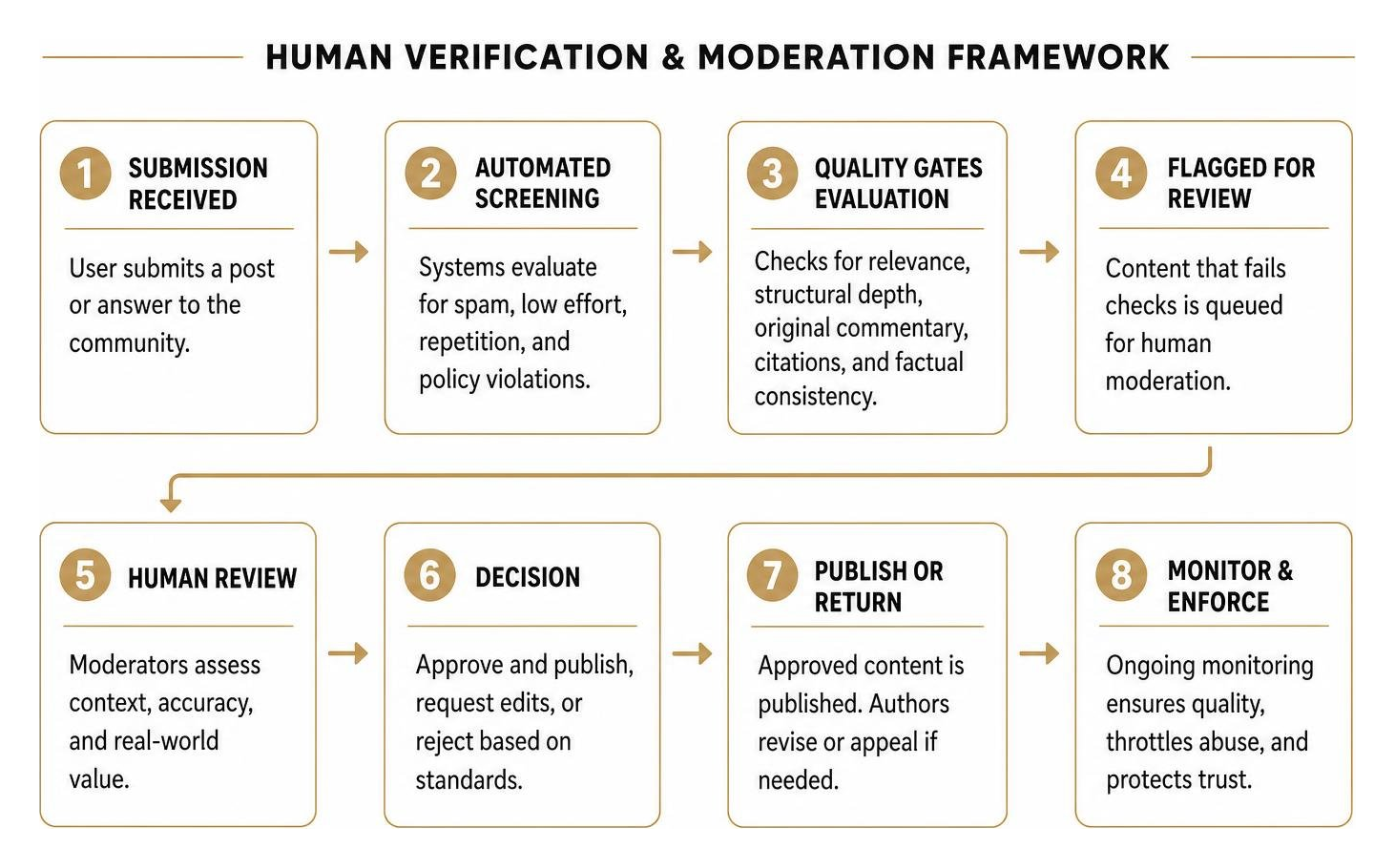
Human verification ensures that contributions contain empirical evidence, clear context, and practical nuance. By requiring subject-matter expertise and manual oversight, knowledge hubs protect the collaborative spirit that makes community platforms valuable.
Trust, Accuracy, and the Risk of Hallucinations
Generative language models are designed to predict probable sequences of words. While they often produce convincing responses, they can also present incorrect information with complete confidence—a phenomenon known as confidence bias. In high-stakes fields such as engineering, healthcare, legal compliance, and finance, a confident hallucination can lead to costly operational mistakes.
| Attribute | Automated Bot Responses | Verified Human Contributions |
|---|---|---|
| Primary Information Source | Statistical language patterns and training datasets | Direct, hands-on experience and verified documentation |
| Nuance & Context Handling | Often misses edge cases, specific constraints, and intent | Adapts dynamically to unique problem variables |
| Factual Reliability | Susceptible to hallucinations and outdated facts | Grounded in practical trial, error, and peer review |
| Accountability | Anonymous, unverified, and difficult to validate | Backed by user reputation, credentials, and track record |
| Community Value | High volume, low differentiation | High context, actionable problem resolution |
Community moderation policies aim to prevent misinformation before it spreads. Requiring transparent verification and human oversight protects both end-users and the platform’s broader search visibility.
Preserving Community Engagement and Authentic Dialogue
A healthy community depends on active peer review, thoughtful discussion, and established reputation systems. When automated bots flood discussion threads, authentic contributors often leave because their nuanced, carefully written answers are buried beneath instant, formulaic replies.
Maintaining user retention requires protecting conversational nuance. Platforms rely on community upvotes, peer commentary, and expert badges to highlight true thought leaders. When members know they are engaging with real practitioners who stand behind their advice, community engagement and collaboration remain strong.
How Modern Search and Answer Engines Parse Community Content
Search engines and modern answer engines treat community Q&A platforms as vital sources of authentic human consensus. In an era where roughly one-third to one-half of users turn to AI tools for step-by-step guidance, plain explanations, and problem resolution, search systems must quickly identify which community answers represent genuine consensus and which are automated noise.

Modern crawling algorithms evaluate semantic relevance, author credibility, and community agreement to determine which answers should be surfaced in search overviews or cited by large language models.
Citation Value and Large Language Model Training
Large language models rely heavily on high-quality community discussions during pre-training, fine-tuning, and live retrieval-augmented generation (RAG). Forums with strict editorial standards provide dense, real-world troubleshooting data that search crawlers prioritize when building semantic knowledge graphs.
When an organization consistently provides verified, transparent answers that solve real-world problems, it builds lasting authority. Earning this level of recognition is central to winning citations through natural brand mentions across both traditional search engines and next-generation answer platforms.
Search Engine Overviews and Zero-Click Information Retrieval
Search behavior is shifting toward zero-click information retrieval, where synthesis engines compile answers directly on the results page. Instead of presenting a simple list of links, modern engines review multiple sources across the web and deliver a single, comprehensive summary with clickable citations.
To have your business recognized in these multi-source summaries, your published content and community contributions must be clear, authoritative, and factually sound. Implementing proven techniques to stand out in AI overviews helps ensure your expertise is accurately parsed and highlighted when prospective clients search for industry solutions.
Ethical Guidelines: Best Practices for Brand Visibility on AI Content Q&A Sites
Navigating community guidelines does not mean your organization must avoid public discussions entirely. Rather, it requires shifting from automated, promotional posting to transparent, value-first participation. Establishing brand authority across discussion platforms requires genuine thought leadership, clear attribution, and a commitment to helping users solve real problems.
Structuring Value-First Contributions
When contributing to community discussions, your primary goal should always be resolving the user’s question completely and accurately. Direct, helpful answers build organic credibility that promotional pitches simply cannot match.
To ensure your contributions adhere to community standards and provide lasting value:
- Lead with the Direct Solution: Provide a clear, actionable answer in the opening sentences before expanding on technical details.
- Incorporate First-Hand Context: Reference real-world scenarios, configuration parameters, or operational constraints that demonstrate practical experience.
- Validate All Data Points: Include verified citations, official documentation links, or reproducible steps to support your claims.
- Disclose Affiliations Transparently: If your organization offers a relevant tool or service, state your affiliation openly while ensuring the answer remains helpful on its own.
Structuring your contributions around real-world expertise helps teach language models your brand story in an authentic, credible way.
Building Sustainable Knowledge Assets
Rather than treating community Q&A sites as quick-fix marketing channels, forward-thinking businesses view them as long-term knowledge assets. By maintaining a centralized internal repository of verified answers, technical guides, and case studies, your team can consistently deliver accurate, high-value responses whenever relevant industry discussions arise.
Developing this internal repository ensures that every public contribution reflects your company’s highest editorial and technical standards. Staying informed on the latest actionable AI search insights allows your team to adapt your knowledge distribution as platform algorithms and moderation standards continue to evolve.
Frequently Asked Questions About Community AI Moderation
Why are Q&A platforms restricting automated AI answers?
Platforms restrict automated answers to protect content quality, prevent spam, and eliminate misleading hallucinations. Unchecked automation dilutes authentic discussions with generic text, making it harder for users to find reliable solutions. Stricter moderation helps ensure that community knowledge bases remain accurate, credible, and useful.
How can organizations contribute ethically without violating platform rules?
Organizations should focus on providing human-reviewed, expert-driven answers that directly solve the user’s problem. Always review each platform’s community guidelines, disclose any professional or corporate affiliations transparently, back up claims with verified sources, and never use automated scripts to publish unverified responses.
How do community answers influence answer engine visibility?
Modern answer engines crawl authoritative community platforms to identify expert consensus and gather real-world troubleshooting data. Well-structured, highly upvoted, and verified answers are frequently parsed by language models, increasing the likelihood that the contributing brand will be cited as a credible authority in synthesized search results.
Conclusion: The Future of Verified Knowledge in AI-Driven Search
As search technology continues to evolve, the distinction between shallow, automated text and verified human expertise will only become more critical. Platforms that prioritize editorial integrity, peer review, and transparent quality gates will remain the most trusted sources of information for both human users and AI answer engines.
Succeeding in this landscape requires a strategic, sustainable approach to visibility. At Upskale Marketing, our Orlando, Florida-based team helps organizations build lasting authority across AI search environments. By combining decades of deep marketing expertise with modern Answer Engine Optimization (AEO), we help brands establish authentic digital signals that earn prominent placement across platforms like ChatGPT, Gemini, and Microsoft Copilot.
Explore our strategic AI optimization services to see how comprehensive optimization can elevate your brand’s presence across the modern search landscape. To discover where your business currently stands in AI-driven search and identify clear opportunities to improve your visibility, schedule a free, data-driven AI evaluation with our team today.