


How SaaS Companies Can Earn AI Recommendations
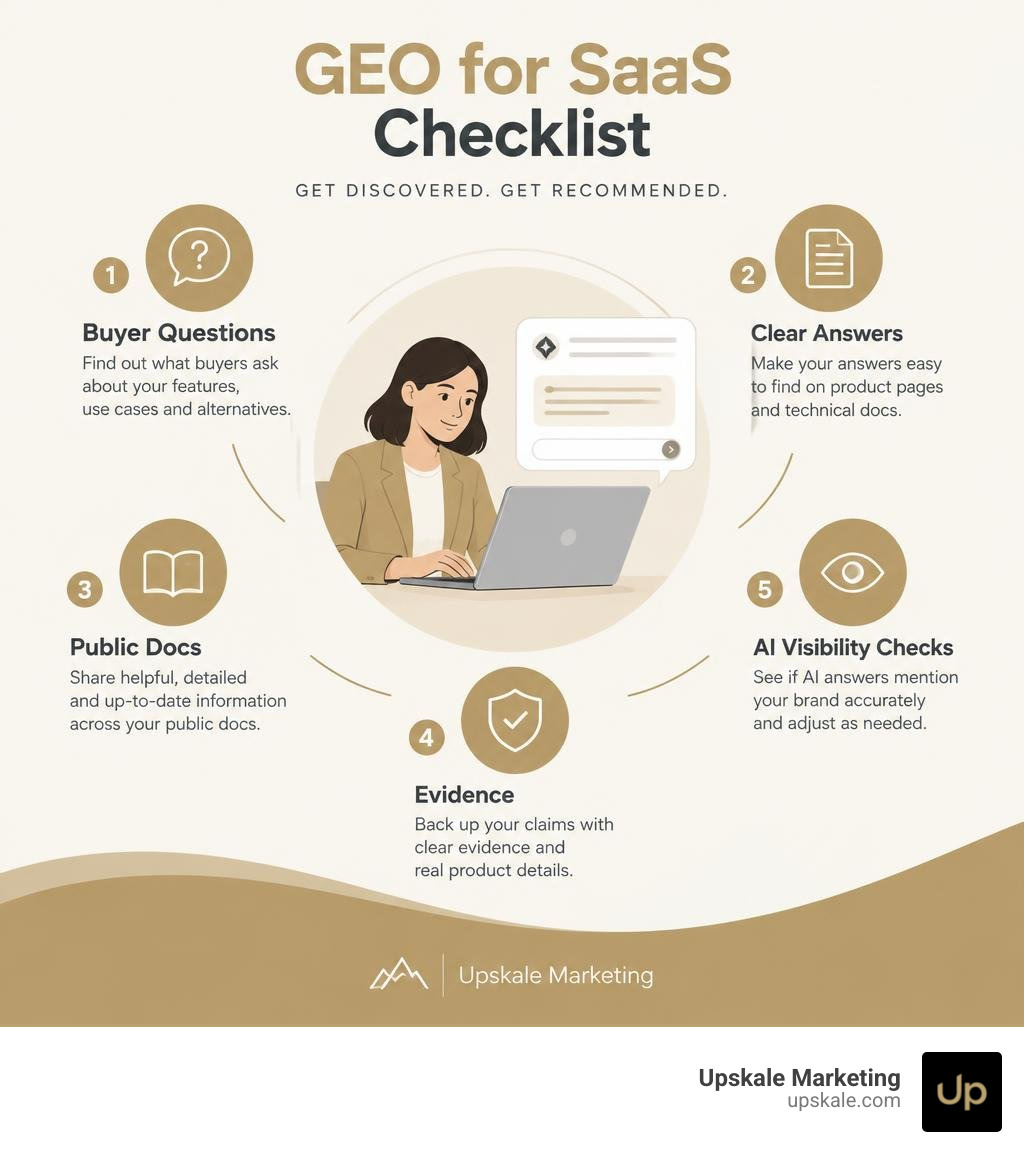
GEO for SaaS companies starts with the questions buyers ask AI. List the questions about your product’s features, use cases, and alternatives. Then make the answers easy to find on public product pages and technical docs. Back up your claims with clear evidence, keep product details current, and check whether AI answers mention your brand accurately.
That work matters because a buyer can now get a software recommendation without opening a search result. Your goal is not just to earn a click. It is to give AI systems reliable information they can use when buyers are weighing their options.
I’m Scott Brazdo, MBA, founder and CEO of Upskale Marketing. I bring more than 30 years of marketing and brand-building experience to GEO for SaaS companies, with a focus on helping brands earn visibility in AI-driven search.
What Is GEO for SaaS Companies and Why Does It Matter in 2026?
The software discovery landscape has changed dramatically. Generative Engine Optimization represents the strategic evolution of search marketing, focused on structuring brand data, product capabilities, and digital authority so that conversational AI engines understand and recommend your platform.
For years, software discovery followed a familiar path: a prospect typed keywords into a standard search bar, clicked three blue links, read several landing pages, and booked a demo. Today, B2B buyers increasingly bypass traditional search engine results pages entirely. Instead, they interact with conversational interfaces like ChatGPT, Google AI Overviews, Perplexity, and Microsoft Copilot to evaluate vendors, compare technical specifications, and build software shortlists.
Industry data confirms this shift. Gartner predicts that traditional search engine volume could drop by 25% by 2026 as users migrate toward conversational interfaces. Furthermore, nearly half of all top-of-funnel informational queries are now satisfied directly within zero-click environments. When a software evaluation takes place entirely inside an AI dialogue, ranking on page one of a traditional search engine is no longer sufficient. If an AI model does not recognize your product as an authoritative solution, your brand remains invisible during the initial evaluation stage.
Understanding the principles of winning the next era of generative search engine optimization has become an essential commercial priority. SaaS leaders who adapt their digital presence to generative search position their platforms directly inside executive-level purchasing conversations.
| Dimension | Traditional SaaS SEO | Generative Engine Optimization (GEO) |
|---|---|---|
| Primary Goal | Rank on page one for specific search queries | Earn direct recommendations and authoritative citations in AI answers |
| User Interaction | Query to Click link to Read landing page | Prompt to Conversational answer synthesized across multiple sources |
| Core Mechanism | Keyword frequency, backlinks, metadata | Entity graphs, technical clarity, multi-source proof density |
| Funnel Impact | Drives website traffic and page-level conversions | Delivers high-intent vendor consideration and direct brand recall |
| Measurement | Organic clicks, impressions, keyword rankings | Share of Model (SoM), citation frequency, sentiment accuracy |
Generative Engine Optimization vs. Traditional SEO
Traditional SEO focuses on reverse-engineering search engine indexing algorithms to capture page clicks. It relies on keyword density, internal linking architecture, URL structures, and backlink authority to secure organic rank.
Generative discovery functions differently. Large language models and neural networks do not simply rank individual URLs; they read, parse, and synthesize information across thousands of indexed pages, third-party publications, and community forums. Rather than serving a list of links, generative engines create direct, contextual answers.
While traditional search optimization captures web traffic, generative optimization builds entity authority so that language models accurately describe your product features, security standards, integrations, and pricing tier viability.
How AI Models Ground Recommendations and Cite Sources
Modern generative engines avoid hallucinations through a process known as Retrieval-Augmented Generation (RAG). When a user asks an AI assistant for a software recommendation, the system executes real-time grounding retrieval:
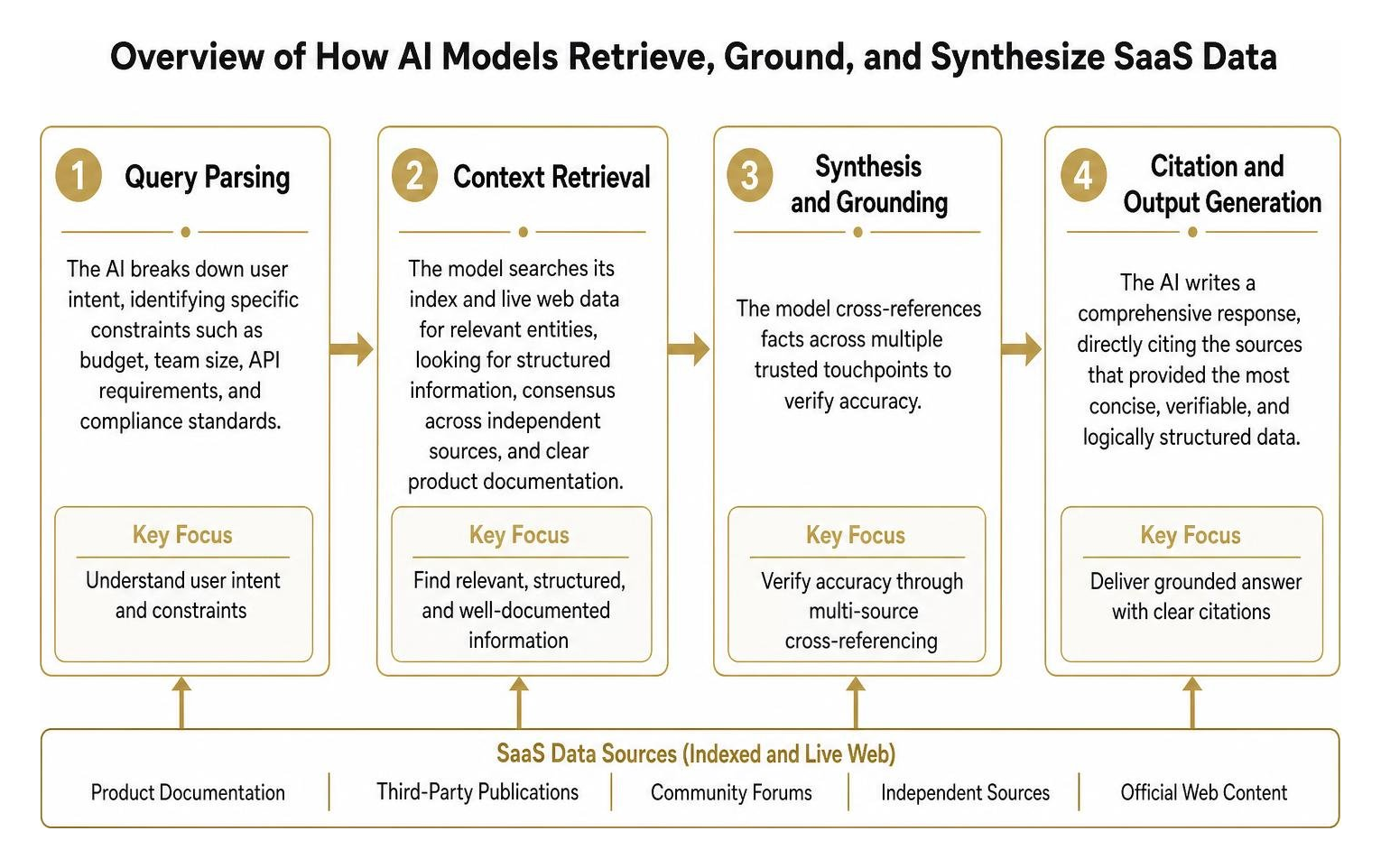
- Query Parsing: The AI breaks down user intent, identifying specific constraints such as budget, team size, API requirements, and compliance standards.
- Context Retrieval: The model searches its index and live web data for relevant entities, looking for structured information, consensus across independent sources, and clear product documentation.
- Synthesis and Grounding: The model cross-references facts across multiple trusted touchpoints to verify accuracy.
- Citation and Output Generation: The AI writes a comprehensive response, directly citing the sources that provided the most concise, verifiable, and logically structured data.
Brands that provide clear, extractable facts become the primary sources that AI engines use to ground their answers.
Core Architectural and Technical Requirements for Generative Discovery
Earning visibility in AI search requires a solid technical foundation. AI crawlers require clean information architecture, explicit schema definitions, and direct content structures to parse your software’s capabilities without ambiguity. Implementing practical AI search optimization techniques ensures your digital assets are easily processed by automated discovery agents.

To maximize crawler accessibility, ensure your site supports modern indexing standards:
- Schema.org Integration: Implement comprehensive JSON-LD markup across your product catalog, specifically using
SoftwareApplication,TechArticle,FAQPage, andOrganizationschema types. - Crawler Accessibility: Verify that your
robots.txtfile permits crawling by major AI user agents, including GPTBot, PerplexityBot, and Google-Extended. - Protocol Distribution: Deploy fast indexation mechanisms, such as XML sitemaps updated in real time and IndexNow protocols, to ensure product updates are immediately available to hybrid search engines.
- LLMs.txt Deployment: Add a clean markdown summary file (
llms.txt) at your root domain detailing your core capabilities, API endpoints, and direct feature summaries for language models to ingest cleanly.
Technical Optimization and the 40-Word Rule in GEO for SaaS Companies
Generative engines prioritize clarity and factual density over conversational filler. One practical way to structure landing pages and product overviews is the 40-Word Rule.
Immediately following your primary section headers (H1 and H2), place a concise, factual definition of 35 to 45 words answering the target concept directly. For example, explain what the feature is, who it serves, and its primary technical outcome. This format gives RAG models an easily extractable summary block suitable for direct quotation.
Following our tactical roadmap for generative engine optimization, accompany these definitions with clean HTML comparison tables, bulleted technical specifications, and unambiguous feature matrices.
Structuring API Documentation and Technical Assets for AI Retrieval
Technical buyers often ask generative engines highly specific architectural questions:
- “Does this CRM support bi-directional syncing via GraphQL?”
- “Which enterprise project management platforms offer SOC2 Type II compliance and SAML SSO out of the box?”
If your technical documentation, integration guides, and API references are locked behind authentication barriers or rendered purely through complex client-side JavaScript frameworks, AI crawlers cannot index them.
Ensure all developer documentation and integration specifications are server-side rendered (SSR) or pre-rendered. Make technical guides publicly accessible to allow generative models to confirm your product’s capabilities when technical evaluators prompt AI assistants.
Building Off-Site Authority Signals That Large Language Models Trust
While on-page technical optimization makes your product understandable, off-site authority convinces AI engines that your software is dependable. Language models determine trustworthiness by evaluating consensus across the wider web.
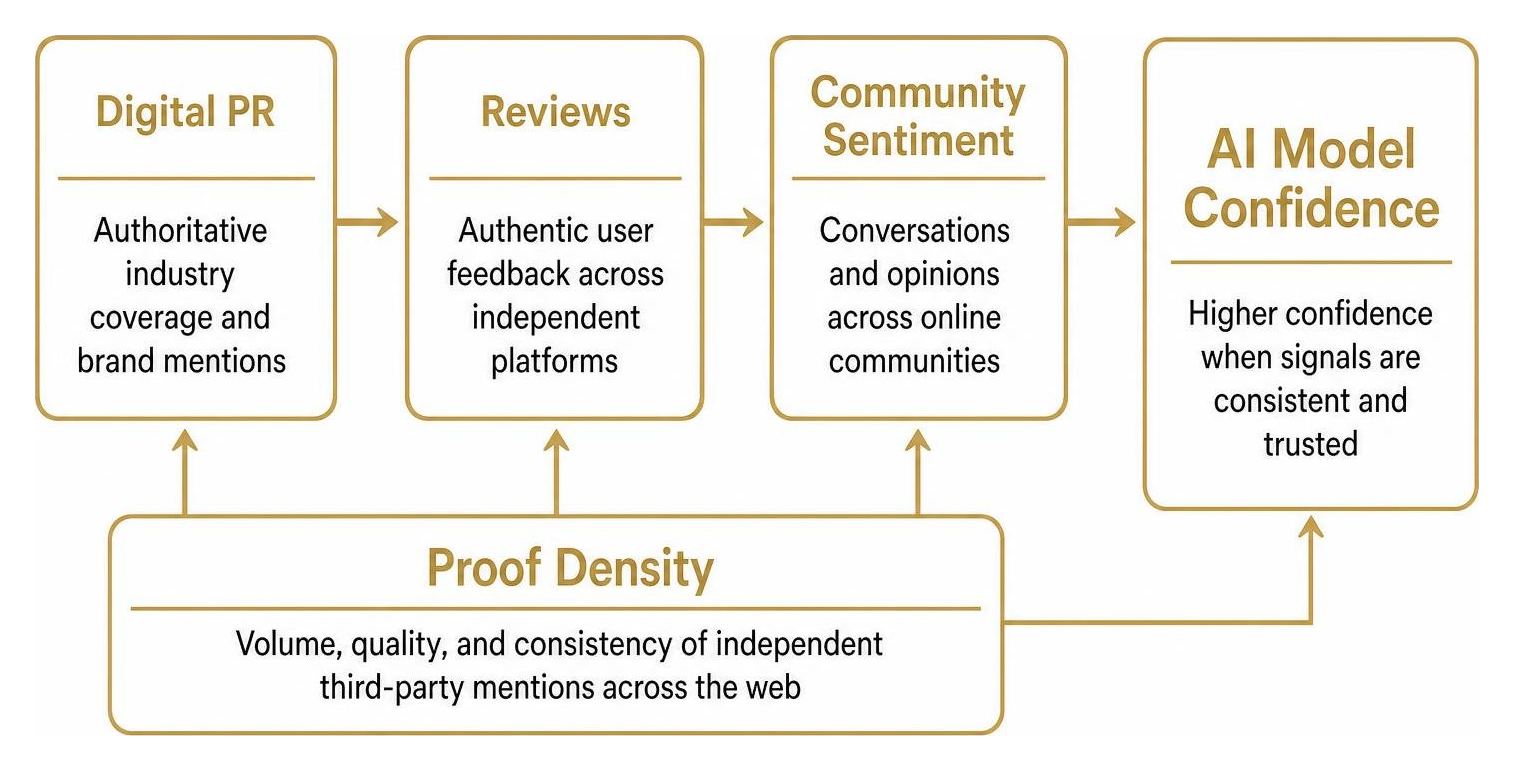
A comprehensive brand authority framework across AI discovery platforms requires active management of external digital footprints. Generative models look for consistent brand descriptions, authoritative industry coverage, and authentic user feedback to validate product claims.
Proof Density and Third-Party Verification Strategies
Proof density refers to the volume, quality, and consistency of independent third-party mentions across authoritative digital ecosystems. AI models assign higher confidence scores to software platforms that display consistent attributes across multiple independent sources.
To build proof density:
- Maintain Entity Consistency: Standardize your brand name, core product descriptions, and feature terminology across all directory listings, knowledge bases, and review platforms.
- Encourage Review Distribution: Cultivate detailed user reviews across major software review platforms. AI models evaluate user sentiment and specific feature commentary found in verified user reviews.
- Publish Original Research: Conduct annual industry benchmark studies, security reports, or proprietary data analyses. Original research creates an authoritative citation footprint that AI systems reference when answering statistical queries.
- Earn Editorial Placements: Secure thought-leadership mentions and technical commentary in respected industry publications to enhance Copilot and generative search visibility.
Prioritizing High-Intent Query Types in GEO for SaaS Companies
When developing content for generative engines, focus resources on query patterns that indicate strong buying intent:
- Direct Comparison Prompts: Queries evaluating two or more solutions (e.g., “Tool A vs. Tool B for enterprise healthcare compliance”).
- Technical Specification Queries: Prompts verifying architecture, security, or integrations (e.g., “SaaS tools with native Snowflake connectors and HIPAA compliance”).
- Use-Case and Persona Prompts: Questions addressing specific organizational challenges (e.g., “Best automated billing platforms for subscription media companies with over 100k users”).
- Alternative and Migration Queries: Prompts seeking replacements for legacy platforms (e.g., “Top self-hosted alternatives to legacy enterprise analytics tools”).
Measuring AI Search Visibility and the 30-Day Implementation Roadmap
Measuring generative discovery requires new metrics. Because conversational AI interfaces provide answers directly within chat sessions, marketers cannot rely solely on traditional click-through rates.
Understanding your position in generative discovery involves deploying an integrated AI search strategy for enterprise brands that monitors brand presence across conversational platforms.

Tracking Share of Model and Visibility Metrics
To understand your presence in AI search, monitor these key visibility indicators:
- Share of Model (SoM): The percentage of generated responses within your software category that cite or recommend your platform across prompt variations.
- Citation Frequency: How often your domain or documentation is hyperlinked as a grounding reference in platforms like Perplexity and Google AI Overviews.
- Brand Sentiment and Positioning Accuracy: Whether AI models accurately describe your current feature set, pricing tier structure, and target buyer persona without hallucinating legacy limitations.
- Downstream Traffic Indicators: Spikes in direct traffic, high-intent brand name searches, and demo requests that mention AI recommendations during initial sales discovery calls.
The 30-Day SaaS Implementation Framework
To establish a structured approach to generative optimization, software teams can use this practical four-week framework outlined in our field guide to generative search optimization:
- Days 1–7: Baseline Visibility Audit Document where your software currently appears across major conversational engines. Test high-intent comparison and specification prompts relevant to your category, noting missing features, outdated details, or competitor advantages.
- Days 8–14: Technical Architecture and Schema Deployment
Implement comprehensive JSON-LD structured data on core product pages. Verify crawler accessibility in your
robots.txtfile, deploy anllms.txtfile, and ensure public access to key technical integration documentation. - Days 15–21: Content Structuring and the 40-Word Rule Update your core product landing pages, feature overviews, and comparison hubs. Place direct 40-word definitions beneath major headings, structure key data inside clean HTML tables, and provide concise answers to standard buyer questions.
- Days 22–30: Proof Density and Off-Site Alignment Standardize your brand descriptions across external review platforms, business profiles, and industry directories. Align your digital PR efforts around original data reports to build authoritative citation sources for AI models.
Frequently Asked Questions About Generative Engine Optimization
How does AEO differ from GEO for a SaaS scale-up?
Answer Engine Optimization (AEO) focuses primarily on capturing single, direct answers in voice search and featured snippets. Generative Engine Optimization (GEO) addresses complex, conversational queries where AI models synthesize information from dozens of sources to generate balanced comparisons, technical recommendations, and detailed software evaluations.
How long does it take for a SaaS company to see results from GEO?
Timeline depends on crawler indexation cycles and third-party authority signals. Updates to structured data and server-side documentation on live-browsing platforms can influence real-time generative responses within 60 to 90 days. Deeper shifts in offline base-model knowledge take longer, developing as foundation models ingest updated web training sets over time.
Do we need to stop traditional SEO to focus on GEO?
No. Traditional SEO and GEO work together as complementary disciplines. The technical accessibility, high-quality content, and domain authority developed through sound SEO practices provide the foundational signals that generative engines use during Retrieval-Augmented Generation. Maintaining strong search hygiene ensures visibility across both traditional SERPs and emerging conversational interfaces.
Conclusion
The transition from keyword-based search to conversational discovery represents a fundamental evolution in how business software is evaluated and purchased. Modern SaaS brands must look beyond standard search rankings and ensure their platforms are accurately understood, cited, and recommended by leading generative models.
By building clear technical foundations, structuring extractable answers, and maintaining consistent authority across the web, your software platform can establish a lasting presence in the conversational discovery ecosystem.
To discover how your brand currently performs across conversational search engines, schedule a free, comprehensive AI search evaluation with Upskale Marketing today. Our data-driven assessment reveals your current Share of Model, highlights visibility gaps, and identifies strategic opportunities to earn top recommendations across major AI platforms.