

Upskale Marketing Field Guide to Generative Search Optimization
Why Modern Brands Must Optimize for Generative Search
To optimize for generative search, focus on three practical priorities: implement clear structured data, maintain clean server-rendered architecture that AI crawlers can access, and write high-density factual content with direct answers. These steps help AI engines parse your pages accurately and cite your brand as a trusted source.
Search has shifted from a simple list of ten blue links into dynamic, conversational answer engines. Rather than browsing through several websites, users increasingly consume synthesized answers compiled by large language models. When potential clients ask complex questions, these systems evaluate vast amounts of indexed information, extract the most reliable facts, and present an integrated response with attributed source citations.
Being cited in these synthesized answers shapes brand perception and drives highly qualified referral traffic. When an engine recommends your brand as the leading authority, the reader is already primed to trust your expertise. Research shows there is roughly a 60% overlap between traditional search ranking factors and generative discovery signals. This means you do not have to discard your existing marketing foundation to succeed with winning generative search engine optimization strategies; rather, you must refine how your digital assets communicate with modern AI systems.
Traditional SEO vs Generative Engine Optimization (GEO)
Traditional search engine optimization focuses primarily on ranking a specific URL near the top of the search engine results page (SERP) to capture clicks. In contrast, Generative Engine Optimization (GEO) focuses on information extraction, quotability, and entity authority. GEO ensures that an AI engine parses your content accurately and selects it as a trusted citation within an overarching synthesized response.
| Optimization Dimension | Traditional SEO | Generative Engine Optimization (GEO) |
|---|---|---|
| Primary Objective | Rank URLs high on SERPs for clicks | Earn source citations in AI-synthesized answers |
| Success Metric | Organic keyword rankings, impressions, CTR | Citation share, brand sentiment, AI referral traffic |
| Content Focus | Keyword density, search intent, page length | Factual density, direct answers, quotable structure |
| Technical Priority | Crawl budget, mobile-friendliness, Core Web Vitals | Machine readability, schema depth, clean DOM rendering |
| Authority Model | Backlinks, PageRank, domain authority | Entity clarity, topical depth, recognized expertise (E-E-A-T) |
How Major AI Engines Select Sources
Four primary AI engines drive the vast majority of source citations across modern search: ChatGPT, Perplexity, Claude, and Google AI Overviews. While their underlying foundation models differ, they rely on similar pipelines to discover, evaluate, and cite web content.
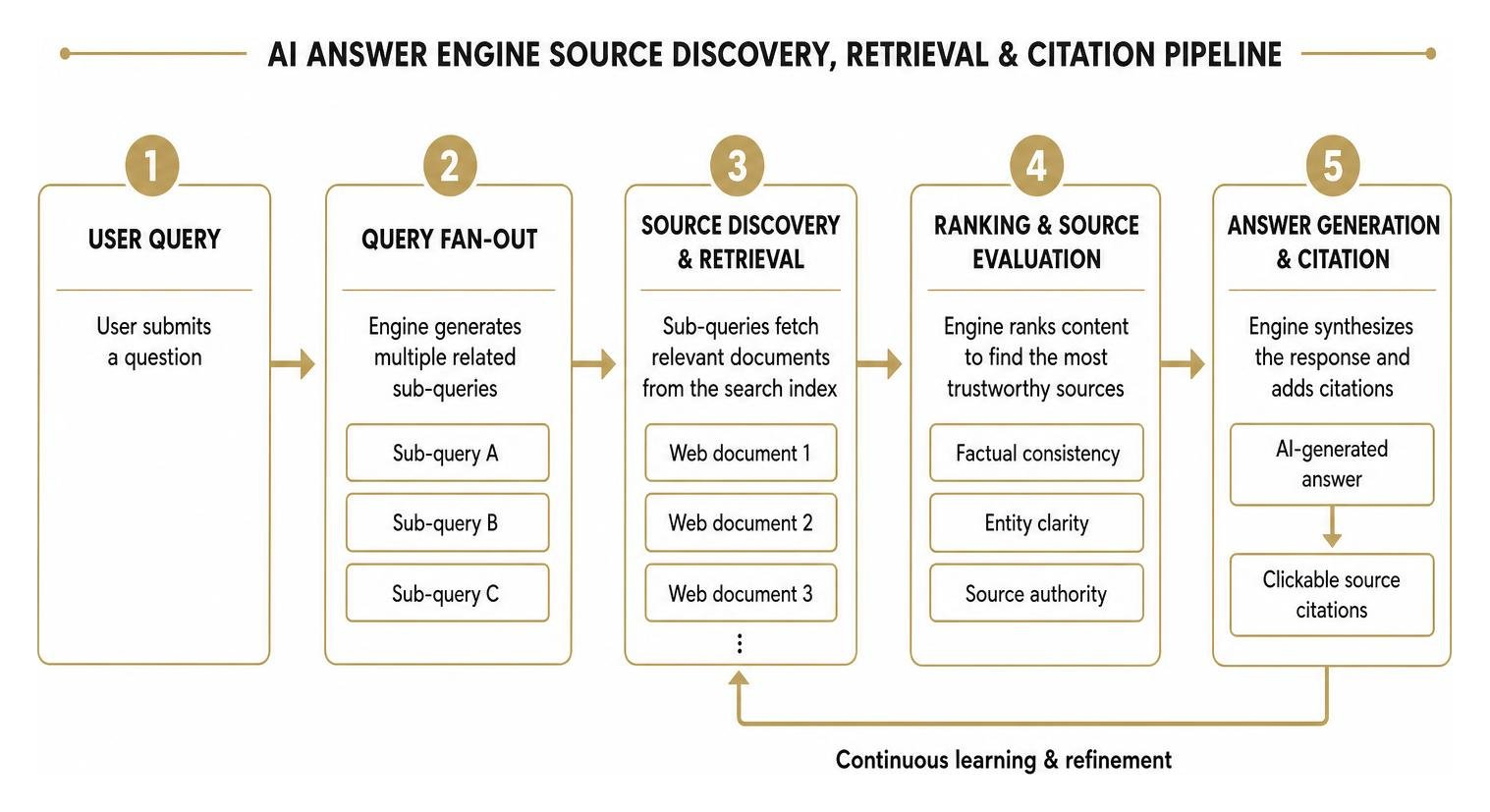
These platforms utilize Retrieval-Augmented Generation (RAG) to ground their language models in real-time, accurate web data. When a user submits an inquiry, the system executes query fan-out—generating multiple related sub-queries to fetch relevant web documents from a search index. The engine then ranks the retrieved content based on factual consistency, brand entity clarity, and source authority before synthesizing the final response and generating clickable attribution links.
The Core Signals AI Engines Use to Decide Citations
AI engines rely on specific structural and contextual signals to determine whether your content is authoritative enough to cite. Establishing clear digital signals makes it easier for retrieval algorithms to identify your brand as an industry authority.
- Schema Markup Depth: Rich structured data provides unambiguous context about your organization, authors, and page topics.
- Entity Recognition: Consistent naming conventions, social profile references, and clear digital associations establish your brand’s presence in knowledge graphs.
- Topical Depth: Comprehensive coverage of core topics through interconnected pillar and cluster content proves domain authority.
- Recency and Freshness Signals: Updated timestamps, current data, and accurate facts signal that your information remains reliable, which is crucial because fresh insights often outweigh older authority in retrieval pipelines.
Learning how algorithms process these layers is essential, and applying modern AI crawler optimization tips ensures your site remains accessible and understandable to automated systems.
Auditing Your Architecture with the SEE Framework
To evaluate and improve a website’s readiness for AI-driven search, we utilize the SEE Framework. This model examines three essential architectural layers:
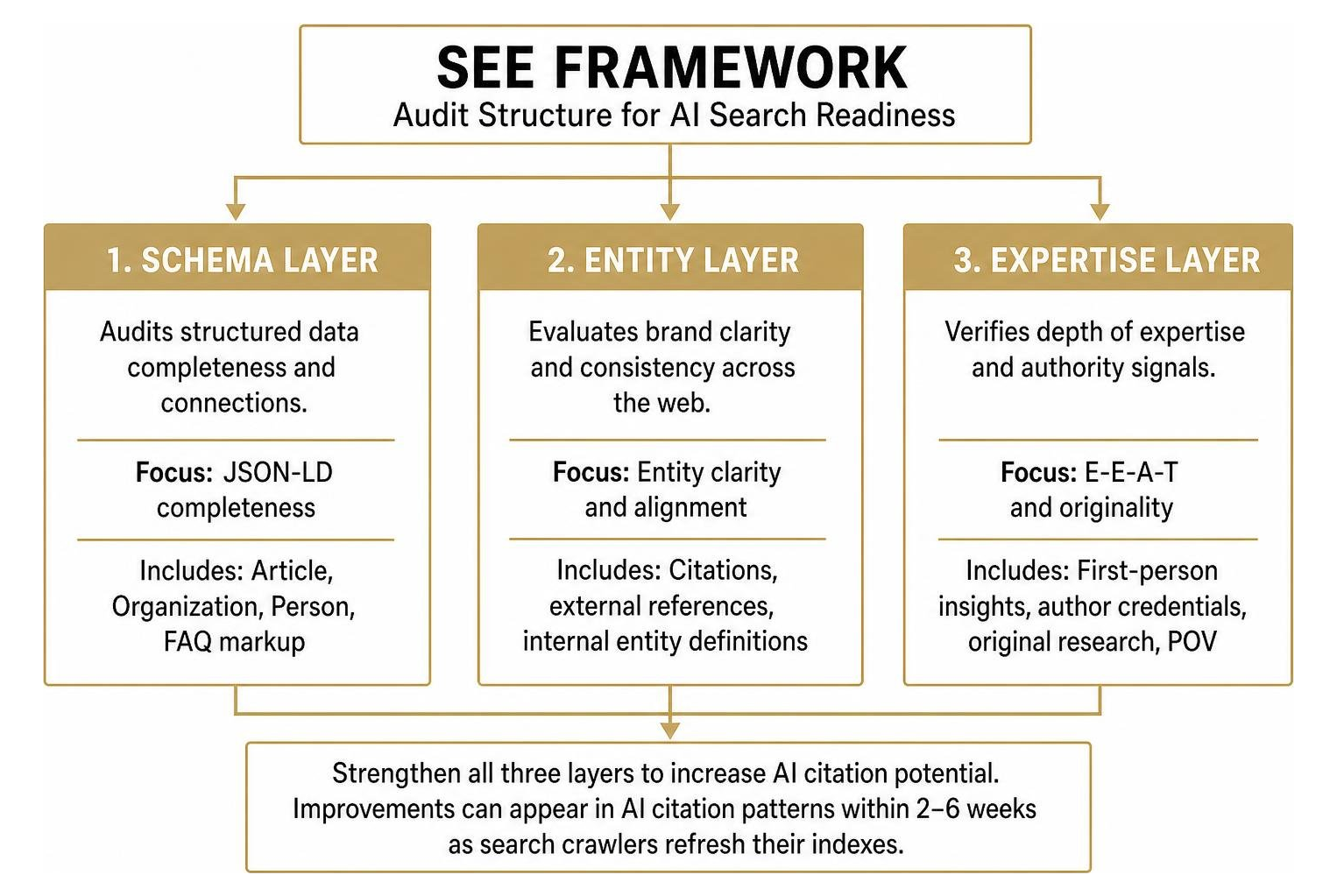
- Schema Layer: Audits the completeness of structured data (JSON-LD), ensuring Article, Organization, Person, and FAQ markup are correctly connected.
- Entity Layer: Evaluates brand clarity across the web, aligning citations, external references, and internal entity definitions.
- Expertise Layer: Verifies first-person experiential insights, author credentials, original research, and clear points of view.
When businesses address foundational gaps across these areas, schema-layer fixes and structural improvements often appear in AI citation patterns within 2 to 6 weeks as search crawlers refresh their indexes.
Technical and Content Playbook for AI Visibility
Achieving sustained visibility across AI-powered search requires both a sound technical foundation and content crafted for effortless machine extraction.
Technical Requirements to Optimize for Generative Search
AI crawlers must be able to access, render, and interpret your pages without technical roadblocks. Implementing practical techniques to stand out in AI Overviews helps ensure your technical infrastructure supports generative discovery.
- Server-Rendered HTML: Ensure critical text and structured data are delivered in server-rendered HTML rather than relying solely on client-side JavaScript execution.
- Robots Accessibility: Verify that robots.txt directives allow legitimate AI search crawlers to access your informational resources.
- Canonical Integrity: Maintain clean, canonical URLs to avoid fragmenting entity signals across duplicate pages.
- Comprehensive JSON-LD: Implement rich schema markup across every page to provide structured context directly in the page header.
- Accessible DOM Tree: Use clean semantic HTML (such as
,,, and) so browser agents and parsers can navigate the document structure effortlessly.
Structuring Content to Optimize for Generative Search Citations
The way your text is written directly influences how easily an AI model can quote it. Research shows that over 40% of AI citations come from factual comparison content, structured data tables, and direct definitions.
- Lead with Direct Answers: Place concise, 40-to-80-word answer summaries immediately beneath major question headings.
- Increase Factual Density: Incorporate specific numbers, verifiable dates, named entities, and clear metrics rather than vague descriptions.
- Publish Comparison Tables: Use structured tables when contrasting services, products, or methodologies to facilitate quick extraction.
- Share First-Hand Experience: Include original insights, practical observations, and non-commodity viewpoints that cannot be replicated by generic summaries.
- Write Self-Contained Sentences: Ensure individual paragraphs can stand alone as complete, coherent thoughts when extracted by RAG pipelines.
Generative AI Search Myths to Ignore
As generative discovery evolves, several misconceptions have emerged regarding what is required for visibility:
- The llms.txt File Requirement: Creating an
llms.txtfile is not a verified ranking factor for major search engines like Google. While it can serve as a lightweight pointer for certain developer tools, major search engines index your standard HTML and structured data. - Artificial Content Chunking: Breaking articles into unnatural, robotic micro-fragments harms human readability without improving AI comprehension. Write clear, logically flowing content with natural headings.
- Over-Optimizing with Keyword Manipulation: Repeating exact-match search phrases is ineffective in semantic vector search. AI models focus on meaning, context, and topical completeness.
- Relying Exclusively on Schema: While structured data aids machine readability, engines evaluate the entire page’s topical substance, original insights, and user experience.
Measuring Visibility and Auditing Readiness in AI Engines
Tracking generative search performance requires moving beyond traditional keyword tracking tools. Because generative answers are dynamic and context-dependent, measuring success involves tracking citation share, referral patterns, and brand authority.

Key metrics to monitor include:
- Generative AI Search Console Metrics: Review dedicated generative AI performance reports to track impressions and click-through rates from AI Overviews.
- AI Referral Traffic: Segment analytics to track traffic arriving directly from conversational engines and AI platforms.
- Brand Citation Frequency: Regularly monitor whether your brand is cited as a recommended solution for key industry inquiries.
- Attributed Source Sentiment: Evaluate how AI models describe your organization’s core strengths, services, and reputation.
Reviewing these metrics provides strategic AI search optimization insights that allow you to continually refine your technical assets and content strategy.
Frequently Asked Questions About Generative Search Optimization
Is traditional SEO still relevant for generative AI search?
Yes. Generative search features rely directly on the underlying search engine index and its core ranking and quality systems. Traditional SEO provides the crawlability, indexing, and technical foundation that allows AI engines to discover your content. With approximately 60% overlap in core signals, strong foundational SEO remains essential for generative visibility.
How long does it take for GEO optimizations to show results?
Technical improvements, such as adding detailed JSON-LD schema or fixing server-side rendering issues, are often detected by search crawlers within days. Changes in citation frequency and AI-generated answers typically become noticeable within 2 to 6 weeks as search engines refresh their retrieval indexes and update model data grounding.
Do I need to create special files like llms.txt to appear in AI search?
No. Special files such as llms.txt are not required to appear in major AI search experiences like Google AI Overviews. AI search platforms discover and evaluate content through standard web crawling, semantic HTML, and structured schema markup. Focusing on crawlable pages, clear content structure, and robust schema delivers the greatest impact.
Conclusion
The shift toward generative search represents a fundamental evolution in how audiences find and trust information. Modern search engines are no longer just indexing links—they are synthesizing answers, evaluating entity credibility, and directly citing the most authoritative voices in every field.
Establishing your brand’s authority within these AI ecosystems requires a structured, data-driven approach focused on building clear digital signals, technical machine readability, and undeniable topical depth. At Upskale Marketing, an Orlando, Florida AI optimization agency, we help businesses build the relevance and authority required to become the top recommendation across major AI platforms through expert generative AI optimization services.
To see where your business stands in the new search landscape, schedule a free AI evaluation with Upskale Marketing today. Our team will provide a clear, data-driven assessment of your current AI visibility and highlight practical opportunities to expand your digital reach.