


How to Evaluate AI Systems for Business Results
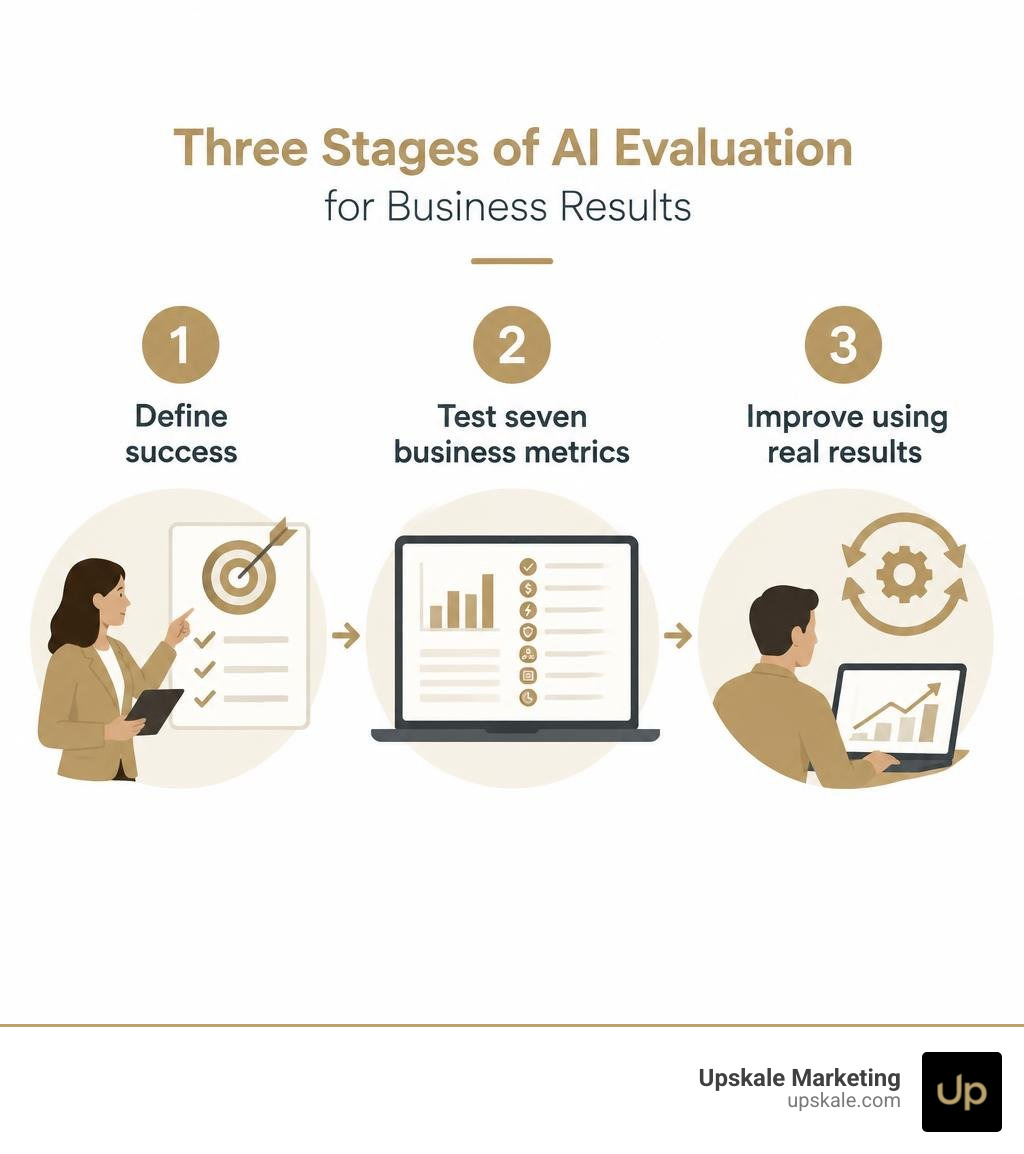
AI evaluation for businesses starts with a real task, not a model score. Choose a workflow your team cares about, test the AI on examples drawn from that work, and set clear rules for what counts as success. Then measure seven things: task completion, cost per successful task, response speed, safety, multi-step workflow performance, hallucinations, and reliability over time.
A strong demo may still fail on messy customer requests or changing data. Before rollout, test common cases and edge cases, have people review high-risk results, and keep checking performance after launch.
I’m Scott Brazdo, MBA, founder of Upskale Marketing, where I draw on more than 30 years of marketing and brand experience to help businesses earn visibility in AI search. That business-outcome focus also shapes my approach to AI evaluation for businesses: define success first, then measure whether the system delivers it.
Why AI Evaluation for Businesses Is Essential in 2026
Over one million businesses worldwide are actively deploying generative models and autonomous agents to automate processes and unlock operational efficiencies. Yet, despite massive enthusiasm, industry data reveals that only 28% of corporate AI initiatives fully meet their expected business ROI, while nearly 20% fail outright.
The primary cause behind this failure rate is the non-deterministic nature of modern language models. Traditional software functions predictably: give it input A, and it returns output B every single time. Large language models (LLMs) operate on probabilistic reasoning, meaning the exact same prompt can yield subtly different or completely ungrounded answers across sessions.
Relying on public benchmarks like MMLU or SuperGLUE to guide commercial deployment decisions is no longer practical. Standardized academic benchmarks suffer from severe data contamination—often artificially inflating model scores by 10% to 20%—and evaluate generic academic reasoning rather than enterprise realities. Deploying an AI engine requires establishing rigorous internal evaluation processes, much like learning how to master generative engine optimization requires looking beyond legacy search engine algorithms.
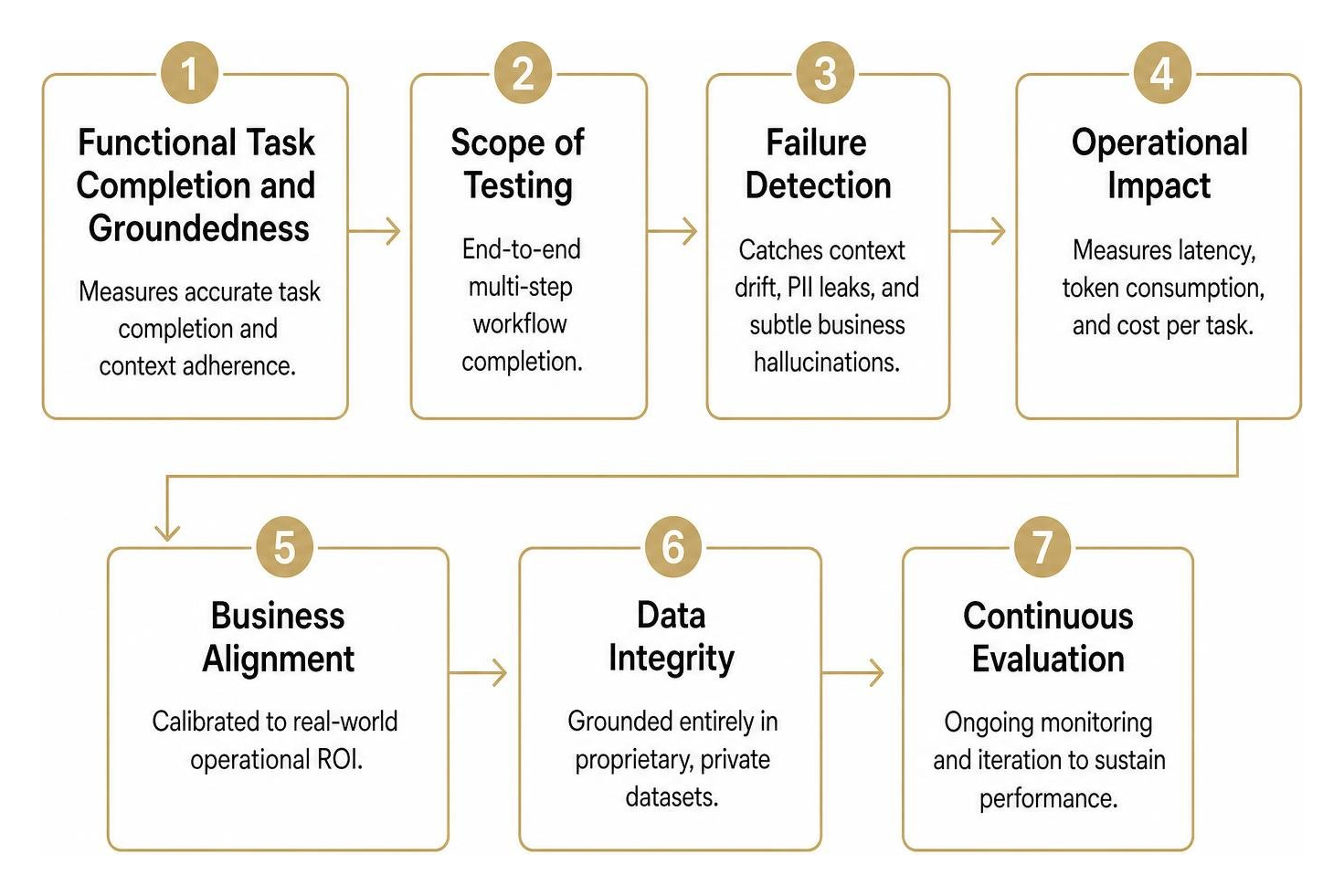
| Metric Dimension | Public Academic Benchmarks | Private In-Domain Evaluations |
|---|---|---|
| Data Integrity | High risk of training data contamination | Grounded entirely in proprietary, private datasets |
| Scope of Testing | Isolated trivia, general coding, standard math | End-to-end multi-step workflow completion |
| Failure Detection | Standardized accuracy scores only | Catches context drift, PII leaks, and subtle business hallucinations |
| Operational Impact | Evaluates raw output capabilities | Measures latency, token consumption, and cost per task |
| Business Alignment | Zero contextual relevance to corporate KPIs | Calibrated to real-world operational ROI |
The Gap Between Pilot Demos and Production ROI
A common organizational trap is evaluating AI purely on early prototype “vibes.” An artificial intelligence tool might perform flawlessly on twenty curated demo prompts, only to collapse under the weight of production volume. Real customers submit ambiguous instructions, incomplete operational inputs, and unexpected edge cases that prompt templates fail to accommodate.
Without structured evaluation, small edge-case failures compound rapidly into severe operational debt. Autonomous tools can get trapped in recursive retry loops, causing massive token cost spikes and severe system latency. Deploying an AI initiative without continuous evaluation creates significant brand risk—just as executing winning generative search optimization strategies requires deep verification of digital signals and brand presence across generative engines.
Translating Business Objectives into Measurable Criteria
To evaluate AI systems accurately, organizations must translate high-level business goals into concrete technical parameters. That transition starts by creating a “golden dataset”—a version-controlled repository of 50 to 500 domain-specific examples representing ideal operational inputs, edge cases, adversarial prompts, and expected outputs.
Building an effective golden set requires a cross-functional discipline:
- Domain Experts: Define the exact business outcomes, brand tone, acceptable answer variance, and compliance requirements.
- Engineering Teams: Construct automated evaluation harnesses, wire up observability telemetry, and manage prompt iteration suites.
- Leadership: Establish clear operational key performance indicators (KPIs), allowable error margins, and unit economics targets.
Establishing a domain-specific error taxonomy ensures that every failure is categorized—distinguishing a simple stylistic error from a critical factual hallucination or privacy violation.
7 Core Metrics for Assessing Enterprise AI Performance

Assessing an enterprise AI system requires a multidimensional measurement framework. Focusing on a single score blinds teams to critical operational flaws. These seven core metrics provide a complete assessment of AI performance.
1. Functional Task Completion and Groundedness
Functional task completion measures whether an AI model accurately solves the exact business problem it was assigned. In structured automation tasks, this can be measured via exact-match accuracy or deterministic parsing rules. However, in generative tasks such as document synthesis, customer service interactions, or internal question-answering, groundedness and faithfulness scoring are essential.
Groundedness evaluates whether the generated output is supported strictly by the provided reference context or enterprise knowledge base. If an AI creates an eloquent response using facts absent from the approved internal context, the output fails context adherence. Reference-free evaluation frameworks allow organizations to score answer relevance and factual consistency automatically against custom business rubrics without requiring a predefined single ground truth.
2. Cost Per Successful Task
Tracking cost purely by “dollars per million tokens” is one of the most misleading practices in enterprise AI development. A cheaper model that exhibits a high failure rate frequently costs significantly more in production due to the automated retries, multi-turn error correction loops, and human oversight required to fix mistakes.
Organizations should calculate their cost per successful task by dividing total infrastructure and token cost by the total number of successfully executed tasks. This metric factors in token utilization efficiency, context window overhead, and the financial impact of automated retry policies. If a lightweight model costs half as much per token but fails 30% of its runs, an advanced reasoning model that succeeds on the first attempt 98% of the time is more cost-effective.
3. Operational Latency and Tail Distributions
While mean or median (p50) response time provides a baseline view of performance, it conceals the severe latency spikes that destroy user experience. In production environments, tail latency—specifically the 95th (p95) and 99th (p99) percentiles—dictates whether an application remains viable.
If an internal workflow assistant answers in 800 milliseconds for half its requests but takes 12 seconds on the remaining queries due to complex tool calls or large context retrieval, users will abandon the system. AI evaluations must benchmark latency under simulated concurrent production loads to identify throughput bottlenecks before full-scale deployment.
4. Safety, Red Teaming, and Governance Compliance
Enterprise deployments demand rigorous security and compliance boundaries. Evaluations must include active adversarial testing (red teaming) to measure resistance against common LLM vulnerabilities, including prompt injection, jailbreaking attempts, and system prompt leakage.
Safety metrics must measure:
- Personally Identifiable Information (PII) Leakage: Verifying that models refuse to regurgitate sensitive customer or corporate data.
- Policy Adherence: Evaluating compliance against internal brand safety rules and industry governance standards like NIST AI RMF.
- Auditability: Ensuring every model response, retrieved context snippet, and automated decision leaves an immutable audit trail for governance verification.
5. Multi-Step Workflow and Agentic Execution
As businesses shift toward autonomous agents that carry out complex, multi-step actions across various software systems, evaluating static single-turn responses is insufficient. Agentic evaluation requires grading the entire operational trajectory.
Key agentic performance indicators include:
- Tool-Calling Precision: Did the agent call the correct API with properly formatted parameters?
- Action Completion Rate: Did the agent successfully update the external CRM, send the intended notification, and close the loop without dropping intermediate data?
- Failure Recovery: When an API call returns a 404 or an unexpected error, can the agent self-correct its execution path rather than halting or repeating the broken call indefinitely?
6. Calibration and Hallucination Frequency
Expected Calibration Error (ECE) evaluates how well an AI system’s internal confidence aligns with its actual accuracy. A well-calibrated system assigns high confidence to correct answers and low confidence to uncertain answers, allowing organizations to route low-confidence tasks to human reviewers automatically.
Tracking domain-specific hallucination frequency measures how often a system generates plausible-sounding falsehoods when operating over company data. Uncalibrated models that project maximum certainty while delivering entirely fabricated numbers present an unacceptable risk to enterprise operations.
7. Drift Detection and Long-Term Reliability
AI systems are not static software; commercial foundational models undergo frequent provider updates that can silently degrade prompt performance, shift output styling, or break API integrations.
Long-term reliability evaluation involves running automated weekly regression benchmarks across your in-domain golden set. Continuous drift monitoring tracks whether accuracy, output length, context retention, or safety guardrails fluctuate over time, ensuring system degradation is identified and remediated before it impacts end users.
How to Build an End-to-End AI Evaluation Framework
Building a continuous evaluation pipeline requires integrating automated evaluation gates into your standard deployment workflow. Rather than treating validation as a one-time pre-launch sign-off, leading teams establish a closed-loop data flywheel where real-world production logs continuously update and expand internal test suites.
This disciplined approach to monitoring and refining digital relevance is identical to how brands implement sophisticated enterprise AI search techniques to protect and expand their market footprint.

Designing Custom AI Evaluation for Businesses and Startups
Small and mid-sized enterprises (SMBs) do not need massive machine learning engineering teams to run world-class evaluations. By focusing on targeted, high-impact workflows, smaller teams can achieve production reliability with minimal overhead:
- Prioritize High-Frequency Workflows: Focus evaluation on high-volume, low-risk customer communication or internal document processing tasks.
- Use Small Model Evaluators: Deploy compact, specialized small language models (SLMs) to grade routine context adherence and relevance, saving larger frontier models for complex edge cases.
- Implement Multi-Model Juries: For ambiguous tasks, use two distinct models to evaluate the output, calling in a human reviewer only when the automated graders disagree.
- Adopt a Fail-Fast Pilot Approach: Run low-risk experiments with real-world inputs to measure actual ROI before committing to broader organizational rollouts.
Overcoming Pitfalls in AI Evaluation for Businesses
When designing an evaluation framework, organizations often fall victim to several common traps:
- Self-Preference Bias: Using the same base LLM to both generate an answer and grade its quality can produce inflated pass rates. Always use alternative model architectures or fine-tuned evaluation engines to grade generation tasks.
- Overfitting to Small Test Suites: If engineering teams optimize prompts exclusively against a fixed list of ten test queries, the system will fail when presented with real-world variation. Golden datasets must be regularly refreshed with masked production edge cases.
- Ignoring the Human Loop: Automated grading provides scale, but periodic human-in-the-loop validation is indispensable for calibrating the automated judges and catching subtle cultural nuances.
Frequently Asked Questions About AI Evaluation
How do you evaluate non-deterministic AI outputs without a single right answer?
Evaluating generative AI without a single ground truth relies on rubric-based reference-free scoring. Instead of checking for an exact word match, automated evaluators assess whether the response meets specific criteria, such as answering the core query, adhering strictly to provided reference documentation, maintaining professional tone, and excluding unverified claims. Applying these structured verification models mirrors the analytical rigor found in actionable AI search optimization insights.
What is the difference between LLM-as-a-judge and small language model evaluators?
LLM-as-a-judge uses large, frontier general-purpose models prompted to act as impartial evaluators based on detailed rubrics. This method provides maximum flexibility when testing new, evolving criteria. Small language model (SLM) evaluators are compact models specifically trained or fine-tuned to score a single dimension, such as context adherence or tone. SLM evaluators execute significantly faster and at a fraction of the inference cost, making them ideal for high-volume automated regression testing once quality rubrics are stabilized.
How can small and medium businesses conduct AI evaluations with limited resources?
Small and medium-sized businesses can establish robust AI evaluations by curating a practical golden dataset of 50 to 100 actual customer interactions or document processing workflows. By testing candidate prompts against this dataset and using open-source evaluation harnesses or affordable small-model graders, SMBs can systematically catch errors, track unit costs, and verify reliability without investing in complex enterprise infrastructure.
Conclusion
Building a successful artificial intelligence capability requires moving beyond surface-level demos and establishing structured, continuous quality assurance. By measuring task completion, cost per successful task, operational latency, governance compliance, agentic execution, calibration, and long-term drift, organizations can protect their operational integrity, achieve clear ROI, and scale automation with complete confidence.
At Upskale Marketing, we combine deep marketing strategy with specialized expertise in Answer Engine Optimization to help forward-thinking brands build authority, relevance, and top-tier visibility across AI discovery platforms.
If you are ready to understand how your brand is perceived by generative answer engines and want to identify clear opportunities for growth, discover how our advanced AI optimization strategies can elevate your business. Schedule a free, data-driven AI evaluation with our team today to uncover your current visibility standing and build a sustainable path to market leadership.