

Turn AI Engine Mentions Into High-Converting Organic Search Traffic
What Defines Brand Authority in AI Search vs Traditional SEO?
Brands earn authority in AI search by making themselves identifiable, verifiable, and consistently referenced across the open web. The most direct AI search brand authority tips are to implement organization and person schema so engines can resolve your entity, secure unlinked third-party mentions from trusted industry sources, and publish expert-attributed content with original data. These signals help generative engines recognize your business as a credible source and cite it in synthesized answers.
For more than two decades, search engine optimization operated on a relatively straightforward formula: build backlinks, target keywords, and elevate your domain rating. In traditional search, search engines relied heavily on the hyperlink graph to calculate trust and PageRank. If reputable sites pointed links to your pages, crawlers assumed your site deserved high placement.
AI search works through an entirely different lens. Large language models (LLMs) and retrieval-augmented generation (RAG) systems evaluate brand authority based on semantic comprehension, entity resolution, and contextual consensus. Instead of simply tallying incoming hyperlinks, generative engines parse text, video transcripts, images, and structured datasets to understand who you are, what specific problems you solve, and why third parties trust your expertise.
Modern search behavior has changed dramatically as well. Roughly 48% of Google searches in 2026 feature AI Overviews, and approximately 93% of AI Mode sessions end without a click to an external site. Because users receive syntheses directly inside the interface, traditional rank tracking no longer tells the whole story. However, being referenced inside an AI Overview yields roughly an extra 35% lift in organic clicks from high-intent users seeking deeper verification.
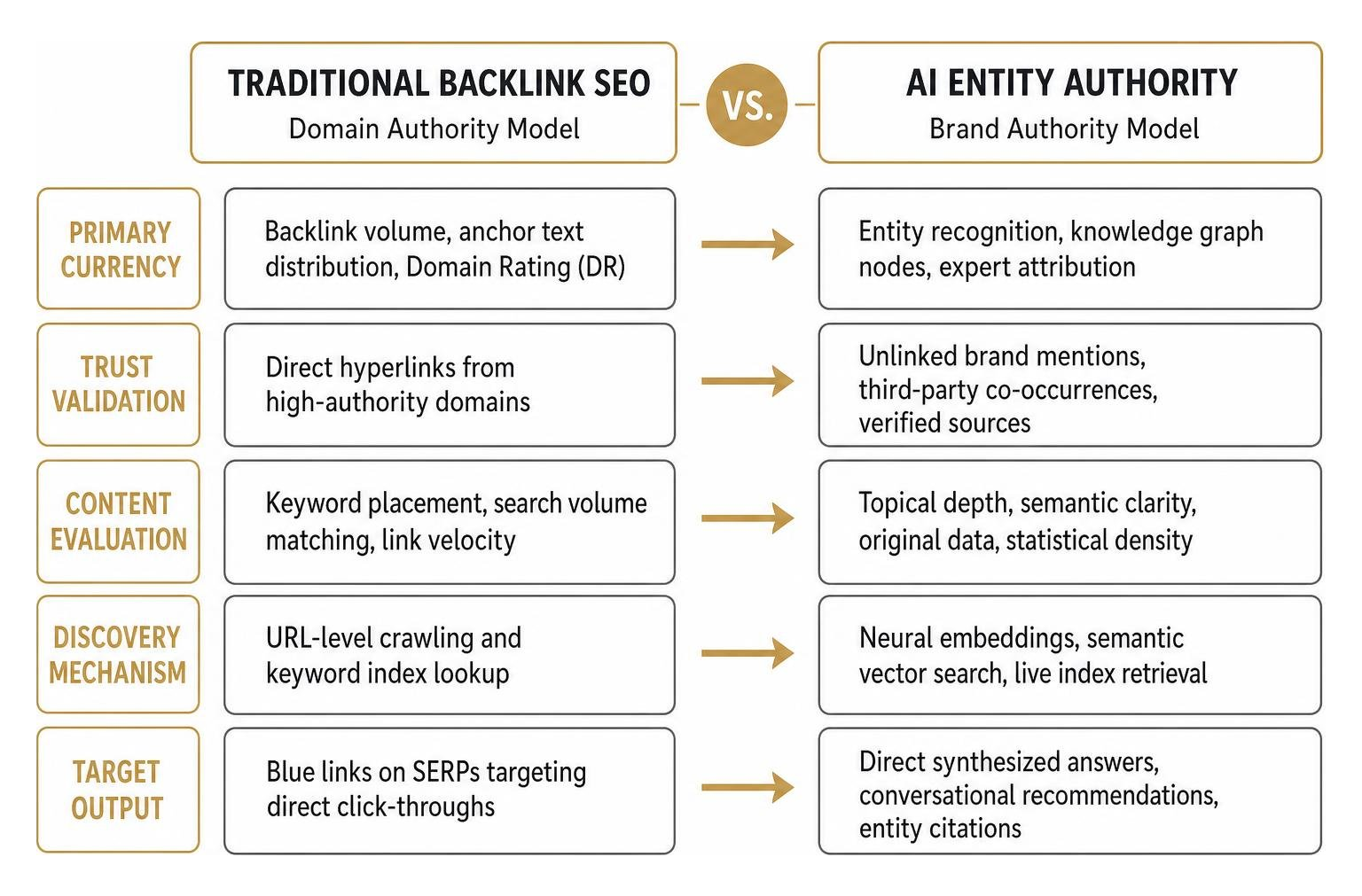
Understanding the difference between traditional SEO metrics and AI-driven authority helps clarify where modern marketing resources should go. Incorporating a forward-looking approach to AI SEO ensures your brand does not get left behind as answer engines replace legacy link lists.
| Evaluation Metric | Traditional SEO Domain Authority | AI Search Brand Authority |
|---|---|---|
| Primary Currency | Backlink volume, anchor text distribution, Domain Rating (DR) | Entity recognition, knowledge graph nodes, expert attribution |
| Trust Validation | Direct hyperlinks from high-authority domains | Unlinked brand mentions, third-party co-occurrences, verified sources |
| Content Evaluation | Keyword placement, search volume matching, link velocity | Topical depth, semantic clarity, original data, statistical density |
| Discovery Mechanism | URL-level crawling and keyword index lookup | Neural embeddings, semantic vector search, live index retrieval |
| Target Output | Blue links on SERPs targeting direct click-throughs | Direct synthesized answers, conversational recommendations, entity citations |
Traditional algorithms ask: “Does this URL have enough domain authority to rank for this keyword string?” AI search engines ask: “Is this organization an established, verifiable authority on this topic across the wider web?”
The 4-Tier Framework and Proven AI Search Brand Authority Tips
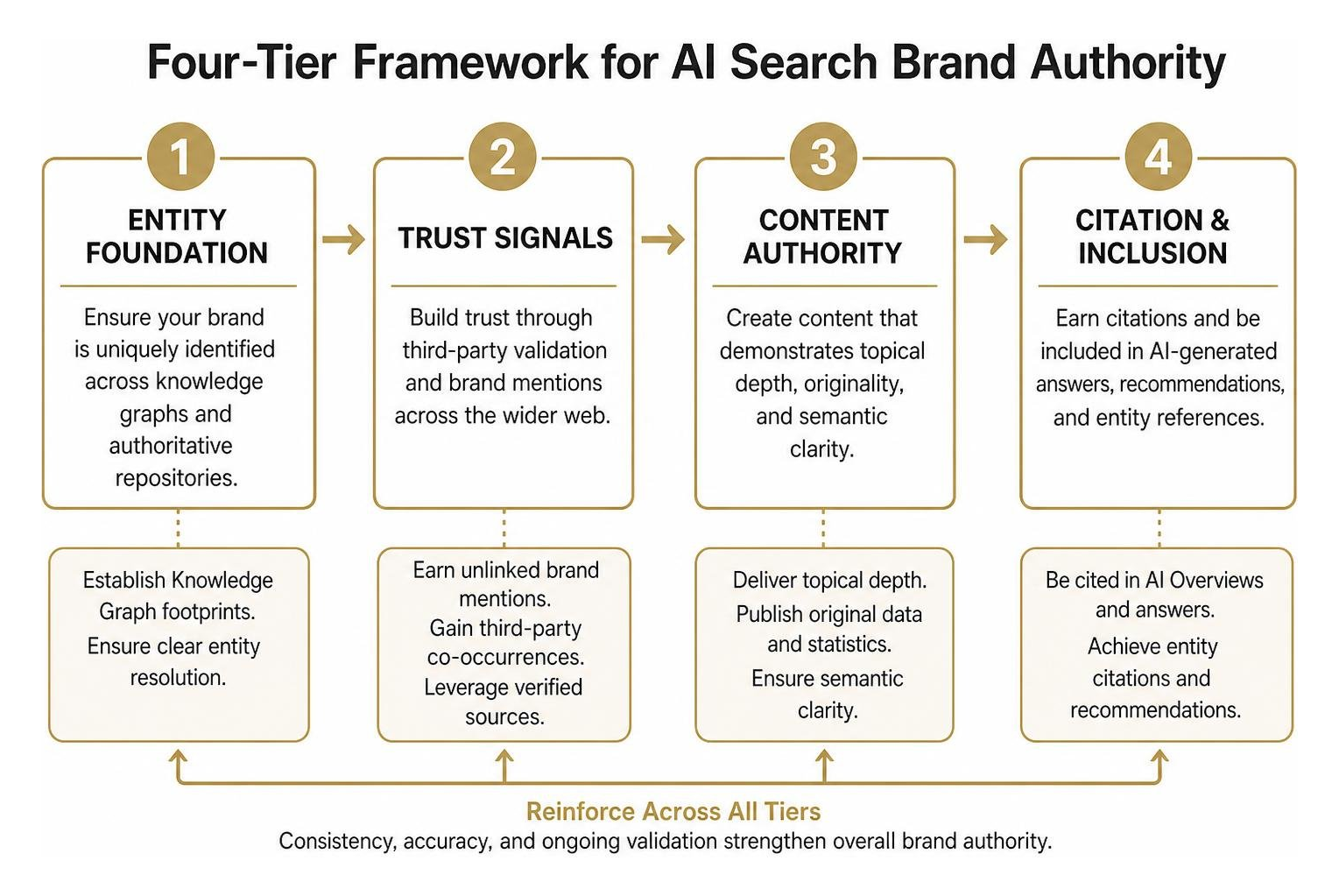
Generative search engines evaluate brand trust through a multi-layered signal architecture. When an AI system compiles an answer, it pulls from verified training data, live web indices, and semantic entity graphs. To consistently earn citations, businesses must build authority systematically across four foundational tiers.
Proven AI Search Brand Authority Tips for Entity Building and Schema
Entity resolution is the process an AI model uses to distinguish your specific business from any other company with a similar name, linking your organization to a clear node in a knowledge graph. If an AI cannot unambiguously identify your brand, it will rarely recommend you.
- Establish Knowledge Graph Footprints: Ensure your business is documented across authoritative public repositories such as Wikidata and industry-specific directories. When an entity exists within knowledge bases, AI systems can cross-reference foundational facts about your organization.
- Deploy Comprehensive Organization Schema: Implement
Organizationstructured data across your entire site. Populate properties such aslegalName,foundingDate,contactPoint,address, anddescriptionto provide explicit machine-readable context. - Leverage sameAs Arrays: Use the
sameAsschema property to connect your website directly to your official social media profiles, business registries, and verified executive biographies. This bridges external digital footprints into a single verified identity. - Secure Google Knowledge Panels: Claim and optimize your entity profile within search engines to ensure foundational details like headquarters locations and executive leadership are synchronized across all digital nodes.
Earning High-Impact Third-Party Mentions and Unlinked Citations
In traditional SEO, an unlinked mention was often viewed as a lost backlink opportunity. In AI search, unlinked citations carry immense weight. AI models ingest vast quantities of unstructured web data, evaluating semantic co-occurrence patterns—noting which brands are consistently discussed alongside specific industry solutions.
In fact, brand mentions sourced from third-party pages account for roughly 85% of AI search signals. LLMs place significant trust in independent validation rather than relying solely on self-published marketing claims.
Brands can increase their generative engine visibility by winning citation visibility through brand mentions on analyst websites, industry review hubs, third-party podcasts, and editorial publications. When reputable third parties mention your brand in connection with specific subject matter, AI models absorb that association into their neural weights and retrieval mechanisms.
Building Expert Attribution, Author Credentials, and E-E-A-T Signals
AI search engines prioritize content backed by verifiable human experience, expertise, authoritativeness, and trustworthiness (E-E-A-T). Anonymous or generic corporate blog posts carry far less weight in generative retrieval pipelines.
- Named Expert Authorship: Replace generic “Admin” or corporate bylines with detailed profiles of subject-matter experts who possess verifiable industry credentials.
- Person Structured Data: Enrich author biography pages with
Personschema markup, integrating links to their publications, verified social profiles, and educational background. - Verified Contributors and Peer Reviewers: When publishing technical or research-backed guides, include a “Reviewed by” line featuring an independent credentialed specialist, reinforced with structured metadata.
- Original Data and First-Party Research: AI engines prioritize unique data points. Statistics-rich content demonstrates an approximate +22% lift in AI search visibility because models frequently cite original facts, numbers, and survey findings to substantiate their direct answers.
Technical and Multimodal AI Search Brand Authority Tips for Maximum Reach
Modern AI search engines process information across multiple modalities—including text, images, voice queries, and video transcripts. Making your content accessible and computationally lightweight allows AI retrieval bots to ingest and cite your information effortlessly.
- Multimodal Embedding Optimization: Structure your multimedia assets with descriptive captions, contextual alt text, and semantic file names. Visual and audio assets should be accompanied by clear text explanations to align with multimodal neural embeddings.
- Publish Full Video and Audio Transcripts: AI crawlers routinely parse YouTube transcripts and podcast notes to source conversational answers. Providing synchronized transcripts ensures your spoken thought leadership becomes indexable text.
- Optimize Crawler Accessibility and Page Speed: Verify that critical AI user-agents (such as GPTBot and PerplexityBot) can freely access your informational pages without encountering aggressive rate limits or blocking rules in your
robots.txtconfiguration. Maintain a fast Time to First Byte (TTFB) and clean semantic HTML to facilitate efficient parsing. - Semantic Content Chunking: Organize articles with logical H2 and H3 question-based subheadings, bulleted summaries, and concise definition blocks. This modular format allows generative engines to extract and cite distinct answers cleanly.
Navigating Platform-Specific Nuances Across Leading AI Engines
Not all AI answer engines retrieve information in the same way. The cross-platform domain citation overlap between ChatGPT and Perplexity is only around 11%. This low overlap highlights that different platforms rely on distinct data pipelines, index sources, and retrieval algorithms.
Reviewing actionable AI search optimization insights helps marketing leaders understand the unique retrieval dynamics of each major AI platform.

ChatGPT and Wikipedia Grounding
OpenAI’s ChatGPT leans heavily on foundational pre-training datasets alongside real-time web browsing capabilities.
- Training Data Dominance: ChatGPT places high value on stable, highly vetted sources. Neutral, encyclopedic documentation like Wikipedia and academic resources carries substantial weight during answer generation.
- Brand Entity Memory: ChatGPT prioritizes consistent brand descriptions across historical datasets, meaning long-term public authority directly influences how the model describes your organization in open conversational prompts.
Perplexity, Microsoft Copilot, and Live Web Indexing
Perplexity and Microsoft Copilot operate primarily as real-time search synthesis engines, pulling directly from active web indices.
- Live Index Freshness: Perplexity and Copilot heavily prioritize current information. Recent articles, news updates, and newly indexed technical guides receive rapid citation.
- Bing Index Reliance: Copilot and Perplexity lean heavily on Bing’s real-time web index. Strong crawlability and accurate XML sitemap submissions within Bing Webmaster Tools are essential for visibility.
- Direct-Answer Formatting: Perplexity favors concise, definitive answers positioned immediately beneath clear headings, allowing its retrieval pipeline to extract snippets directly for citations.
Google AI Overviews and Gemini Knowledge Integration
Google AI Overviews and Gemini utilize Google’s Knowledge Graph combined with advanced multimodal models.
- Knowledge Graph Synergy: Gemini references Google’s massive repository of verified entities. Having synchronized entity attributes across official properties is critical.
- Strict E-E-A-T Adherence: Google’s generative layers heavily prioritize credentialed authors, academic references, and authoritative consensus.
- Topical Authority Over Raw Domain Power: Around 88% of AI Mode citations do not appear in the top 10 standard organic search results for the exact same query. Highly focused, deep topical guides from niche publishers regularly outrank high-authority legacy domains inside AI Overviews.
Critical AI Brand Authority Mistakes and Common Pitfalls
Building brand authority for AI search requires a methodical strategy. Avoiding these widespread mistakes helps ensure your digital signals remain clear, trusted, and easily read by generative models:
- Inconsistent Name, Address, and Profile (NAP) Data: Altering your company name, mission descriptions, or executive details across different web channels creates confusion for entity resolution algorithms, preventing AI models from confidently linking your brand to specific topics.
- Cosmetic Freshness Updates: Simply changing the publication date at the top of an old blog post without updating the substance does not fool AI search engines. LLMs evaluate semantic changes and substantive factual updates; purely cosmetic date edits can result in your content being deprioritized.
- Gating Core Educational Content: Placing your best research, industry explainers, and foundational guides behind PDF downloads or email capture forms prevents AI search crawlers from reading and citing that information.
- Over-Reliance on Thin, Repetitive Listicles: Generic summaries generated without real-world expertise fail to satisfy AI search systems. AI engines look for deep explanations that address the deeper intent behind a user’s question rather than surface-level keyword repetitions.
- Neglecting Structured Data Implementation: Failing to mark up your core entity details, articles, and leadership profiles leaves AI retrieval bots to guess your context rather than parsing direct, structured facts.
How to Audit and Measure AI Search Brand Visibility
Because AI search sessions often result in zero clicks on traditional SERPs, measuring brand visibility requires tracking new, generative-focused metrics rather than relying solely on keyword rankings and raw page impressions.

A comprehensive AI search brand authority audit should track the following performance indicators:
- Brand Mention Frequency: How often your company name or products are cited across generative responses for category-specific conversational queries.
- Citation Position and Prominence: Whether your brand is cited as the primary recommendation in the opening sentences of an AI synthesis or relegated to secondary source footnotes.
- Query Breadth: The range of related topics, long-tail questions, and use-case scenarios where AI models naturally reference your organization.
- Factual Citation Accuracy: Whether the AI engine accurately portrays your product features, core business value, leadership team, and operational locations.
- Category Benchmark Share: How your brand’s citation frequency compares against category averages across ChatGPT, Perplexity, Gemini, and Microsoft Copilot.
Frequently Asked Questions About AI Search Brand Authority
How is brand authority in AI search different from domain authority?
Domain authority in traditional SEO is heavily tied to the quantity and quality of backlinks pointing to a website’s domain. In contrast, AI search brand authority measures how effectively large language models recognize an organization as a trusted, verified entity within knowledge graphs, supported by third-party mentions, topical depth, and structured author expertise.
Do traditional backlinks still matter for AI engine citations?
Yes, but their role has shifted. Backlinks remain useful because they help search bots discover pages and signal general web popularity. However, AI engines treat backlinks primarily as a byproduct of brand credibility. Unlinked brand citations, analyst reviews, and co-occurrences across third-party media outlets now provide direct signals that fuel generative engine recommendations.
Can a smaller brand outrank legacy industry competitors in AI Overviews?
Yes. AI retrieval models focus on topical depth, original research, and clear entity attribution rather than domain age or backlink volume alone. In fact, approximately 88% of citations in AI Mode come from pages outside the top 10 standard organic search results. A focused, niche publisher that provides structured data, unique industry statistics, and deep answers can easily earn prominent citations over large, generalized competitors.
Conclusion
The shift toward AI-powered search is transforming how audiences find, evaluate, and choose businesses. With generative interfaces providing direct answers to nearly half of all search queries, building a recognizable, verified brand entity is no longer optional—it is the cornerstone of sustainable organic reach.
Achieving lasting visibility requires more than legacy keyword techniques. It calls for structured entity mapping, comprehensive expert attribution, original data publishing, and strategic optimization tailored to the unique retrieval behaviors of platforms like ChatGPT, Gemini, Perplexity, and Copilot. By putting these principles into practice, your business can build the credibility needed to earn top citations and turn AI engine mentions into high-converting organic engagement.
At Upskale Marketing, an Orlando, Florida AI optimization agency, we help business leaders and marketing executives navigate this shifting landscape through comprehensive, end-to-end AI Optimization. If you are ready to discover where your organization currently stands across leading generative engines, schedule a free AI evaluation with our team today. We will provide a straightforward, data-driven assessment of your brand’s AI search visibility, highlight entity gaps, and outline clear opportunities for measurable growth.