


ChatGPT SEO Tips for Clearer, More Useful Business Content
How AI Search Engines Evaluate and Rank Content
Effective ChatGPT SEO tips start with a disciplined workflow: develop an outline and draft sections separately, consider what customers want to learn and the specific phrases they search for, and use human editorial review to verify facts and demonstrate experience, expertise, authoritativeness and trustworthiness (E-E-A-T). These practices support content quality and clarity for both traditional search and AI answer engines, without guaranteeing rankings or citations.
AI-generated answers are changing how customers discover businesses. Modern search engines and AI assistants no longer rely solely on simple keyword matching. They consider what a person is asking, how fully content answers the question, and connections between businesses, products and topics. Understanding this shift is essential for any modern content strategy.
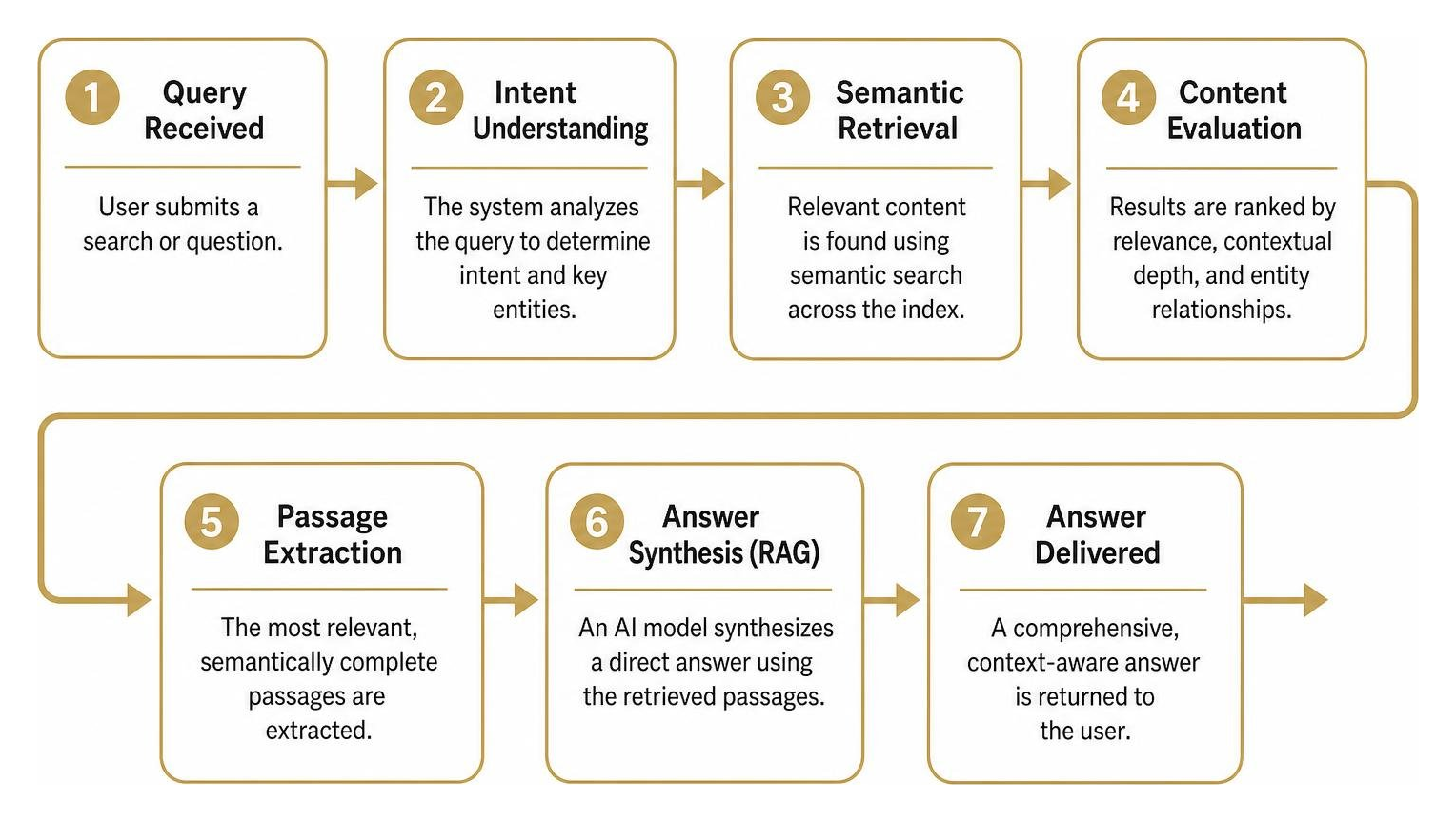
Retrieval-Augmented Generation and Semantic Search
Some AI answer systems use Retrieval-Augmented Generation (RAG): they retrieve information from an available source, such as a search index, and use it to help compose an answer. This supplements information learned during training. Retrieval does not necessarily use a live index, and the sources available vary by system.
Semantic search evaluates the underlying concepts within a page rather than counting exact-phrase repetitions. When optimizing for these systems, your copy must clearly define concepts, resolve related sub-questions, and maintain logical topical flow. To explore how machine learning models interpret web pages in greater detail, review our guide on AI search optimization insights.
Upskale Marketing combines decades of marketing expertise with a focus on AI-search optimization and Answer Engine Optimization, helping businesses work toward greater visibility on platforms such as ChatGPT, Gemini and Copilot.
Balancing Traditional Search Rankings with AI Citations
AI Optimization is the broader marketing discipline of helping AI search systems understand a business and represent it accurately. It brings together clear website content, accessible pages, consistent business information and evidence of relevant expertise. Answer Engine Optimization (AEO) focuses on making information useful for systems that answer customer questions directly. Generative Engine Optimization (GEO) focuses on how generative systems describe, mention and cite a business when composing answers. These approaches overlap; none guarantees a recommendation.
AI visibility is whether, where and how accurately a business appears in AI-generated answers. It matters when prospective customers use those answers to research services or compare options, even if they do not immediately click through to a website. Search-enabled AI systems can retrieve relevant passages and use them to compose answers, so clear explanations and verifiable business information help systems interpret what a company offers. Businesses can assess visibility through evidence such as relevant brand mentions, citations and the accuracy of service descriptions. This helps answer practical questions: Can customers discover us, is our business represented correctly, and where are the gaps?
Achieving strong visibility now requires a dual-track mindset:
- Traditional Organic Rankings: Working toward visibility in unpaid search results through an accessible, well-functioning website, useful content and relevant links from other websites.
- AI Answer Visibility: Helping AI systems understand and accurately represent your business when people ask relevant questions on platforms such as ChatGPT, Gemini and Copilot. A mention or citation is not guaranteed.
Traditional rankings and AI citations are different outcomes. Clear definitions, accurate information and structured data that describes a page can help search systems interpret its content, but their effects vary by platform and query. Considering both channels helps businesses support customers who use either search results or AI-generated answers.
Essential ChatGPT SEO Tips for Keyword Research and Topic Clustering
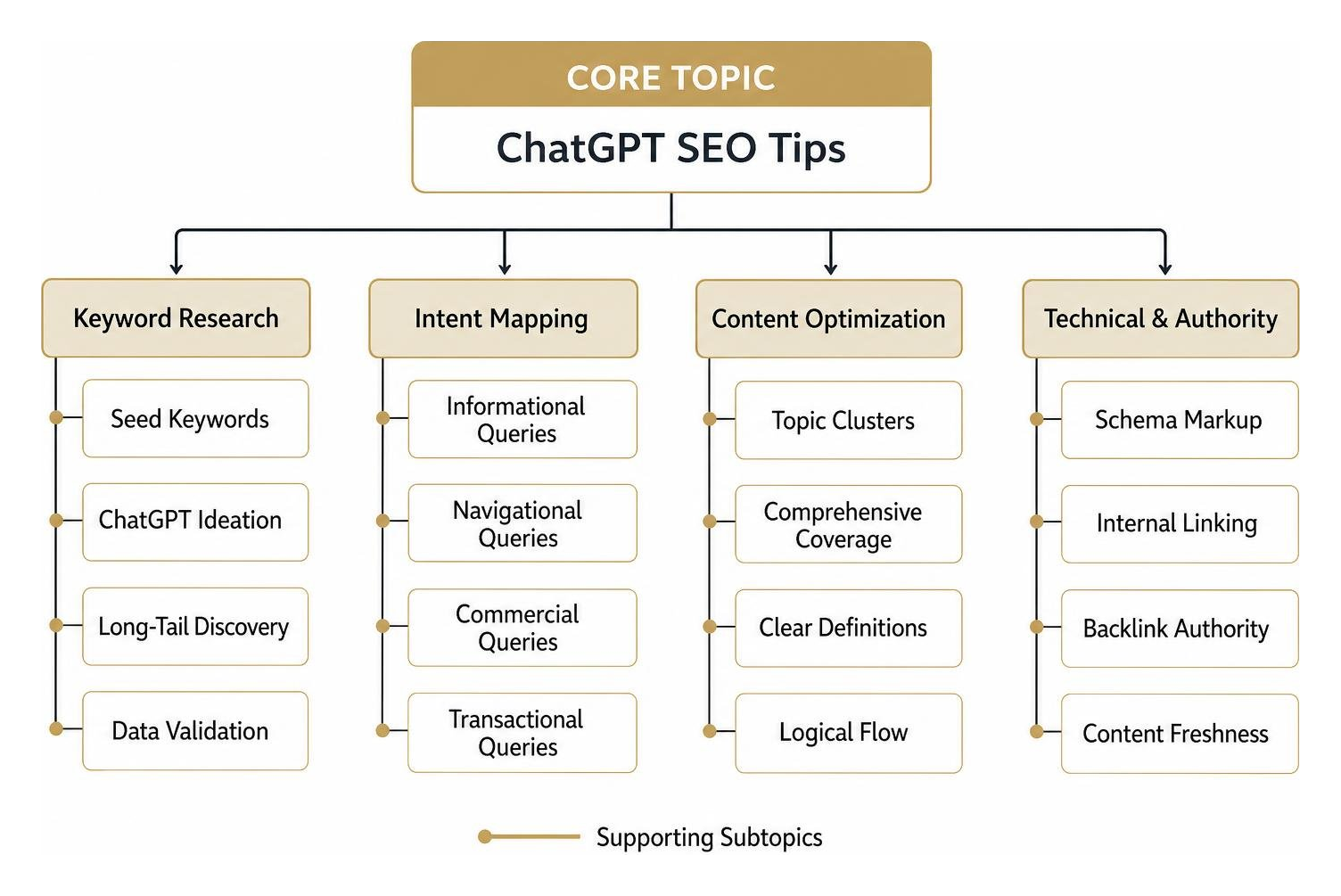
Keyword research with ChatGPT works best when you treat the model as an ideation assistant rather than a live database. Because large language models do not natively track current search volume (how often a term is searched) or keyword difficulty (an estimate of how competitive it is to rank for that term), pair their suggestions with verified SEO data.
Actionable ChatGPT SEO Tips for Intent Mapping and Long-Tail Keywords
To explore long-tail queries—searches with relatively low individual search volume, often longer and more specific—give ChatGPT customer profiles, customer needs and product categories. Ask it to group terms by search intent, meaning what the searcher wants to accomplish:
- Informational: Queries seeking explanations, definitions, or guides.
- Commercial Investigation: Searches comparing solutions, evaluating features, or reading reviews.
- Transactional: High-intent terms indicating readiness to purchase or request a consultation.
- Navigational: Brand-specific lookups.
By mapping queries across the buyer journey, you can spot unanswered questions that matter to your customers. For businesses building industry authority, combining strategic keyword discovery with winning the citation game with AI search brand mentions can support visibility in both traditional search results and AI answers.
Semantic Keyword Expansion and Topic Cluster Mapping
A topic cluster links a main overview page, often called a pillar page, to articles answering related questions. ChatGPT can suggest ways to group keyword lists by subject.
Ask the model to generate supporting subtopics, related industry terminology, and common questions associated with your core subject. Organizing and linking related pages helps readers and search systems understand the subjects your website covers.
Step-by-Step Workflow to Create Useful AI-Assisted Content
Generating high-performing copy with ChatGPT requires a disciplined, multi-stage workflow. Relying on a single prompt to write an entire 2,500-word post often results in vague, repetitive text that lacks original perspective.
Advanced ChatGPT SEO Tips for Multi-Stage Content Drafting
Break your content production into discrete phases to maintain quality and depth:
- Stage 1: Outline Creation: Prompt the tool to build a detailed outline featuring question-based second- and third-level headings (H2s and H3s) based on your target keywords.
- Stage 2: Section-by-Section Drafting: Feed the outline back into the model one section at a time. Provide specific constraints, such as required subtopics, tone preferences, and formatting guidelines.
- Stage 3: Information Enhancement: Integrate proprietary insights, practical examples, and original data points into each section.
| Feature | Raw AI Generation | Human-Edited AI Workflow |
|---|---|---|
| Accuracy | May contain fabricated information (AI hallucinations) or outdated facts | Verified against industry data |
| Tone & Voice | Generic, average internet style | Distinct, brand-aligned, authoritative |
| Search Intent | Often misses subtle nuances | Precisely targeted to audience needs |
| E-E-A-T Signals | Lacks first-hand experience | Showcases real-world expertise and proof |
Human Editorial Review, E-E-A-T, and Fact-Checking
E-E-A-T describes experience, expertise, authoritativeness and trustworthiness as considerations in assessing content quality. AI can help organize material you provide, but it does not have first-hand experience. Editors should supply and verify examples drawn from real work rather than ask the model to invent them.
A qualified human editor must review every draft to:
- Verify factual claims, metrics, and dates.
- Remove generic filler phrases and repetitive sentence structures.
- Infuse authentic case studies, practical insights, and unique company viewpoints.
On-Page Optimization, Schema Markup, and Technical SEO
Page titles, descriptions and headings help search systems understand what your content covers. ChatGPT can help draft metadata—information describing a page—and structured data, also called schema markup, which labels content for search systems.

How Can ChatGPT Help Draft Page Titles, Descriptions and Headings?
Prompt ChatGPT to craft multiple variations of title tags and meta descriptions within standard length guidelines (under 60 characters for titles, under 160 characters for descriptions).
Instruct the model to place primary keywords near the beginning while incorporating clear value propositions and strong action verbs. For more techniques on structuring on-page signals, explore our dedicated AI SEO category.
Implementing Structured Data and Avoiding Common AI Mistakes
Structured data provides context to search systems. You can use ChatGPT to draft markup in JSON-LD, a format for adding structured data to a page, for various schema types:
- FAQPage Schema: Identifies questions and answers on a page. It does not guarantee an enhanced search listing, and eligibility depends on the search platform’s rules.
- Article Schema: Defines authors, publication dates, and the subjects covered.
- HowTo Schema: Describes the steps in completing a task.
- Speakable Schema: Identifies portions of a page intended for text-to-speech use. It does not guarantee AI citations.
Have AI-generated structured data reviewed for accuracy and consistency with the page before publishing it on your website. Avoid publishing unreviewed, bulk-generated AI pages; prioritize accuracy, originality and usefulness.
How Can Businesses Keep Existing Content Useful?
Updating existing pages can address outdated information and unanswered customer questions. Keeping content accurate and relevant helps readers make informed decisions; changing a publication date alone does not establish quality.

Reviewing Evergreen Content for Accuracy
Review evergreen pages—content intended to stay useful over time—when business information, customer questions or supporting evidence changes:
- Use ChatGPT to flag potentially outdated statistics, obsolete tools, or shifts in industry terminology, then verify its suggestions against current information.
- Add concise answers beneath relevant headings so readers and search systems can easily identify the key information.
- Add updated examples and newly relevant search queries to existing sections.
Repurposing Long-Form Content Across Formats
Repurposing content maximizes the return on your initial research investment. Feed your comprehensive blog posts into ChatGPT to extract:
- Key takeaways for social media posts and newsletters.
- Concise scripts for short-form video explainers.
- Summary modules for customer emails and executive briefs.
Distributing your core message across multiple channels expands your digital footprint and reinforces your brand’s authority across the wider web.
Frequently Asked Questions About ChatGPT SEO
Can Google penalize content written with ChatGPT?
Search engines do not penalize content simply because AI assisted in writing it. Search guidelines focus on the overall quality, originality, and utility of the material rather than the production method.
However, websites that publish unedited, bulk-generated AI copy that lacks original insight, contains factual errors, or attempts to manipulate search rankings risk lower search visibility under search engines’ spam and content-quality policies.
How does ChatGPT help improve existing page rankings without writing new posts?
ChatGPT can analyze existing page copy against search intent to identify content gaps, suggest clearer H2 and H3 structures, draft concise answers that may be useful for featured snippets—the short answers displayed in search results—and generate relevant FAQ sections with schema markup. These changes can make underperforming pages clearer and more complete for customers researching relevant questions.
What are the main limitations of using ChatGPT for SEO tasks?
ChatGPT does not possess real-time search volume databases, live tracking of links from other websites, or native keyword difficulty metrics. It is also susceptible to factual hallucinations and defaults to a generic writing style if not guided by structured prompts and strict editorial oversight. To achieve top performance, combine AI drafting capabilities with verified search-performance data and thorough human review.
Conclusion
Generative AI has changed how digital content is researched, written and optimized. ChatGPT can support research and drafting, but sustainable search visibility depends on clear content, accurate business information, relevant expertise and careful editorial review.
Navigating the intersection of traditional search and emerging AI answer engines is an ongoing discipline. Schedule a free AI evaluation with Upskale Marketing through our AI optimization assessment for a straightforward, data-driven view of where your business currently stands in AI search, its visibility and potential improvement opportunities.