

Building Strong ChatGPT Brand Authority for Long-Term Visibility
Why ChatGPT Brand Authority Matters for AI Search Visibility
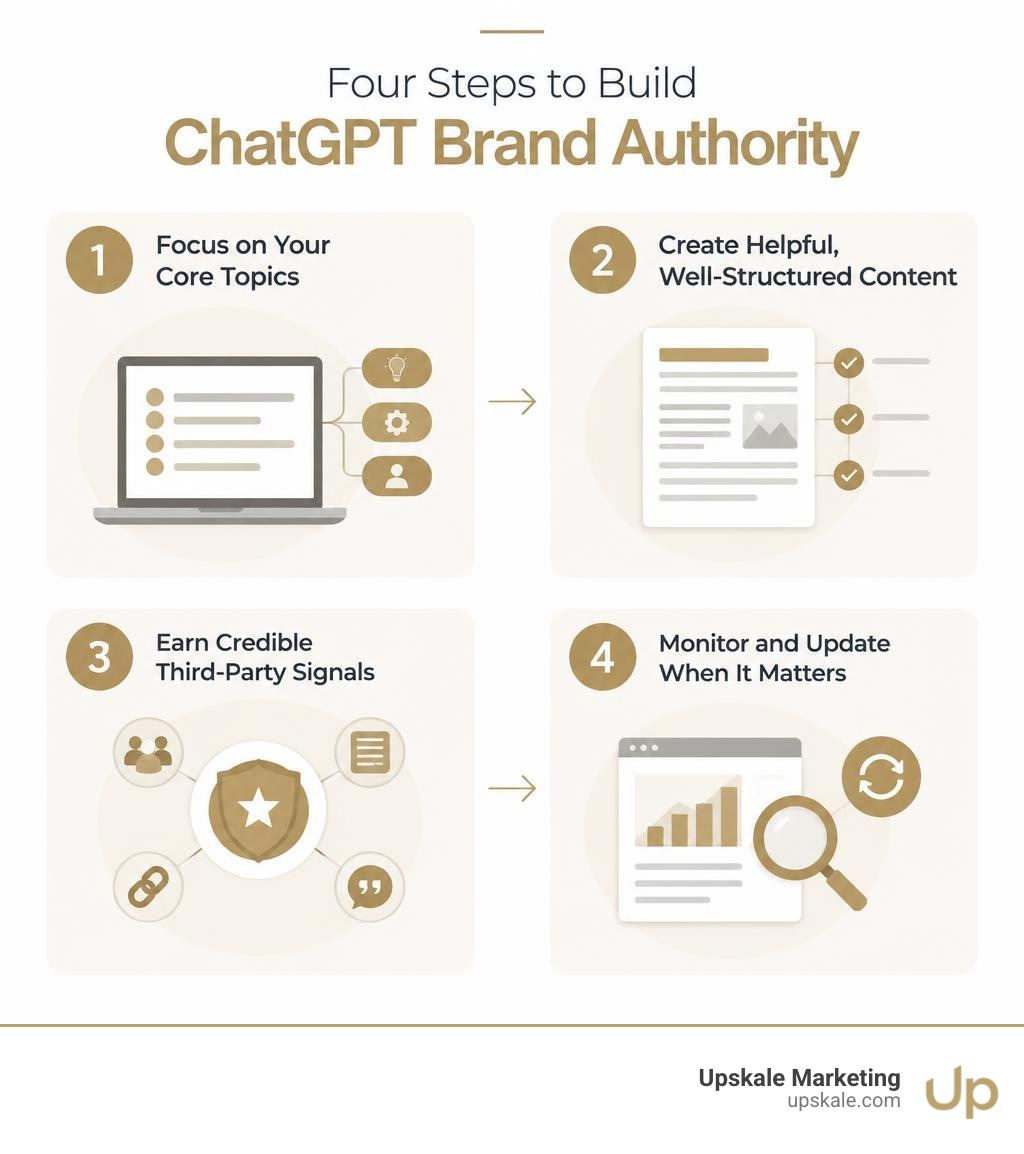
To build ChatGPT brand authority, make your expertise easy for AI systems to find, verify, and connect to your brand. Focus on a small set of topics you truly own, publish useful and well-structured content around them, earn credible third-party signals, and update important pages when facts or customer needs change.
- Build deep coverage for core services, use cases, and buyer questions.
- Use clear headings, facts, examples, and self-contained sections that can support an AI answer.
- Strengthen named-brand recognition through consistent positioning and expert-led content.
- Track citations and brand mentions across important prompts, then improve weak topic areas.
ChatGPT is already one of the most recognized names in generative AI. But for every other business, its importance is even broader: customers increasingly ask AI assistants who to trust, what to buy, and which provider fits their needs. Visibility in those answers is not a shortcut or a one-time SEO win. It is the result of relevance, evidence, reputation, and repeated topical coverage.
AI systems may retrieve information at the passage level, not simply reward the page that ranks first in traditional search. That means a clear answer to a specific customer question can create value even when it lives within a larger guide. Depth matters, too. Research on AI visibility suggests brands earn stronger named mentions when they appear repeatedly across closely related prompts, rather than showing up once across many unrelated topics.
I am Scott Brazdo, MBA, founder and CEO of Upskale Marketing, with more than 30 years of experience in marketing, branding, and business strategy. I help organizations apply established brand-building principles to ChatGPT brand authority, so their expertise can earn durable visibility as AI-driven discovery evolves.
Understanding the Mechanics of AI Brand Salience and Retrieval
Generative discovery operates on an entirely different mechanical foundation than traditional search engine result pages. When a user enters a complex prompt, generative models do not simply match a single keyword string against a web index. Instead, they activate retrieval-augmented generation (RAG) pipelines that break queries down, retrieve relevant evidence, and assemble synthesized responses.
A critical component of this retrieval mechanism is query fan-out. Rather than evaluating a prompt in isolation, AI systems expand a single user question into multiple synthetic sub-queries. For example, a user asking for the best operational tools for a growing company might trigger 8 to 15 parallel sub-queries covering software reliability, scalability benchmarks, integration features, and customer satisfaction metrics.
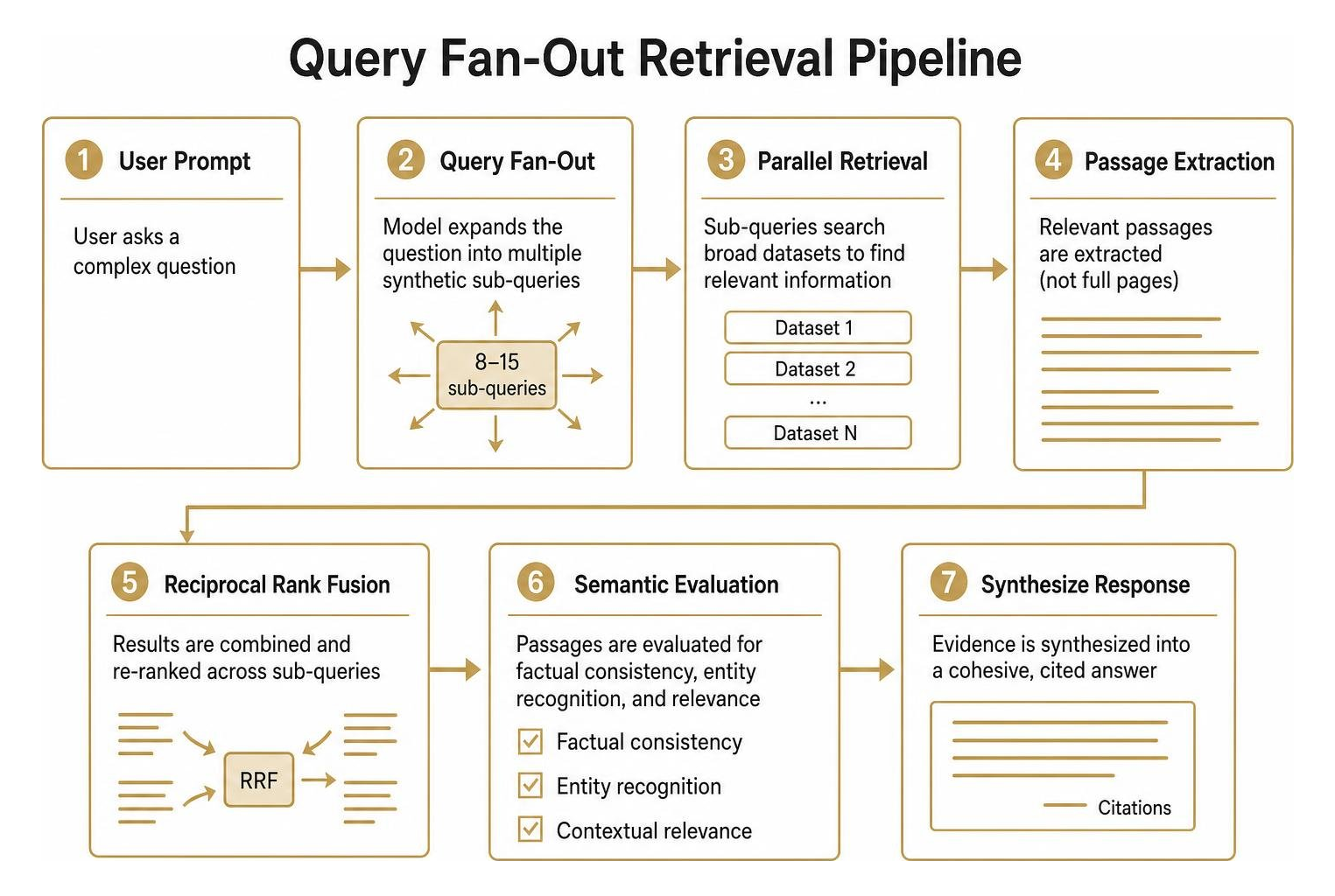
During this process, the model scans broad datasets to extract granular passages rather than full web pages. These passages undergo reciprocal rank fusion and semantic evaluation, where the engine checks for factual consistency, entity recognition, and contextual relevance. Understanding these retrieval mechanics allows organizations to apply proven AI search optimization insights that structure information for rapid parsing, verification, and answer placement.
Differentiating Citations from Named Brand Mentions
In generative search, earning a citation link is fundamentally different from earning a named brand mention in the generated text. A citation indicates that an AI engine referenced a web asset as underlying evidence for a statement. A named mention occurs when the model explicitly recommends, discusses, or highlights a company by name within the response body.
Research into AI retrieval patterns shows that citations spread more broadly across adjacent categories than direct mentions. While an engine might cite technical documentation or data points from a wide variety of domains, it reserves named mentions for organizations that demonstrate concentrated authority and clear entity positioning.
| Attribute | Source Citations | Named Brand Mentions |
|---|---|---|
| Primary Role | Provides factual evidence and source grounding | Acts as the direct recommendation or subject |
| Spread Mechanism | Spreads across broad, related topic categories | Requires deep topical authority in anchor topics |
| Entity Impact | Validates content accuracy and relevance | Establishes definitive market leadership |
| Optimization Focus | Fresh data, statistics, and modular extracts | Strong brand narrative and consistent positioning |
Scaling Category Depth to Anchor ChatGPT Brand Authority
To establish enduring visibility, businesses must focus on category depth before attempting category breadth. When an organization attempts to cover dozens of disparate topics without establishing deep expertise in any single area, AI models struggle to associate the brand with a specific entity profile.
Data reveals that brands appearing consistently across multiple related prompts within a single vertical achieve significantly higher named-mention rates. Demonstrating repeated presence across core use cases establishes anchor authority. Once an organization solidly owns an anchor category, that credibility creates a halo effect, making it substantially easier to expand into adjacent service areas.
Strategic Framework to Establish ChatGPT Brand Authority
Achieving lasting prominence requires more than basic technical optimization; it demands narrative centrality. When analyzing how generative models synthesize market landscapes, entities that occupy the core of industry conversations consistently earn higher influence scores.
Brand authority in AI engines rests on three pillars:
- Salience: How quickly and consistently the brand comes to mind within a specific category.
- Meaningful Difference: Clear differentiation in capabilities, perspective, or execution that separates the business from generic alternatives.
- Earned Trust: Verifiable track records, objective data, and consistent positive signals that validate claims.
For leadership teams navigating this landscape, reviewing resources that focus on addressing common AI implementation questions helps demystify how these authority signals translate into digital visibility.
Balancing Executive Visibility with Corporate Equity
Executive leadership frequently serves as an accelerant for brand visibility. High-profile commentary, published insights, and leadership participation in industry debates generate substantial media footprints that AI models ingest during training and retrieval cycles.
However, over-relying on a single executive voice introduces concentration risk. If brand equity is tied exclusively to an individual rather than the organizational entity, changes in leadership or shifts in public perception can destabilize digital authority. Sustainable authority requires distributing thought leadership across multiple subject-matter experts within the enterprise, anchoring value to company-owned assets, proprietary frameworks, and institutional knowledge.
Professional Engagement and Thought Leadership
Where a conversation takes place directly influences how AI systems weight sentiment and credibility. Professional networks and structured B2B channels carry high authority in AI retrieval scoring. Discourse on professional platforms often involves nuanced debates, complex use cases, and technical evaluations.
AI retrieval models recognize that professional commentary reflects real-world implementation rather than passive promotional material. Active participation in specialized industry dialogues builds the contextual associations necessary for generative systems to cite an enterprise as an authoritative voice.
Structuring Modular Content for AI Answer Placement
To ensure content is easily ingested by AI retrieval pipelines, assets must be organized into modular, self-contained sections. Large, unstructured documents force retrieval engines to expend computational resources parsing context, which can lower citation probability.
Adopting an entity-attribute content matrix ensures that every key topic explicitly details relevant attributes, such as definitions, implementation considerations, real-world examples, and quantitative benchmarks. Semantic header hierarchies (H2s and H3s written as clear, natural-language questions or direct statements) allow retrieval engines to map queries directly to concise passages.
Structured schema markups provide an essential semantic layer that reinforces this architecture:
- Organization Schema: Clearly defines the corporate entity, brand assets, and verified digital properties.
- Article and TechArticle Schema: Identifies publication dates, author expertise, and foundational technical content.
- FAQPage Schema: Formats direct question-and-answer pairs for passage extraction.
- ItemPage and Service Schema: Outlines core service offerings, attributes, and operational scopes.
- About and Mentions Entities: Links content to established knowledge graph entities to enhance semantic understanding.
Implementing Continuous Refresh Cadences to Prevent Decay
Information recency plays a substantial role in AI retrieval. Retrieval pipelines consistently favor updated sources, with research showing that AI assistants cite content that is substantially fresher than standard organic listings. Over half of dynamic citations point to content substantively updated within the preceding quarter.
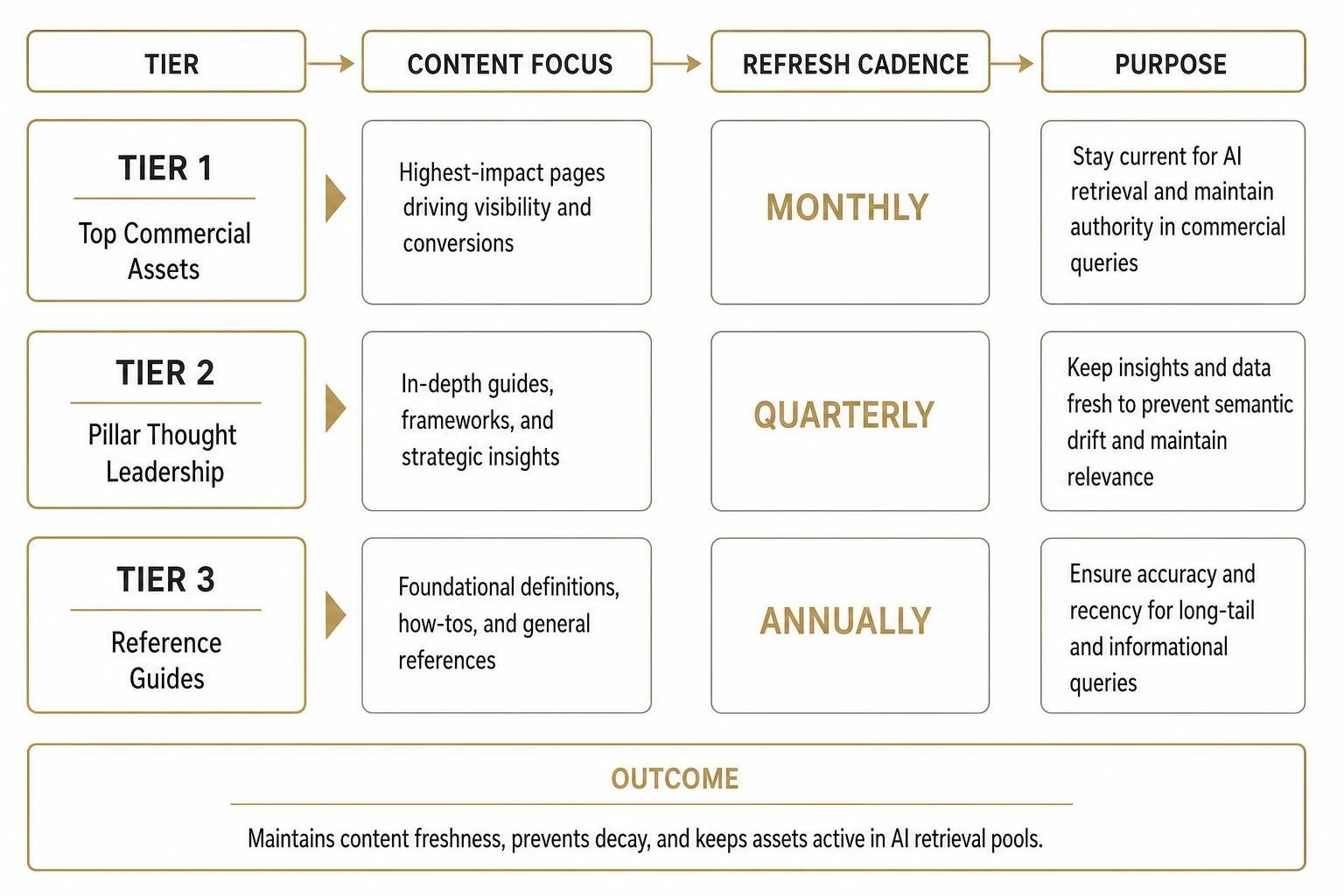
Content decay and semantic drift occur when market terminology evolves or industry data changes while an article remains static. Updating publish dates without making substantive edits is ineffective, as retrieval models evaluate passage changes and factual freshness. Maintaining a tiered cadence—updating top commercial assets monthly, pillar content quarterly, and general reference guides annually—ensures assets remain active in retrieval pools.
Measuring ChatGPT Brand Authority Across Model Cycles
Evaluating AI visibility requires moving beyond static keyword tracking. Because generative responses are probabilistic, visibility fluctuates depending on prompt variations and model updates.
Organizations must monitor baseline citation rates, share of voice within target prompt clusters, and the consistency of named recommendations across consecutive test runs. Tracking these metrics over time reveals whether content updates are expanding topical coverage or if specific service lines require deeper technical grounding.
Frequently Asked Questions About Building Brand Authority in AI Engines
How does query fan-out impact brand mentions in AI responses?
Query fan-out transforms a single prompt into multiple synthetic sub-queries evaluated simultaneously. Visibility depends on whether an organization provides authoritative, passage-level answers to those underlying sub-topics. Brands that build comprehensive topic clusters earn mentions across a broader percentage of generated answers.
What is the difference between brand fame and brand trust in AI search?
Brand fame reflects high recognition or sheer mention volume, but fame alone does not guarantee favorable placement. AI models evaluate earned trust through factual accuracy, verifiable third-party validation, and domain-specific relevance. Enterprise value and sustained recommendations require both high salience and proven reliability.
How frequently should digital assets be updated for AI citations?
High-priority assets covering fast-moving topics, service specifications, and technical workflows should undergo substantive quarterly reviews. Incorporating fresh data points, updated examples, and precise schema signals preserves citation authority and prevents semantic drift.
Building Lasting Authority in Generative Search
Earning enduring brand authority in AI assistants is an ongoing discipline rooted in relevance, technical clarity, and verified expertise. As generative platforms continue to shape how decisions are made, organizations that systematically build topical depth and structured digital signals will secure lasting visibility.
At Upskale Marketing, based in Orlando, Florida, we combine decades of strategic marketing insight with specialized Answer Engine Optimization to help businesses establish authority across generative platforms. To understand how your business is currently recognized by AI engines, schedule a data-driven evaluation through our comprehensive AI optimization assessment to identify your key visibility opportunities.