


What to Look for in an AI Search Audit Tool
Core Capabilities of a Modern AI Search Audit Tool
An AI search audit examines whether automated systems can access your pages, identify your business and find clear, supported answers. It can review website accessibility, the organization of content and the evidence behind claims. These checks reveal readiness issues; they do not establish how much weight an AI platform gives each factor or guarantee inclusion in its answers.
AI Optimization is the broader discipline of improving how AI systems discover, understand and represent a business. Answer Engine Optimization (AEO) focuses on making content useful for direct answers. Generative Engine Optimization (GEO) focuses on how a business and its content appear in AI-generated responses. These approaches overlap: clear answers, accessible pages and credible supporting information help systems interpret your business. AI visibility means whether—and how accurately—your business appears in relevant AI answers. For decision-makers, an audit helps distinguish website readiness issues from actual visibility gaps and prioritize improvements; a readiness score alone does not establish that an AI engine will recommend the business.
A comprehensive audit platform can assess several areas that affect whether systems can access, interpret and reuse your content:
- Crawler access: Check whether automated visitors can access relevant pages, distinguishing search retrieval from model training.
- Readable page content: Check whether important text is available in the page’s initial HTML rather than appearing only after browser scripts run.
- Business information: Review structured data—machine-readable labels describing your organization, services and people—for clarity and consistency.
- Direct answers: Assess whether pages answer customer questions clearly and concisely.
- Discovery files: Review files that describe site content, distinguishing established files such as sitemaps from emerging AI-oriented proposals.
These fundamentals are part of AI search optimization, which considers how a business is represented in AI answers as well as traditional search results. Clear structure and supporting evidence can make content easier to interpret, but an audit cannot guarantee that an AI engine will trust or cite it.
When Is an AI Search Audit Useful for a Business?
Traditional audits commonly examine page titles, links and whether search engines can access important pages. Generative search platforms can synthesize information across multiple sources to construct direct answers. An AI search audit adds a review of how accessible and useful your business information is for that purpose.
If automated visitors cannot access important pages or product details, some AI systems may have difficulty retrieving that information. An AI search audit tool can help identify these access gaps so your team can prioritize review.
| Evaluation Metric | Traditional SEO Audit Software | Dedicated AI Search Audit Tool |
|---|---|---|
| Access | Whether search engines can access and index pages | Whether relevant AI retrieval systems can access content |
| Page analysis | HTML analysis, sometimes with browser rendering | Availability of important text in the fetched page; methods vary by tool |
| Measurement | Technical health and, with tracking tools, search performance | Content-readiness checks; actual mentions and citations require separate monitoring |
| Business information | Metadata and structured data | Clarity and consistency of business, service and author information |
| Discovery files | robots.txt and sitemaps | AI crawler permissions and, where relevant, emerging files such as llms.txt |
These areas overlap; capabilities vary by product.
Key Metrics Measured by an AI Search Audit Tool
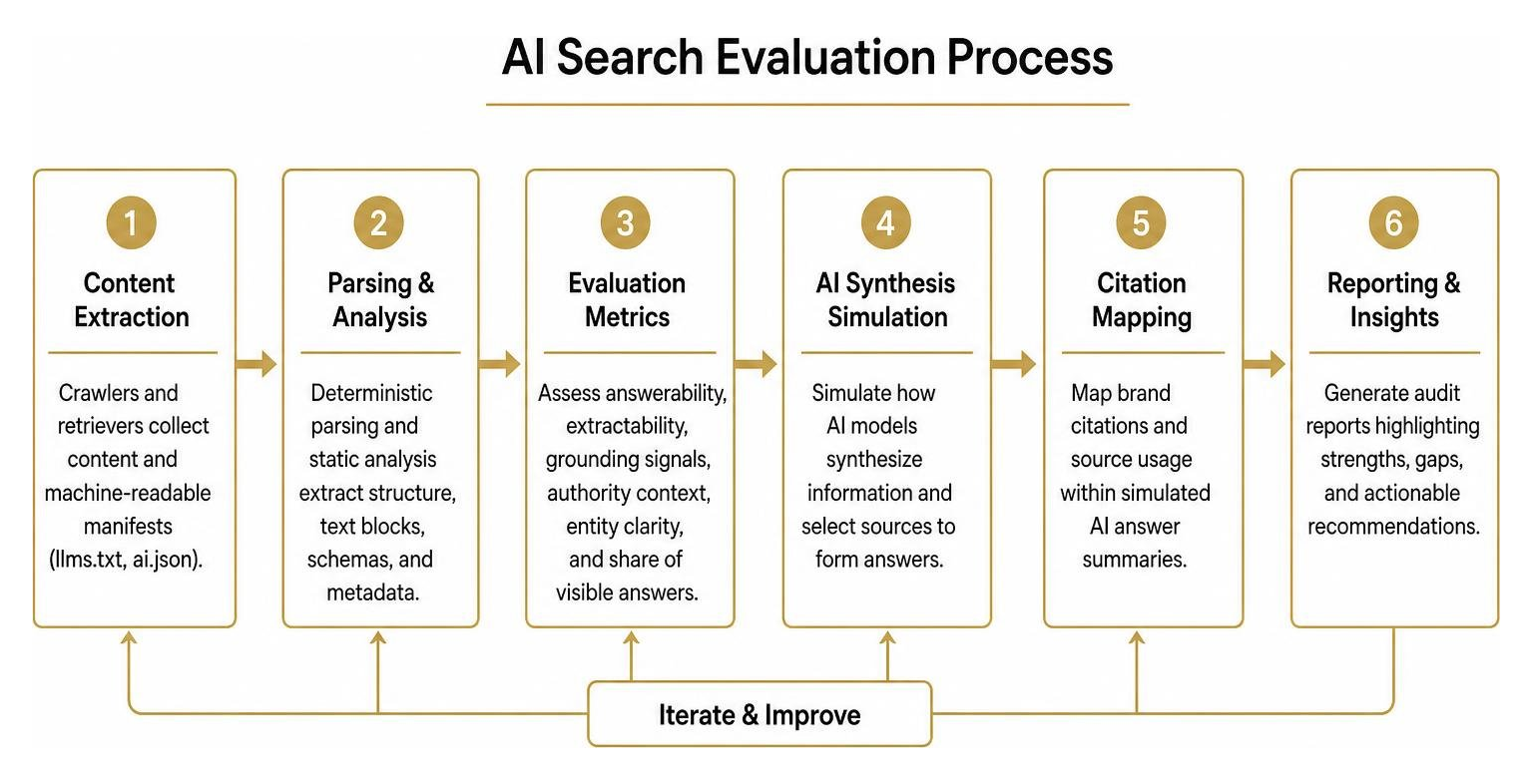
Audit tools may organize readiness checks into categories such as the following. Their scores depend on each tool’s rules and should not be treated as predictions of AI citations:
- Answerability Score: Evaluates how effectively text blocks provide direct, unambiguous answers to user questions without unnecessary filler.
- Content Extractability: Checks whether headings, tables and lists make important information easy to identify.
- Grounding Signals: Checks whether claims have relevant supporting evidence. This does not guarantee that an AI system will avoid inaccurate summaries.
- Authority Context: Reviews author credentials, clear business identification and supporting evidence across your website.
- Entity Clarity: Evaluates how clearly your pages define subjects, services and core concepts using structured data, such as JSON-LD—a format for adding machine-readable descriptions to a page.
- Observed AI Visibility: Separate monitoring can record whether and how your brand appears in a defined set of AI answers. A static website-readiness audit does not measure this by itself.
How Do AI Search Audit Tools Evaluate a Website?
Some audit tools inspect page content using predefined rules; others add model-based review. Their capabilities, security safeguards and suitability for large websites vary. Understanding these differences helps teams choose tools that fit their needs.

How Do Rule-Based Checks Differ from AI Model Reviews?
When auditing a website, teams may use rule-based checks of page content, reviews performed by an AI language model, or both. These approaches serve different purposes: checking predefined criteria and assessing qualities such as clarity and tone.
Rule-based analysis checks fetched page content against predefined criteria. Some tools run without calls to an external AI service. Results and processing time depend on the tool, configuration and page being checked. Consider these factors when evaluating a tool:
- Repeatable results: A deterministic tool can return the same score when its version, settings and fetched content remain unchanged. The score still reflects the tool’s chosen rules.
- Processing capacity: Assess whether a tool can handle the size of your website; processing time and network retrieval speed vary.
- Data handling: Some tools analyze content locally without sending it to an AI service. Local processing alone does not guarantee security.
- Security safeguards: Review a tool’s protections before allowing automated access to URLs, especially when handling sensitive or unpublished content.
Rule-based checks can flag structural issues, while model-based reviews can help assess qualities such as clarity and tone. The approaches can complement each other, but neither establishes whether an AI platform will cite a page.
Is Your Business Information Clear to Automated Systems?
Structured data provides machine-readable descriptions of a business, its services and its authors. Audit tools can check this information for clarity and consistency, including:
- Relevant structured data: Review descriptions of the organization, services and articles, using properties appropriate to each type rather than applying the same fields to every item.
- Consistent identification: Check whether business names, author details and identifying URLs agree across the site.
- Discovery files: Review sitemaps and crawler instructions. Some tools also inspect emerging files such as
llms.txt,llms-full.txtand.well-known/ai.json; their formats and adoption vary, and their presence does not establish that AI engines use them.
For more on making business information clear and consistent, explore our AI Search Optimization Insights.
How Can Teams Check AI Search Readiness Before Publishing?
Maintaining AI visibility is an ongoing commitment. Teams can add automated readiness checks to their publishing or software-release process. When configured to run before publication, these checks can flag selected content, structured-data or access issues for review.

Reviewing Draft Changes Before Publication
When teams use automated assistants to create content or code, draft review remains important. Review proposed content and website changes before approving publication.
Draft readiness checks may help teams identify structural issues before publication. These checks assess the content available to the tool; they do not establish future citation performance.
Keeping Records and Learning from Changes
When visibility shifts occur, engineering and marketing teams need clear historical records to understand what changed:
- Change records: Keep dated records of important website updates and audit findings.
- Team reviews: When results worsen, review what changed without assigning blame. Investigate whether changes to structured data or page layout made content harder to read.
- Future checks: Use confirmed findings to improve subsequent reviews and flag similar issues before publication.
This continuous improvement loop helps teams build institutional knowledge about what works for AI search visibility and what doesn’t, turning each audit into a learning opportunity rather than a one-time fix.
Frequently Asked Questions About AI Search Audits
How does an AI search audit differ from a traditional search audit?
A traditional search audit commonly examines whether pages can be indexed, how page titles and content are presented, and how links support discovery. An AI search audit adds checks for clear answers, accessible content, supporting evidence and consistent business information. The areas overlap. Readiness checks help identify possible issues, while monitoring actual AI answers is needed to assess mentions and citations.
What discovery files should be inspected during an audit?
An audit can review robots.txt, which contains instructions for automated crawlers, and XML sitemaps, which list site URLs and may include modification dates. Some tools also check emerging AI-oriented files such as llms.txt, llms-full.txt and .well-known/ai.json. These files have different formats and varying adoption; their presence does not demonstrate that an AI system reads them or can avoid retrieving individual pages.
How Can Teams Reduce the Risk of AI Search Readiness Issues?
Teams can review important pages before publishing changes and configure automated checks for selected access, content and structured-data issues. Some tools can stop a release when a configured score threshold is not met. These checks can flag readiness risks, but they cannot prevent every change in AI visibility or guarantee that a business will appear in AI answers.
Conclusion
Building a clear AI search presence is an evolving marketing discipline focused on relevance, technical accessibility and verifiable business information. As customers use AI-generated answers alongside traditional search results, businesses benefit from making their information accessible, clear and well supported.
Understanding where your digital assets stand within AI answer engines requires an objective, data-driven look at your site’s technical structure. Partnering with a dedicated agency helps turn these complex technical requirements into a clear growth strategy.
Schedule a free AI evaluation with Upskale Marketing to receive a comprehensive, data-driven assessment of your brand’s presence across generative platforms. Our team in Orlando, Florida will analyze your current visibility, identify technical gaps, and outline clear opportunities to elevate your AI Optimization strategy.